Terra2026-04-13T14:13:37+03:00Inche, Faza & Mourynhttps://terrain.co.keWhy Jane Spent 400K on Supplements and Got SickerInche, Faza & Mourynhttps://terrain.co.ke/how-fasting-and-bones-of-indigenous-cattle-restored-what-herbs-and-diets-couldnt/2026-04-04T01:33:00+03:00
Jane Wambui's kitchen in South B, Nairobi, looks like a health food store that has exploded.
There are jars of moringa powder from a company that promised "100 percent organic, pure Kenyan superfood." There are turmeric capsules with pictures of smiling yogis on the label. There is spirulina from a multi-level marketing company her friend convinced her to join. There is maca root from Peru, ashwagandha from India, and something called "black seed oil" that cost her four thousand shillings for a bottle the size of her thumb.
She estimates she spent, over three years, close to four hundred thousand shillings on supplements.
]]>
Jane Wambui's kitchen in South B, Nairobi, looks like a health food store that has exploded.
There are jars of moringa powder from a company that promised "100 percent organic, pure Kenyan superfood." There are turmeric capsules with pictures of smiling yogis on the label. There is spirulina from a multi-level marketing company her friend convinced her to join. There is maca root from Peru, ashwagandha from India, and something called "black seed oil" that cost her four thousand shillings for a bottle the size of her thumb.
She estimates she spent, over three years, close to four hundred thousand shillings on supplements.
"I believed," she says, sitting at her dining table, pushing aside a jar of something called "Alkaline Greens" to make space for her tea. "I really believed that if I just found the right combination, the right brand, the right protocol, my body would finally cooperate."
Her body had stopped cooperating in 2019. That was the year the fatigue arrived and never left. The year her digestion, which had been reliable for 38 years, became a source of daily anxiety. The year her skin developed rashes that came and went without warning or explanation.
She visited doctors. They ran tests. They told her everything was within normal range. They suggested she might be stressed. They recommended therapy, exercise, more water.
So Jane went the other way. She found naturopaths online. She joined Facebook groups dedicated to healing through nutrition. She watched YouTube videos from American wellness influencers who spoke with absolute certainty about detox protocols and liver flushes and the dangers of modern medicine.
She bought what they sold.
"I did green smoothies for six months," she says. "Every morning, a handful of kale, some cucumber, green apple, ginger. I thought: this is it. This is what my body has been waiting for."
But the fatigue did not lift. The digestion did not improve. The rashes continued.
"So I tried raw vegan. Then keto. Then intermittent fasting with herbal supplements. Then a 14-day juice cleanse that cost me thirty thousand shillings for the program alone."
She pauses.
"Nothing. Nothing changed. If anything, I got worse. By the end of 2022, I could not climb the stairs to my apartment without stopping twice. I was 41 years old."
Jane is not alone. Across Nairobi's middle-class neighborhoods, across the country's upwardly mobile households, there is a quiet epidemic of people who have spent fortunes on supplements and special diets, only to find themselves sicker than when they started.
They have done everything right. They have bought the products. They have followed the protocols. They have believed the promises.
And their bodies have not responded.
He Bought Every Book on Nutrition
Peter Ochieng, 52, is an accountant in Kisumu. He is also, by his own admission, something of an obsessive researcher. When he was diagnosed with hypertension and borderline diabetes in 2018, he did what he always does when faced with a problem. He bought books.
Dozens of them.
"The China Study. How Not to Die. The Obesity Code. Grain Brain. The Plant Paradox. I read them all," he says, sitting in his office. The afternoon light catches the titles on the shelf behind him. "Each one made perfect sense when I was reading it. Each one promised that if I followed its recommendations, I would get better."
Peter became a plant-based eater. He eliminated meat, dairy, eggs, oil. He ate lentils and beans and whole grains and vegetables. He bought organic when he could afford it. He took the supplements the books recommended. B12, vitamin D, magnesium, omega-3s from algae.
His blood pressure did not improve. His blood sugar climbed.
"So I tried the opposite," he says. "I went carnivore. Just meat, salt, water. I lasted three months. Lost weight, yes. But my cholesterol shot up, and I felt... wrong. Aggressive. Constipated. Something was off."
He tried paleo. He tried Mediterranean. He tried a protocol from a German doctor that involved drinking olive oil mixed with lemon juice first thing in the morning.
"By 2023, I was on four medications. Four. And I was eating more carefully than anyone I knew. That was the part I could not understand. I was doing everything right. Why was I getting sicker?"
What Research Actually Says About Herbal Supplements
The multi-billion-dollar global supplement industry runs on a simple promise. Put this isolated compound into your body, and your body will use it to heal.
The science tells a more complicated story.
Dr. Mukiri Gitonga, an integrative medicine practitioner in Nairobi, has spent fifteen years studying why some people respond to nutritional interventions and others do not.
"The supplement industry assumes that the body is a passive container," he says. "You pour in the herb, and the herb does its work. But that is not how biology functions. The body is an active system. It processes, transforms, absorbs, or rejects what you give it based on the condition of the terrain."
Recent research supports this view. A 2025 study on ashwagandha, one of the most popular herbal supplements globally, found that bioavailability varies dramatically depending on the formulation. One extract delivered plasma concentrations 118 times higher than another, despite containing the same labeled dose.
"The supplement you buy may not be the supplement your body receives," Dr. Gitonga explains. "If your gut is inflamed, if your microbiome is depleted, if your stomach acid is imbalanced, the herb passes through you unabsorbed. You are essentially creating expensive urine."
Another 2025 study on curcumin, the active compound in turmeric, found that standard formulations are so poorly absorbed that they barely register in the bloodstream. Only specialized extracts with bioavailability enhancers achieved meaningful concentrations.
"People spend fortunes on turmeric for inflammation," Dr. Gitonga says. "But most of it never reaches their tissues. They are swallowing hope, not medicine."
The deeper problem is accumulation.
Even if supplements were perfectly absorbed, they would still fail to address the fundamental issue confronting modern humans.
We are, every one of us, walking repositories of accumulated poison. Research documents the staggering burden of environmental toxins now carried by the average person. Heavy metals like arsenic, cadmium, mercury, and lead accumulate in tissues over a lifetime, disrupting enzyme function, damaging mitochondria, and contributing to chronic disease.
PFAS, the forever chemicals from industrial products, persist in the body for years and have been linked to immune disruption, inflammation, and organ damage.
Pesticides. Herbicides. Plastic compounds. Pharmaceutical metabolites. The list is long and growing.
"Into this toxic terrain, we pour herbs," Dr. Gitonga says. "And we expect them to work. But the herbs are not failing. The terrain is failing. You cannot build a house on a swamp and blame the lumber."
The Internal Garden
To understand why terrain matters, consider what happens in a healthy body.
The gut lining is a single layer of cells separating your internal environment from the external world. When functioning properly, it allows nutrients to pass through while keeping toxins and pathogens out.
The gut microbiome, trillions of bacteria living in your intestines, activates plant compounds, produces vitamins, and regulates immune function.
The liver processes toxins for elimination. The kidneys filter the blood. The cells generate energy in mitochondria that must be kept clean and functional.
This is the terrain.
In a healthy terrain, supplements can do their work. Herbs are absorbed. Nutrients are utilized. Toxins are processed and eliminated.
But in a compromised terrain, inflamed gut, depleted microbiome, toxic overload, nothing works properly. Supplements pass through unabsorbed. Nutrients are not utilized. Toxins accumulate further.
"The body has a sequence," Dr. Gitonga says. "First it must clear what has accumulated. Then it must restore the structures that enable function. Then, and only then, can it utilize what you give it. Most people try to skip the first two steps. They pour herbs into a body that cannot receive them, and they wonder why nothing changes."
The Fast That Cleared the Debris
Jane Wambui, the woman with the supplement-filled kitchen, heard about our sequence from a friend who had been sicker than she was and had somehow recovered.
"She told me: stop buying things. Just stop eating and drinking for half a day. Let your body clean itself."
Jane was skeptical. She had read about fasting. Some experts said it was dangerous. Others said it was the key to everything. She did not know what to believe.
But she was desperate.
"I started small. I would stop eating after dinner and not eat again until lunch the next day. About 12 hours with no food and no water. It was not as hard as I expected. The first few times, I felt hungry. But after a while, I noticed something. My head felt clearer. My body felt lighter."
What Jane was experiencing was autophagic flux. Research indicates that autophagy can begin to activate within 8 to 12 hours of fasting, creating the cellular clean-up effect. Multiple cycles of these shorter fasts produce cumulative benefits without the risks associated with extended fasting.
"The body, when given repeated breaks from constant digestion, finally has resources to do the cleaning it has been postponing for years," explains Dr. Wanjiku Mwangi, a clinical psychologist who has studied the psychological effects of fasting protocols. "Patients often report mental clarity, emotional calm, and physical lightness after these short fasts. They are experiencing what happens when the cellular debris is finally cleared."
Jane began doing dry fasts of 8 to 12 hours several times a week. She would finish dinner by 7 p.m. and not eat or drink anything until 7 a.m. the next morning.
"It became routine. I did not find it difficult anymore. And slowly, over weeks, my energy began to return. Not dramatically. But I noticed I was not collapsing in the afternoons anymore."
The Salts That Restored the Balance
When Jane broke her fast each morning, she did not reach for food.
She followed her friend's instructions. A warm glass of water laced with full-spectrum salts. Not ordinary table salt. Salt from specific sources, salt that contained the full spectrum of minerals her depleted body needed.
"This is called mineral priming," she says. "I would drink the warm salt water, then wait. Two full hours before eating or drinking anything else."
The first time she tried it, she noticed something unexpected.
"I felt my body drink it. I felt the water go exactly where it needed to go. My stomach, which had been tight for years, relaxed. My shoulders dropped. I felt myself let go of something I had been holding for a long time."
The science here is straightforward but rarely discussed.
Modern diets are notoriously low in trace minerals. Industrial agriculture depletes soils. Processing removes what little remains. The result is widespread deficiency in minerals that cellular function requires. Magnesium. Potassium. Zinc. Selenium. Dozens of others.
When the body enters a fasted state and begins cleaning house, it also depletes its mineral reserves. Reintroducing these minerals before food is critical.
"The sequence matters," Dr. Gitonga explains. "After the fast, the terrain is cleared but also vulnerable. If you introduce solid food immediately, you shock the system. If you introduce isolated supplements, they may not be absorbed. But warm water with full-spectrum mineral salts, that the body can use immediately. It restores electrolyte balance. It alkalizes the internal environment. It prepares the cells to receive nutrition."
The two-hour wait is essential. During this window, the salts penetrate cell membranes. The mineral imbalance that the fast created is corrected. The internal environment, which became acidic during the release of stored toxins, begins to alkalize. Gastric acid production resumes. Digestive enzymes are secreted. The gut lining becomes active again.
"If you introduce broth too early, you are asking the gut to work before it is ready," Dr. Mbugua explains. "If you wait, the gut is prepared. The two-hour window is not arbitrary. It is the time the body needs to complete the transition from cleaning to receiving."
Traditional pastoral communities understood this implicitly. The Tsonga people of South Africa have harvested salt from the Baleni spring for over two thousand years. The communities along Ethiopia's Omo River produce salt from the ash of specific plants. These are not condiments. They are medicines.
Jane did her mineral priming every morning after her dry fast.
"It felt like... like the water was going exactly where it needed to go. I know that does not sound scientific. But my body knew what to do with it in a way it never knew what to do with the supplements."
The Broth That Rebuilt Everything
After the two-hour wait, Jane's friend told her, came the most important step.
Broth. But not just any broth.
Broth from the bones and tendons of indigenous cattle. Animals that had lived as animals should live, browsing on the plants of this land, concentrating their medicine into their tissues. Simmered for only 3 to 4 hours. Just long enough to extract the collagen, gelatin, glycine, glutamine, and bioavailable minerals without destroying the delicate compounds.
Jane was skeptical again. She had tried bone broth before. She had bought the expensive organic boxes from health food stores. She had sipped it dutifully and felt nothing.
"This is different," her friend said. "The animal matters. How it lived matters. What it ate matters. And the shorter simmer time keeps the broth light and digestible. You can drink it frequently."
She was right.
Jane found a source, a small farm in Laikipia where cattle roam freely, browsing on acacia, kinkeliba, and the dozens of other shrubs and herbs that cover that landscape. She bought bones and tendons. She simmered them for just 3 hours. She drank the broth warm, slowly, after her two-hour wait, repeating the cycle as many days as she could.
"By the fourth week, I noticed something. My digestion, which had been erratic for years, became quiet. Regular. I stopped bloating after meals. By the sixth week, the rashes on my arms faded. By the third month, I realized I had not felt fatigued in days. Weeks. I could not remember the last time I had climbed the stairs without stopping."
What was happening inside Jane's body was not unknowable. It was biology.
Collagen and gelatin from the broth repaired her gut lining, sealing the leaks that had allowed toxins into her bloodstream. Glycine supported her liver's detoxification pathways and calmed her nervous system. Glutamine fed the cells of her intestinal wall, providing the fuel they needed to regenerate. Minerals in bioavailable form restored what years of depletion had removed.
And most importantly, the concentrated compounds from every plant the animal had consumed entered her body. The anti-inflammatory flavonoids of acacia. The kidney-flushing properties of kinkeliba. The antimicrobial resins of African myrrh.
"I realized," Jane says, "that I had been trying to take all of these things separately. Moringa here, turmeric there, ginger, garlic, everything. I had been chasing individual compounds. But the broth contained them all, already combined, already processed, already predigested. The animal had done the work for me."
A 2021 study on bone broth's anti-inflammatory properties found that it significantly reduced inflammation in animal models of ulcerative colitis. Other research has shown neuroprotective effects, reducing pain and sensitization in models of migraine and jaw pain.
"The bioavailability of nutrients from properly prepared bone broth is exceptional," Dr. Gitonga explains. "These compounds are already broken down, already dissolved. The body can absorb them immediately, without digestion, without strain. For a compromised gut, this is the difference between medicine and waste."
Peter's Story
Peter Ochieng, the accountant from Kisumu who had read every nutrition book and tried every diet, found the protocol six months after Jane did.
He was on four medications by then. His doctor had warned him that insulin might be next.
"I was desperate enough to try anything," he says. "But I was also skeptical. I had tried so many things. Why would this be different?"
He followed the revised sequence. Short dry fasts of 8 to 12 hours. Mineral priming with warm water and full-spectrum salts. A two-hour wait. Then broth from indigenous cattle, sourced from a Maasai friend who understood what Peter was trying to do. He repeated the cycle as many days as he could.
"Three months later, my blood pressure was normal. Not better. Normal. My blood sugar had dropped from 11.4 to 5.8. My doctor reduced my medications. By month five, I was off everything."
Peter pauses.
"I had spent years and thousands of shillings on books and supplements and special diets. None of it worked. Three months of repeating this simple cycle, short fasts, mineral priming, waiting, broth, and my body remembered how to be healthy."
He is careful not to overstate.
"I am not saying broth cures everything. I am not implying my protocol will work for everyone. But I am saying this. The sequence matters. You cannot pour inputs into a body that cannot receive them. You have to clear the terrain first, even if only for a few hours at a time. You have to restore the mineral balance. You have to provide nutrition in a form the body can actually use. That is what the broth did. It did not heal me. It gave my body what it needed to heal itself."
Why Indigenous Cattle Matter
The question Peter gets most often is: why indigenous cattle? Why not the bones from the supermarket, from animals raised in feedlots on grain and hormones?
The answer lies in what the animal consumed over its lifetime.
Indigenous cattle, the Zebu, the Boran, the Sahiwal, are not fed grain. They browse. They wander. They consume dozens of different shrubs and herbs every single day. Plants that humans cannot digest. Plants with documented medicinal properties.
Acacia contains anti-inflammatory flavonoids.
Kinkeliba flushes the kidneys.
African myrrh fights microbial infection.
Zanthoxylum has antimalarial properties.
The cabbage tree contains alkaloids that cleanse the colon.
These compounds concentrate in the animal's tissues, in its bones, in its tendons, in its marrow. When you simmer those bones and tendons for just 3 to 4 hours, you extract enough of these compounds to provide meaningful support without the heaviness of longer-simmered stocks.
"Feedlot cattle eat grain," Dr. Gitonga says. "Grain is cheap. Grain fattens them quickly. But grain does not contain the diversity of phytochemicals that browsing animals consume. The bones from feedlot cattle are nutritionally poor. They lack the medicinal compounds that make traditional broth medicine."
Research on cattle nutrition in East Africa confirms that free-ranging animals consume a far more diverse diet than confined animals, with corresponding differences in the nutritional quality of their products.
"We are not romanticizing tradition," Dr. Gitonga continues. "This is basic biology. What goes into the animal determines what comes out. If you want the medicine of the savannah, you need animals that have eaten the savannah."
Grace's Story
Grace Akinyi, 35, is a teacher in Nakuru. For seven years, she suffered from what doctors called IBS, irritable bowel syndrome.
Bloating. Cramping. Alternating constipation and diarrhea. A constant sense that something in her abdomen was wrong.
She tried everything. Low-FODMAP diets. Probiotics. Digestive enzymes. Herbal bitters. Elimination protocols. Nothing worked for more than a few weeks.
"I had accepted that this was just my life," she says. "Some people have bad backs. I had a bad gut. That is what I told myself."
A friend told her about the sequence. She was skeptical but willing.
She started with short dry fasts of 8 hours overnight. In the morning, she would drink warm water with full-spectrum salts. Then she would wait two hours. Then she would drink a bowl of broth made from indigenous bones and tendons, simmered for just 3 hours. She repeated this cycle as many days as she could.
"The first time I tried mineral priming, I felt my stomach relax. It had been tight for years. I did not even know it was tight. The wait was hard at first, I was hungry. But after a few days, my body adjusted. By the time I drank the broth, I was truly ready for it."
After two weeks, she realized she had not taken any digestive medication in days. After a month, she ate a meal that would have destroyed her before, beans, ugali, sukuma, and nothing happened. No pain. No bloating. Nothing.
She continued the sequence for three months. At the end, her gut was, in her words, boring. Regular. Quiet. Functional.
"I spent seven years looking for the right supplement, the right diet, the right combination. And what worked was not another thing to buy. It was a simple cycle I could repeat every day. Short fast. Mineral priming. Two-hour wait. Broth. That is all. And my body healed."
Why Sequence Matters More Than Substance
Dr. Leon Matata, a sociologist at the University of Nairobi who studies medical systems, has observed the supplement industry's rise with concern.
"We have created a culture of consumption around health," he says. "The message is always: buy this, take that, consume more. But health is not something you can purchase. It is something you cultivate. And cultivation requires preparation of the soil."
He draws a parallel to farming.
"You cannot plant seeds in a field that is choked with weeds and depleted of minerals. You have to clear the field first. You have to restore the soil. Then, and only then, can the seeds grow. The body is the same. The supplements are seeds. The terrain is the soil. If the soil is not ready, the seeds will not grow."
Dr. Mwangi adds a psychological dimension.
"People who have spent years and fortunes on supplements often carry deep frustration. They did everything right. They made the sacrifices. They spent the money. And their bodies still failed them. This creates shame, self-blame, a sense of personal failure. They think: if the supplements did not work, it must be because I did not try hard enough."
The sequence approach, she says, relieves that burden.
"It shifts the focus from what you consume to how you prepare. It says: your body is not broken. It is just clogged. Clear the clog, restore the balance, provide the raw materials, and your body will remember what to do. That is empowering. It replaces shame with agency."
Dr. Gitonga summarizes the revised protocol simply.
"Phase one: short dry fasts of 8 to 12 hours. Do them as often as you can. Let the body clean house in small, manageable cycles. Phase two: mineral priming with warm water and full-spectrum salts. Then wait two hours. Let the salts work. Let the terrain open. Phase three: consume broth from indigenous bones and tendons, simmered for just 3 to 4 hours. Provide the raw materials in a form the body can use immediately.
"That is it. Repeat this cycle as many times as you can. No expensive supplements. No complicated protocols. No dietary ideologies to adopt or reject. Just sequence. Just preparation. Just repetition. And over time, the cumulative effect is profound."
Return to Jane
Jane Wambui's kitchen in South B looks different now.
The jars of moringa and spirulina and ashwagandha are gone. Some she gave away. Some she threw out. Some are still there, tucked away in a cabinet, reminders of a time when she believed that healing came in bottles.
On her counter, a jar of full-spectrum salt sits next to her kettle. In her refrigerator, a container of broth made from Laikipia bones and tendons, simmered for just 3 hours, ready to be warmed and drunk after her morning mineral priming.
"I wake up. I do my 8-hour fast. I drink my warm salt water. I wait two hours. I drink my broth. I do this as many days as I can. It has become my morning ritual. I do not think about it anymore. I just do it."
She pauses.
"I spent four hundred thousand shillings on supplements. Four hundred thousand. And what healed me cost almost nothing. Bones from a farm. Salt from traditional sources. Water from my tap. And the discipline to repeat a simple cycle every day. The expensive part was not the money. The expensive part was unlearning everything I thought I knew."
She laughs.
"But I unlearned it. And my body thanked me."
The Conclusion
In Kisumu, Peter Ochieng no longer buys nutrition books. He has read enough. He knows enough. He does his short fasts, his mineral priming, his two-hour wait, his broth. He repeats the cycle. His blood pressure stays normal. His blood sugar stays stable. His body, once broken, now functions.
In Nakuru, Grace Akinyi eats beans without fear. She has not taken digestive medication in over a year. Her gut, which once dictated her life, is now just background. Present. Functional. Quiet. She repeats her cycle. Her body remembers.
In Laikipia, the cattle browse as they have always browsed, consuming acacia and kinkeliba and a dozen other plants whose names no one has written down. Their medicine concentrates in their bones and tendons. Their bones and tendons simmer in pots across the country for just a few hours, releasing their gentle medicine. And in kitchens like Jane's, the cycle continues. Short fast. Mineral prime. Two-hour wait. Broth. Repeat.
The supplement industry will continue to sell hope in bottles. The wellness influencers will continue to promise that the next product, the next protocol, the next purchase will finally deliver what all the previous ones could not.
But in the quiet of their homes, people who have walked that path and found it empty are discovering something else.
Not another product. Not another purchase. Not another promise.
A cycle. A sequence. A repetition.
The body knows how to heal. It only needs the debris cleared, the minerals restored, the raw materials provided. And sometimes, the raw materials come not from a bottle shipped halfway around the world, but from a pot on the stove, simmering quietly for just a few hours, filling the kitchen with the smell of animals that lived as animals should live, on land that still remembers what medicine grows where.
The Terrain Repair Sequence: A Summary
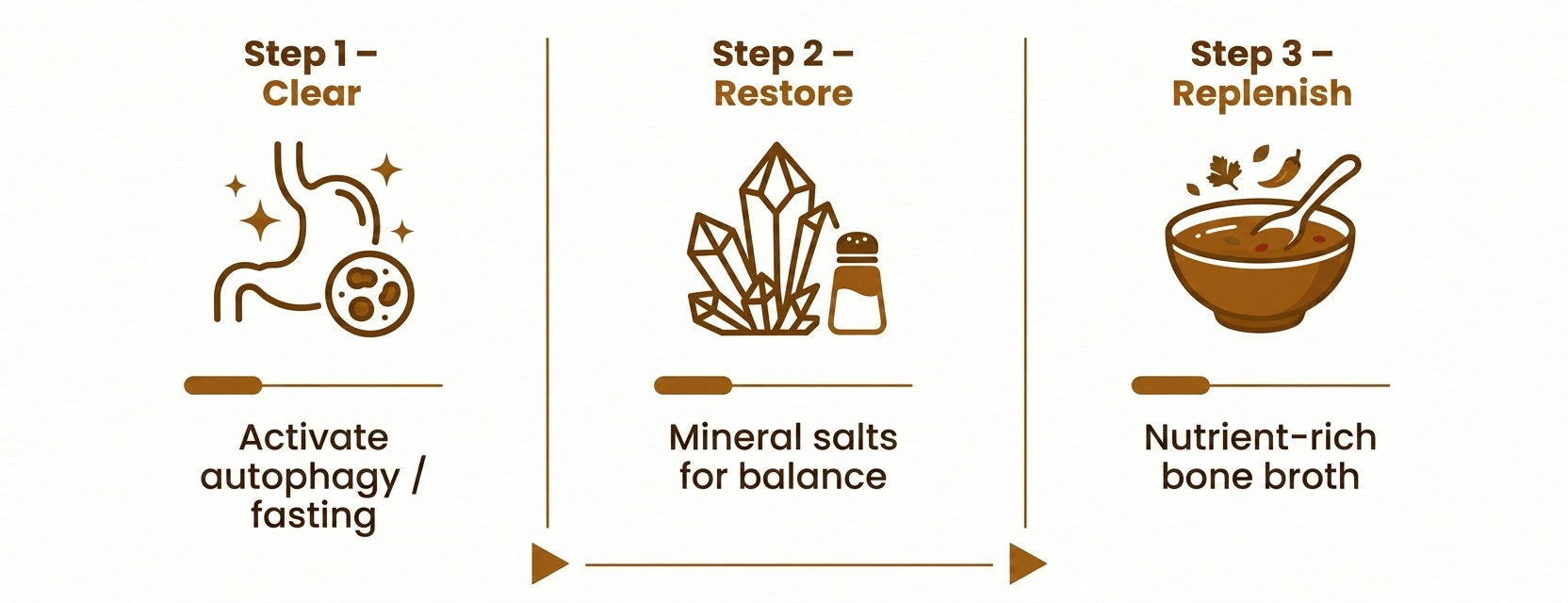
Sequence One: Intermittent Short-Term Dry Fast (8 to 12 hours) No food. No water. Repeat as often as you can. Purpose: Activate autophagic flux. Clear cellular debris in small, manageable cycles.
Sequence Two: Mineral Priming Break the fast with warm water laced with full-spectrum salts. Then wait two hours. Purpose: Restore electrolyte balance. Alkalize internal environment. Allow the terrain to open.
Sequence Three: Slow Simmered Bone and Tendon Broth (3 to 4 hours) After the two-hour wait, drink a bowl of broth from indigenous cattle, simmered for 3 to 4 hours. Purpose: Provide bioavailable collagen, minerals, and concentrated plant compounds. Heal the gut. Restore cellular function.
Repetition: Repeat this three-step cycle as many times as you can. The cumulative effect is profound.
The Terra methodology is a framework for understanding, not a medical prescription. Consult your healthcare provider before beginning any fasting or dietary protocol, especially if you have underlying health conditions or take medications. I am sharing documented stories and experiences, not practicing medicine. Your body is yours. Your choices are yours.
]]>
Why Where a Cow Lived Determines What Medicine Its Bones CarryInche, Faza & Mourynhttps://terrain.co.ke/how-where-a-cow-lived-determines-what-medicine-its-bones-carry-and-how-they-interact-with-specific-salts/2026-03-30T12:56:51+03:00
There is a question we hear often from participants in our Foundational Program: is all broth the same? The answer, we have learned over five years of research, is no. Broth is not broth. The medicine that comes from an animal's bones is a direct reflection of what that animal ate over its lifetime. And what an animal eats depends entirely on where it lived.
A cow that spent its life in the grasslands of Laikipia, browsing on acacia and wild grasses, carries a different medicine than a cow that grazed on the shrublands of Turkana, eating plants built for dry conditions. A goat that climbed the hills of Meru, eating leaves and bark from trees that grow nowhere else, produces broth with a different mineral makeup than a cow that wandered the Rift Valley, drinking from alkaline springs and eating plants that thrive in volcanic soil.
]]>
There is a question we hear often from participants in our Foundational Program: is all broth the same? The answer, we have learned over five years of research, is no. Broth is not broth. The medicine that comes from an animal's bones is a direct reflection of what that animal ate over its lifetime. And what an animal eats depends entirely on where it lived.
A cow that spent its life in the grasslands of Laikipia, browsing on acacia and wild grasses, carries a different medicine than a cow that grazed on the shrublands of Turkana, eating plants built for dry conditions. A goat that climbed the hills of Meru, eating leaves and bark from trees that grow nowhere else, produces broth with a different mineral makeup than a cow that wandered the Rift Valley, drinking from alkaline springs and eating plants that thrive in volcanic soil.
The animal eats plants that humans cannot digest. It processes those plants through its unique digestive system. And it concentrates the bioactive compounds, the flavonoids, alkaloids, glycosides, and terpenoids, into its bones, its connective tissues, its marrow. When we simmer those bones for 3 to 4 hours, we take out what the animal gathered. We drink the medicine of a place.
This article looks at three distinct geographical regions in Kenya, the plants that grow there, the cattle that eat them, and the broths that result. It looks at how these broths work with specific salts, Baleni, Omo River, Rift Valley, and Boke, to target particular health conditions. And it shares the stories of people who discovered that the place an animal lived was as important as the animal itself.
Laikipia: Acacia and Wild Herbs
The Landscape
Laikipia lies in the highlands of central Kenya, a vast plateau that stretches from the foothills of Mount Kenya to the edge of the Rift Valley. It is a landscape of open grasslands, acacia woodlands, and riverine forests. The altitude ranges from 1,500 to 2,000 meters, and the climate is moderate, warm days, cool nights, with seasonal rains that support a wide variety of plants.
This is cattle country. The ranches of Laikipia have been managed for generations, some by Kenyan families, some by pastoral communities who have moved through this landscape for centuries. The cattle here are not locked up. They roam across thousands of acres, browsing on the plants that grow naturally in this area.
The Plants
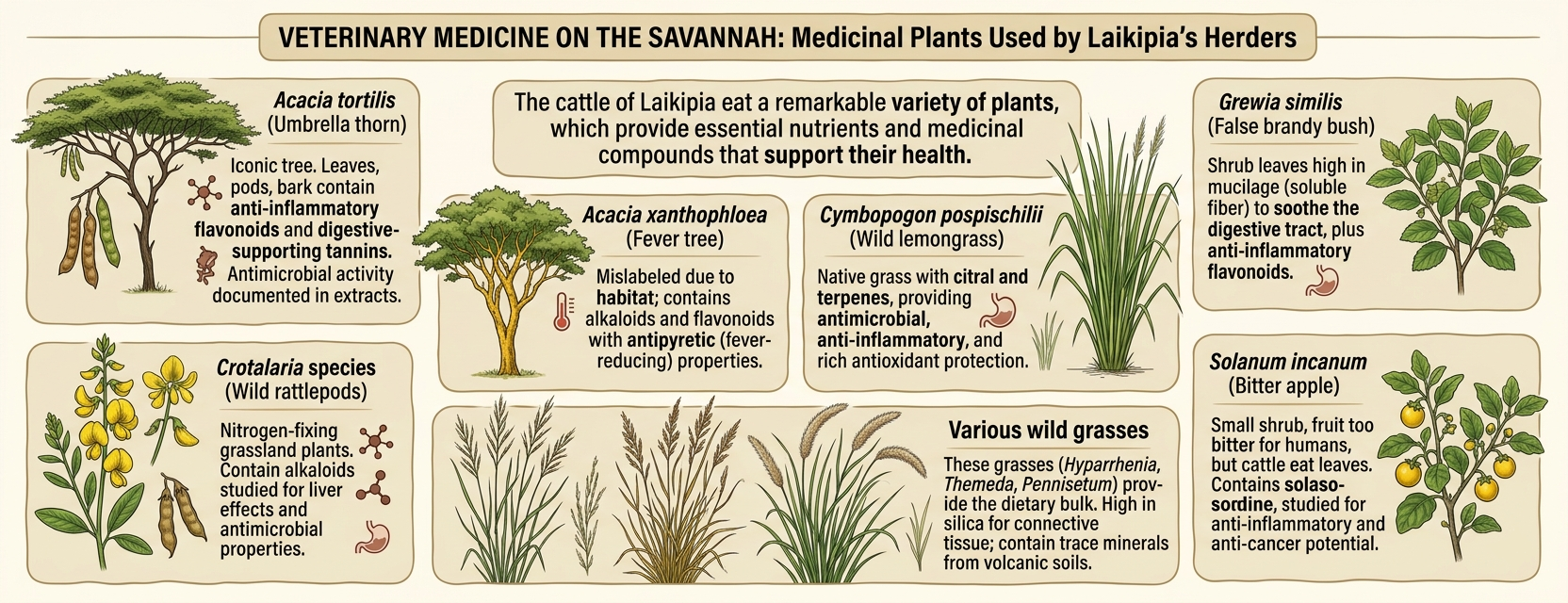
The cattle of Laikipia eat a remarkable variety of plants:
Acacia tortilis (Umbrella thorn) The most iconic tree of the African savannah. Its leaves, pods, and bark contain flavonoids with anti-inflammatory properties. The tannins in its bark have astringent effects that support digestive health. Research has documented antimicrobial activity in acacia extracts, effective against a range of pathogens.
Acacia xanthophloea (Fever tree) Named for the mistaken belief that it caused malaria (it grows in swampy areas where malaria was common), this tree contains alkaloids and flavonoids with antipyretic properties, compounds that help reduce fever.
Cymbopogon pospischilii (Wild lemongrass) A native grass related to cultivated lemongrass. It contains citral and other terpenes with antimicrobial and anti-inflammatory activity. It is also rich in antioxidants that protect cells from damage.
Grewia similis (False brandy bush) The leaves of this shrub are high in mucilage, soluble fiber that soothes the digestive tract. It also contains flavonoids with anti-inflammatory properties.
Crotalaria species (Wild rattlepods) These nitrogen-fixing plants grow throughout the grasslands. They contain alkaloids that have been studied for their effects on the liver and their antimicrobial properties.
Solanum incanum (Bitter apple) A small shrub whose fruit is too bitter for humans, but cattle eat its leaves. It contains solasodine, a compound studied for its anti-inflammatory and potential anti-cancer properties.
Various wild grasses Hyparrhenia, Themeda, and Pennisetum species provide the bulk of the diet. These grasses are high in silica, which supports connective tissue, and contain a range of trace minerals drawn from the volcanic soils of the region.
The Broth
Broth from Laikipia cattle is known for:
High collagen content: The cattle move over long distances, developing strong connective tissue that translates to rich gelatin in the broth.
Balanced mineral profile: The volcanic soils of the area contribute a full range of trace elements.
Flavonoid richness: The acacia species are rich in anti-inflammatory compounds.
Moderate silica: From the native grasses, supporting connective tissue repair.
Target Conditions
Laikipia broth is especially effective for:
General inflammation: The anti-inflammatory flavonoids from acacia address inflammation throughout the body.
Digestive issues: The tannins and mucilage soothe the gut lining.
Connective tissue repair: The silica and collagen support joints, tendons, and ligaments.
Immune modulation: The mix of plant compounds helps support balanced immune function.
Interaction with Salts
Baleni Spring Salt works exceptionally well with Laikipia broth. The complete mineral profile of Baleni salt provides the magnesium and calcium that work together with the broth's flavonoids and silica. Together, they create a foundation for whole-body restoration.
Turkana: Desert Shrubs
The Landscape
Turkana is the land of extremes. Northwestern Kenya, bordering Lake Turkana, is a vast area of arid plains, volcanic rock, and dry riverbeds. Rainfall is scarce and unpredictable. Temperatures are high. Water is life here, and life has adapted to scarcity.
The cattle of Turkana are not the large, calm breeds of Laikipia. They are the small, hardy Zebu, animals that can go days without water, that can survive on plants that would starve other cattle. They are herded by the Turkana people, pastoralists who move with their animals across this harsh landscape, following the rains and the grazing.
The Plants
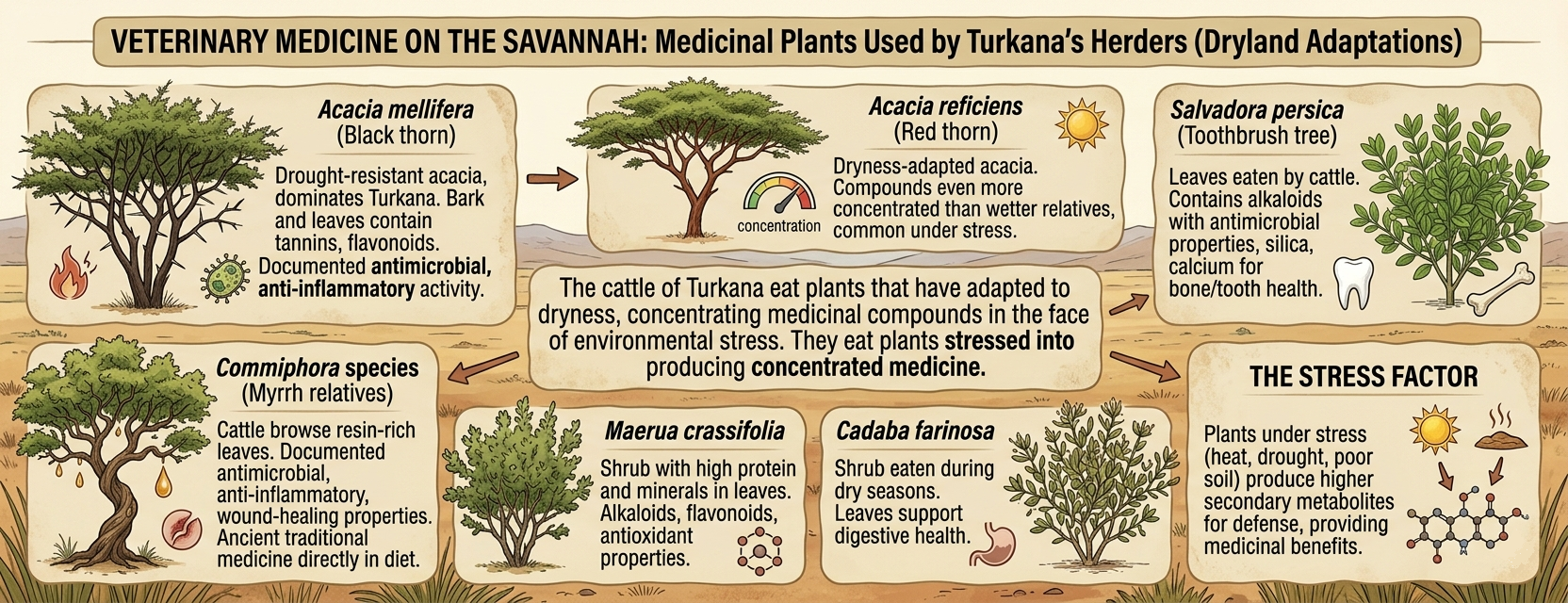
The cattle of Turkana eat plants that have adapted to dryness, and that have concentrated their medicinal compounds in the face of environmental stress:
Acacia mellifera (Black thorn) A drought-resistant acacia that dominates much of the Turkana landscape. Its bark and leaves contain high amounts of tannins and flavonoids, with documented antimicrobial and anti-inflammatory activity.
Acacia reficiens (Red thorn) Another acacia species adapted to dryness. Its compounds are even more concentrated than those of its relatives that grow in wetter areas, a common thing in plants that grow under stress.
Salvadora persica (Toothbrush tree) The leaves of this tree are eaten by cattle in Turkana. It contains alkaloids with antimicrobial properties, as well as silica and calcium compounds that support bone and tooth health.
Commiphora species (Myrrh relatives) Several Commiphora species grow in Turkana, producing resin-rich leaves that cattle browse. These contain compounds with documented antimicrobial, anti-inflammatory, and wound-healing properties. Myrrh has been used in traditional medicine for thousands of years, and here it enters the cattle's diet directly.
Maerua crassifolia A drought-tolerant shrub whose leaves are high in protein and minerals. It contains alkaloids and flavonoids with antioxidant properties.
Cadaba farinosa A shrub that grows in dry areas, eaten by cattle during dry seasons. Its leaves contain compounds that support digestive health.
The stress factor: Plants growing under stress, heat, drought, poor soil, often produce higher amounts of secondary metabolites, including the compounds that serve as plant defense and that provide medicinal benefits. The cattle of Turkana are not just eating plants. They are eating plants that have been stressed into producing concentrated medicine.
The Broth
Broth from Turkana cattle is known for:
High antimicrobial activity: The acacia and Commiphora species contribute compounds that support the body's defenses.
Concentrated flavonoids: Stress-grown plants produce higher amounts of anti-inflammatory compounds.
Dense mineral content: The cattle browse on plants that draw minerals from volcanic soils.
Distinctive flavor: The resinous compounds from Commiphora give the broth a slightly bitter, complex taste that experienced broth drinkers recognize as medicine.
Target Conditions
Turkana broth is especially effective for:
Infections: The antimicrobial compounds support the body's ability to clear pathogens.
Chronic inflammation: The concentrated flavonoids address deep inflammatory processes.
Wound healing: The myrrh-related compounds support tissue repair.
Oxidative stress: The antioxidant compounds protect cells from damage.
Interaction with Salts
Boke Black Salt is the ideal partner for Turkana broth. The volcanic origin of Boke salt, harvested from the depths of the El Sod crater in southern Ethiopia, echoes the volcanic landscape of Turkana. The iron content of Boke salt supports the blood, while the sulfur compounds work together with the myrrh-related compounds in the broth. Together, they create a strong combination for infection and inflammation.
Rift Valley: Alkaline Lakes
The Landscape
The Great Rift Valley is one of the most geologically active regions on earth. Here, tectonic plates are pulling apart, creating a landscape of volcanoes, cliffs, and deep basins. The valley floor is dotted with alkaline lakes, Lake Bogoria, Lake Magadi, Lake Elementaita, whose waters are filled with minerals from deep underground.
The cattle that graze along the Rift Valley have access to plants that grow nowhere else, plants adapted to alkaline soils, plants that draw minerals from volcanic deposits, plants that have evolved in one of the most mineral-rich environments on earth.
The Plants
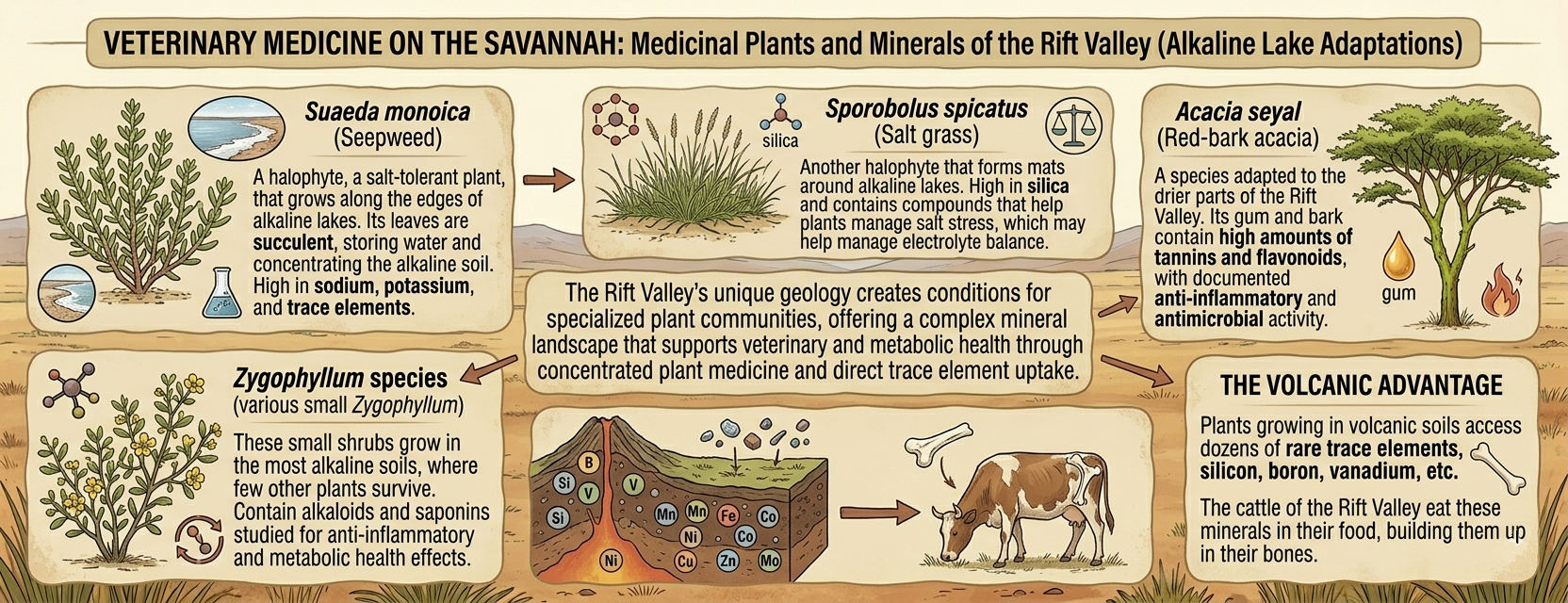
The Rift Valley's unique geology creates conditions for specialized plant communities:
Suaeda monoica (Seepweed) A halophyte, a salt-tolerant plant, that grows along the edges of alkaline lakes. Its leaves are succulent, storing water and concentrating minerals from the alkaline soil. It is high in sodium, potassium, and trace elements.
Sporobolus spicatus (Salt grass) Another halophyte that forms mats around alkaline lakes. It is high in silica and contains compounds that help plants manage salt stress, compounds that may help the body manage electrolyte balance.
Acacia seyal A species adapted to the drier parts of the Rift Valley. Its gum and bark contain high amounts of tannins and flavonoids, with documented anti-inflammatory and antimicrobial activity.
Zygophyllum species These small shrubs grow in the most alkaline soils, where few other plants survive. They contain alkaloids and saponins that have been studied for their effects on inflammation and metabolic health.
The volcanic advantage: Plants growing in volcanic soils have access to a wider range of minerals than plants growing in sedimentary soils. Volcanic rocks contain dozens of trace elements, silicon, boron, vanadium, chromium, manganese, iron, cobalt, nickel, copper, zinc, molybdenum, that are rare in other soils. The cattle of the Rift Valley eat these minerals in their food, and those minerals build up in their bones.
The Broth
Broth from Rift Valley cattle is known for:
High mineral diversity: The volcanic soils contribute a broad range of trace elements.
Alkalizing compounds: The halophytes contribute minerals and compounds that support pH balance.
Silica richness: From the salt grasses, supporting connective tissue.
Unique flavor: The alkaline environment gives the broth a distinctive quality that many describe as "bright" or "clean."
Target Conditions
Rift Valley broth is especially effective for:
Acidic terrain: The alkalizing compounds help restore pH balance after years of acid-forming diets.
Connective tissue issues: The silica supports joints, tendons, and ligaments.
Mineral depletion: The broad mineral spectrum addresses deficiencies that other foods cannot.
Electrolyte imbalance: The sodium, potassium, and magnesium from the halophytes support proper cellular function.
Interaction with Salts
Rift Valley Alkaline Salt is the natural partner for Rift Valley broth. Both come from the same geological system. Both carry the mineral signature of the volcanic corridor. Together, they create a combined effect, the salt providing the immediate mineral restoration that prepares the terrain, the broth providing the deeper nourishment that rebuilds it.
How Broths Interact with Salts
The relationship between broth and salt is not random. It follows principles that we have seen across hundreds of participants.
Place Matters
Broth and salt from the same geographic region often work together in a supportive way. The Baleni salt from South Africa and the broth from cattle that graze on the same South African landscape would naturally complement each other. The same is true of Rift Valley salt and Rift Valley broth.
Cattle grazing the Savannah
This is ecology. The plants of a region concentrate minerals from the soil. The animals that eat those plants concentrate those minerals in their tissues. The salt from that region carries a similar mineral signature. Together, they provide the body with a complete picture of that place's mineral and plant chemical wealth.
Complementary Profiles
Broth and salt with complementary mineral profiles can work together even when they come from different regions.
Baleni salt, with its balanced magnesium-calcium ratio, complements the anti-inflammatory flavonoids of Laikipia broth. The magnesium supports relaxation while the flavonoids address inflammation.
Omo River salt, with its high potassium content, complements the antimicrobial compounds of Turkana broth. The potassium supports cardiovascular function while the broth's compounds address infection.
Boke black salt, with its iron and sulfur, complements the connective tissue support of Rift Valley broth. The iron supports energy while the silica helps rebuild structure.
The Body Knows
In the end, the relationship between broth and salt is felt, not just prescribed. Participants in the Terrain Repair program learn to pay attention to how their bodies respond.
"I started with Laikipia broth and Baleni salt," one participant said. "My inflammation went down. Then I switched to Turkana broth with Boke salt when I felt an infection coming on. My body fought it off faster than it ever had. Then I used Rift Valley broth with Rift Valley salt when I felt my joints needed support. The rotation made sense to me."
Stories of Recovery From Our Program
The Man Who Healed His Gut
Kennedy Kamau, 48, had suffered from ulcerative colitis for seven years. He had tried every medication without success. His gastroenterologist was talking about surgery.
"Nilikuwa nimeshinda. Nimejaribu kila kitu. Rafiki yangu aliniambia kuhusu supu ya ng'ombe wa Laikipia. Alisema miti ya acacia huko ina vitu vya kupunguza uvimbe na kuponya utumbo." (I was at the end of my rope. I had tried everything. A friend told me about broth from Laikipia cattle. She said the acacia trees there have compounds that heal the gut.)
He started the revised protocol. Short dry fasts of 8 to 12 hours, repeated as often as he could manage. After each fast, mineral priming with warm water and full-spectrum salts. A two-hour wait. Then broth from Laikipia cattle, simmered for 3 to 4 hours.
He rotated salts, Baleni, then Omo River, then Rift Valley, then Boke, but always with Laikipia broth. He made large batches on weekends and froze portions.
"Baleni salt na Laikipia broth pamoja, hapo ndipo utumbo wangu ulianza kupona. Uvimbe ukapungua. Damu ilikoma. Mwisho wa mwezi wa tatu, colonoscopy ilionyesha hakuna ugonjwa unaoendelea." (The Baleni salt and Laikipia broth together, that was when my gut began to heal. The inflammation went down. The bleeding stopped. By the end of the third month, my colonoscopy showed no active disease.)
Kennedy is now off all ulcerative colitis medication.
"Sikujiponya mimi mwenyewe. Supu haikuniponya. Lakini mwili wangu, ukipewa kile unachohitaji, ulifanya kile kilikuwa kinahitajika kufanya kwa miaka mingi. Ulipona." (I did not cure myself. The broth did not cure me. But my body, given what it needed, did what it had been trying to do for years. It healed.)
The Woman Who Cleared Chronic Infection
Fatima Hassan, 52, had suffered from recurrent urinary tract infections for over a decade. Antibiotics would clear one infection, and another would return within weeks.
"Nilikuwa natumia dawa za vijasumu kila mara. Utumbo wangu ulikuwa umeharibika. Mwili wangu ulikuwa umechoka. Waliniambia niishi na hali hii tu." (I was on antibiotics constantly. My gut was destroyed. My immune system was exhausted. I was told I would just have to manage it.)
She heard about Turkana broth from a relative who had used it to clear a wound infection that would not heal.
"Nikawa, kama inaponya majeraha, labda inaweza kuponya kibofu changu." (I thought: if it can heal wounds, maybe it can heal my bladder.)
She started the revised protocol. Short dry fasts of 8 to 12 hours. Mineral priming with warm water and Boke salt. A two-hour wait. Then Turkana broth, simmered for 3 to 4 hours. She repeated the cycle as often as she could manage.
After three months, her infections stopped.
"Sasa nimepita mwaka nzima sina UTI. Mwili wangu umepata nguvu. Utumbo wangu umepona. Turkana broth na Boke salt zilifanya kile antibiotics haikuweza kufanya. Hazikuua bacteria tu. Zilibadilisha mazingira ya mwili wangu, bacteria ikashindwa kurudi." (I have not had a UTI in over a year. My immune system is strong. My gut healed. The Turkana broth and Boke salt did what antibiotics could not. They did not just kill the bacteria. They changed the terrain so the bacteria could not come back.)
Expert Views
Dr. Sarah Mbugua on Geographic Medicine
"What we are seeing with these geographically distinct broths is something that modern medicine has largely forgotten: the place an animal lived determines the medicine its body carries. The plants of Laikipia produce different compounds than the plants of Turkana. The soils of the Rift Valley provide different minerals than the soils of the highlands. The animal concentrates what the place provides."
She pauses.
"This is not alternative medicine. This is ecology. It is understanding that health is not just about what we eat. It is about where that food came from."
Naanyu on the Wisdom of the Elders
"Our elders knew that cattle from different places produced different broth. They knew that broth from the Rift Valley was good for the bones. Broth from Turkana was good for fighting sickness. Broth from Laikipia was good for the stomach. They did not have laboratories. They had generations of paying attention."
She smiles.
"We are not discovering something new. We are remembering something old."
Dr. James O'Sullivan on the UK Perspective
"In the UK, we have lost this connection between food and place. Our meat comes from animals raised on imported grain, in confinement, far from the land. The broth from those animals is the same whether it comes from Scotland or Cornwall. There is no geographic medicine. There is just commodity."
He has been following TerraFix participants with interest.
"What I see in the participants who use these geographically distinct broths is something I cannot explain through conventional nutrition. Their inflammation markers drop. Their energy improves. Their conditions resolve. I think we are only beginning to understand what is lost when we separate food from place."
The Geography of Broth
The broth from Laikipia carries the medicine of acacia and wild grasses. The broth from Turkana carries the concentrated compounds of desert shrubs grown under stress. The broth from the Rift Valley carries the mineral wealth of volcanic soils and alkaline lakes.
They are not the same. They are not interchangeable. And when combined with the right salts, Baleni with Laikipia, Boke with Turkana, Rift Valley with Rift Valley, they create medicines that address specific conditions with a precision that modern nutrition cannot replicate.
The animal is a bio-accumulator. It eats the plants of a place and concentrates their medicine into its bones. When we simmer those bones for 3 to 4 hours, we drink the medicine of that place. When we combine that broth with salt from a complementary source, we give the body what it has been missing.
Kennedy healed his gut with Laikipia broth and Baleni salt. Fatima cleared her infections with Turkana broth and Boke salt. Samuel regenerated his joints with Rift Valley broth and Rift Valley salt. They are people who discovered that the place an animal lived was as important as the animal itself.
The body knows where it came from. It knows the land. It knows the plants. It knows the minerals. Give it what it remembers, and it will heal.
The geographic origin of broth matters. The plants an animal ate determine the medicine its bones carry. Combine with the right salts, and the body receives what it has been missing.
]]>
How Alternating Minerals Deepens Terrain RestorationInche, Faza & Mourynhttps://terrain.co.ke/salt-rotation-how-alternating-minerals-deepens-terrain-restoration/2026-02-28T08:41:00+03:00
"Why do I need to rotate the salts? Why can't I just pick one and stick with it?"
It is the question we hear most often in the Terrain Repairfoundational program. The question makes sense. The salts we source, Baleni Spring Salt from South Africa, Omo River Plant Ash Salt from Ethiopia, and Black Salt from Boke in southern Ethiopia, are each remarkable in their own right. Each contains a full spectrum of minerals. Each has its own distinct profile. Each, on its own, can restore what the fast has depleted.
So why rotate?
]]>
"Why do I need to rotate the salts? Why can't I just pick one and stick with it?"
It is the question we hear most often in the Terrain Repairfoundational program. The question makes sense. The salts we source, Baleni Spring Salt from South Africa, Omo River Plant Ash Salt from Ethiopia, and Black Salt from Boke in southern Ethiopia, are each remarkable in their own right. Each contains a full spectrum of minerals. Each has its own distinct profile. Each, on its own, can restore what the fast has depleted.
So why rotate?
The answer lies in understanding what the terrain actually is, and what it needs to be fully restored.
The body is not a simple machine that requires one fuel. It is a complex ecosystem that evolved to receive nutrients from diverse sources. The pastoral communities who taught us did not consume a single salt. They moved across the land, accessing different sources depending on where their herds traveled, depending on the season, depending on what their bodies told them they needed.
They understood something that modern nutrition has forgotten: the terrain requires variety. Not just variety in food. Variety in minerals.
One Salt Is Not Enough
Every salt we source is complete. That is not the issue. Baleni salt contains a full spectrum of minerals. Omo River salt contains a full spectrum. Rift Valley salt contains a full spectrum. Boke salt contains a full spectrum.
But they are not the same spectrum.
Baleni Spring Salt emerges from a geothermal spring in South Africa, drawn from ancient geological formations that include fossilized seabeds. Its mineral profile is balanced, with notable levels of magnesium, calcium, and trace elements in ratios that support general cellular function.
Omo River Plant Ash Salt is derived from plants that grew along the Omo River in Ethiopia. Because it comes from plant tissues, its minerals are organically complexed, bound to organic molecules that the body may process differently. It is notably higher in potassium than sodium, making it particularly valuable for cardiovascular support.
Black Salt from Boke is harvested from the depths of a volcanic crater in southern Ethiopia. Divers plunge into dark waters to bring up mineral-rich mud. Its iron content gives it its dark color, and its volcanic origin provides a distinct profile of sulfur compounds and trace elements.
Each salt is complete. But each is complete in a different way.
Dr. Sarah Mbugua, the gastroenterologist who has worked with TerraFix participants, explains the significance.
"Imagine you have been eating a diet deficient in minerals for decades. Your body is not just missing one mineral. It is missing dozens. It is missing the synergistic relationships between minerals. When you introduce a single salt, even a complete one, you are giving the body one version of completeness. But the body evolved to receive minerals from multiple sources. The terrain is not a single lock that a single key opens. It is a complex system that requires multiple inputs to fully restore."
This is why rotation matters. The terrain is not just depleted. It is depleted across a spectrum. Restoring it requires addressing the full range of deficiencies, and different salts address different aspects of the deficiency.
What Science Says
The scientific literature on mineral diversity is surprisingly sparse, not because the topic is unimportant, but because it has been largely ignored by a nutrition research establishment focused on single nutrients.
What does exist, however, supports the intuition that variety matters.
Synergistic Mineral Interactions
Minerals do not work in isolation. Magnesium is required to activate vitamin D, which is required to absorb calcium. Zinc and copper must remain in balance; an excess of one can create a deficiency of the other. Selenium and iodine work together to support thyroid function.
A 2023 review in the journal Nutrients noted that "mineral deficiencies rarely occur in isolation" and that "restoration of mineral status requires attention to the full spectrum of interacting elements."
Providing a single mineral profile, even a complete one, may not address the specific imbalances that have developed over years of deficiency. Rotating profiles increases the likelihood that all deficiencies will be addressed.
Bioavailability Variation
Different mineral sources have different bioavailability. The form in which a mineral is presented affects how well the body can absorb and use it.
A 2021 study comparing mineral absorption from different salt sources found that bioavailability varied significantly depending on the mineral matrix. Minerals from plant-based salts were absorbed differently from minerals from geological salts. Minerals from volcanic sources had different absorption kinetics than minerals from marine sources.
The authors concluded that "diverse mineral sources may provide complementary benefits" and that "reliance on a single source may leave certain absorption pathways underutilized."
The Terrain as Ecosystem
Perhaps the most compelling framework comes not from nutrition science but from ecology.
Dr. Leon Matata, the sociologist who has studied traditional health systems, puts it this way:
"The body is not a factory. It is a garden. A factory requires a single fuel. A garden requires diverse inputs. You cannot feed a garden the same fertilizer every season and expect it to thrive. The soil needs variety. The minerals need to come from different sources. That is what the pastoral communities understood. That is what we have rediscovered."
Our Rotation Protocol
In the foundational Terrain Repair program, participants rotate through the four salts over the course of the three-month protocol.
The standard rotation:
Week 1-2: Baleni Spring Salt — Establishing mineral balance
Week 3-4: Omo River Plant Ash Salt — Supporting potassium-sodium balance
Week 5-6: Inland Alkaline Lake Salt — Deep alkalization and connective tissue support
Week 7-8: Black Salt from Boke — Iron and volcanic mineral replenishment
Week 9-12: Rotation continues with shorter intervals (3-5 days per salt)
Some participants require different sequences based on their specific conditions. Those with hypertension may spend more time on Omo River salt. Those with connective tissue issues may extend the Inland Alkaline Lake Salt. Those with anemia may need additional time on Boke salt.
But the principle remains constant: the terrain receives multiple mineral profiles over time, addressing the full spectrum of deficiency that a single source cannot reach.
Why Rotation Works
Dr. Sarah Mbugua has been following TerraFix participants for three years. She has seen the outcomes firsthand.
"What I observe is that participants who rotate through the salts consistently report better outcomes than those who use a single salt. Their markers improve more dramatically. Their symptoms resolve more completely. Their energy returns more fully."
She grounds her observations in physiology.
"The body has multiple mineral transport systems. Different minerals are absorbed through different pathways. Some are absorbed in the small intestine. Some in the colon. Some require specific transporters. Some are absorbed passively. When you provide minerals from a single source, you are only engaging one subset of these pathways. When you rotate, you engage multiple pathways over time. The terrain receives what it needs through the channels that were designed to receive it."
She also notes the role of the gut microbiome.
"We are increasingly understanding that the gut bacteria play a critical role in mineral absorption. Different bacteria process different mineral forms. A diverse mineral intake supports a diverse microbiome. A diverse microbiome supports better mineral absorption. It is a virtuous cycle."
A UK Doctor's Perspective
Dr. James O'Sullivan is a general practitioner based in London who has been working with TerraFix participants for the past eighteen months. He initially became interested in the program through a patient who had reversed her chronic fatigue.
"I had a patient who had been under my care for five years. She had chronic fatigue syndrome. She had tried everything. Nothing worked. Then she disappeared for a while. When she came back, she was different. She had energy. She looked alive. She told me about this program."
Dr. O'Sullivan was skeptical but curious.
"I asked her to send me the materials. I read them. I thought: this is interesting, but where is the evidence? She said: the evidence is my body. I could not argue with that."
Since then, Dr. O'Sullivan has observed the program's effects in multiple patients.
"What I see is consistent across cases. Patients who complete the three-month protocol, rotating through the salts, show improvements that conventional medicine cannot explain. Their inflammation markers drop. Their energy improves. Their reliance on medication decreases. Some of them have reversed conditions I was told were irreversible."
He is particularly interested in the rotation aspect.
"The diversity of mineral sources makes physiological sense. The human body evolved in environments where mineral sources were varied. Pastoral communities did not consume the same salt every day. They moved across landscapes. They accessed different springs, different plants, different geological formations. The rotation mimics this natural diversity."
Dr. O'Sullivan is careful not to overstate.
"I am not saying that salt rotation cures disease. I am saying that when the inner environment is restored, the body functions better. And when the body functions better, symptoms improve. Sometimes they disappear. Sometimes they become manageable. In either case, the patient's quality of life improves. That is what medicine should aim for."
What Happens Inside
The process by which salt rotation restores the terrain is not mysterious. It follows a predictable sequence.
Phase One: Correcting Acute Deficiencies
The first time the body receives full-spectrum minerals after a fast, it corrects the most immediate deficiencies. Magnesium levels rise. Potassium is restored. Calcium becomes available. This is why participants often feel immediate relief. The body is receiving what it has been missing.
Phase Two: Addressing Chronic Imbalances
After the acute deficiencies are corrected, the body begins to address chronic imbalances. The sodium-potassium ratio improves. Magnesium-calcium balance is restored. Trace element deficiencies are corrected.
This phase takes longer. It is why the protocol requires months, not days.
Phase Three: Restoring Mineral Systems
As minerals are restored, the systems that depend on them begin to function properly. The nervous system, which requires magnesium for relaxation, becomes calmer. The cardiovascular system, which requires potassium for regulation, becomes more stable. The digestive system, which requires a full spectrum of minerals for enzyme function, begins to work as it should.
Phase Four: Terrain Regeneration
Finally, with the mineral foundation restored, the terrain itself regenerates. The gut lining, which depends on minerals for repair, becomes whole. The microbiome, which depends on minerals for diversity, becomes robust. The cells, which depend on minerals for energy production, become efficient.
This is what the rotation achieves. Each salt contributes to this process in a different way, addressing different aspects of the deficiency, engaging different absorption pathways, supporting different systems.
The Wisdom of Diversity
The pastoral communities who taught us did not rotate salts because they had read a research paper. They rotated because they observed that their bodies responded differently to different sources. They noticed that salt from one spring made them feel one way. Salt from another spring made them feel another way. Over generations, they learned that the body needs variety.
Modern nutrition has lost this wisdom. We have been taught that minerals are interchangeable, that a magnesium supplement is a magnesium supplement, that any salt will do. But the body knows better.
The rotation is not complicated. It is not expensive. It is not difficult. It is simply giving the body what it has been missing, diverse minerals from diverse sources, delivered in the sequence that allows the terrain to open and receive.
The Terrain Repair Method Cleanse. Restore. Replenish.
The salt rotation is a core component of the foundational Terrain Repair program. It is not a medical treatment. Consult your healthcare provider before beginning any fasting or dietary protocol. Individual results vary.
]]>
What Happens When You Pause Between Salt and BrothInche, Faza & Mourynhttps://terrain.co.ke/why-the-space-between-salt-and-broth-is-where-true-healing-begins/2025-10-17T12:29:00+03:00
When we first began documenting the three-sequence protocol among pastoral communities, we noticed something unexpected. After the fast, after the salt water, the elders did not immediately eat or drink broth. They waited.
Sometimes an hour. Sometimes two. Sometimes longer, depending on how they felt.
At first, we thought this was unnecessary. The body had just completed a fast. It was
]]>
When we first began documenting the three-sequence protocol among pastoral communities, we noticed something unexpected. After the fast, after the salt water, the elders did not immediately eat or drink broth. They waited.
Sometimes an hour. Sometimes two. Sometimes longer, depending on how they felt.
At first, we thought this was unnecessary. The body had just completed a fast. It was
depleted. It needed nutrition. Why delay?
Then we began to understand the physiology of what was happening in those two hours. And what we learned changed how we teach the protocol.
Akinyi's Mistake
Akinyi, our community outreach lead, was the first among us to learn why the two-hour window matters. She had completed her 48-hour fast. She was hungry and tired. She wanted the process to be over.
She drank her salt water. Then she drank her broth immediately.
What happened next was subtle. Her stomach cramped. Not badly. Just a low, persistent discomfort. She felt full in a way that was not comfortable. Her energy, which had been returning, seemed to flatten.
She continued this way for three days. The discomfort persisted.
She called Otieno. "Something is wrong," she said. "The protocol is not working."
"How long are you waiting between salt and broth?" he asked.
She was not waiting. She thought the waiting was optional.
He explained what the elders had observed over generations: the body needs time to transition from cleaning mode to receiving mode. The salts need time to work. The digestive system needs time to wake up.
Akinyi restarted. After her salt water, she sat. She did not eat. She did not drink. She waited.
By the end of the first hour, she felt something shift. A lightness. A sense that her body had exhaled. By the second hour, she was hungry, not the hollow hunger of the fast, but a clean, grounded hunger. When she finally drank the broth, her body received it differently. No cramping. No fullness. Just warmth. Just nourishment.
It was like the difference between pouring water onto concrete and pouring it into soil.
What Happens in Two Hours
The two-hour window is not arbitrary. It is the time the body needs to transition from catabolism (breaking down) to anabolism (building up).
Hour One: Cellular Restoration
When you drink warm water with full-spectrum mineral salts after a fast, electrolytes enter the bloodstream rapidly. Magnesium, potassium, calcium, sodium. They are absorbed through the stomach lining, bypassing slower digestion.
Within minutes, these minerals restore the ionic balance that the fast depleted. Nerve signals become crisp. Tight muscles relax. The heart settles.
But this is only the beginning.
"The first hour is about restoration," explains Dr. Sarah Mbugua, a gastroenterologist who has worked with our participants. "The cells are receiving the minerals they need to function. But they are still in a state of metabolic shock. They have been through intense cellular cleaning, autophagy, and they need time to stabilize before they can process new material."
Think of it like waking up from deep sleep. You do not jump out of bed and run a race. Your body needs time to transition. Your cells are no different.
Hour Two: Digestive System Awakens
Between the first and second hours, something else shifts.
Electrolytes penetrate cell membranes. The mineral imbalance is corrected. The internal environment, which became acidic during toxin release, begins to alkalize.
Now the digestive system wakes up.
"The second hour is when gastric activity resumes properly," Dr. Mbugua says. "Gastric acid production, dormant during the fast, starts again. Digestive enzymes are secreted. The gut lining becomes active. If you introduce broth too early, you are asking the digestive system to work before it is ready. The material arrives before the machinery is prepared."
This is why the timing matters. Not because of tradition. Because of basic digestive physiology.
Dr. Mbugua's Observations
Dr. Mbugua began working with Terra participants three years ago. She was skeptical at first.
"The idea that waiting two hours between salt and broth could make a meaningful difference seemed unscientific."
Then she tracked her patients' outcomes.
"I had a patient with severe ulcerative colitis. She had failed every medication. After completing the three-sequence protocol, her inflammation markers dropped by 70 percent. I asked her what part made the biggest difference. She said the waiting."
She started asking every patient who had success. Consistently, those who waited the full two hours reported better outcomes. Faster symptom resolution. Deeper energy restoration. Fewer digestive issues.
"Fasting triggers autophagy," she explains. "But it also suppresses digestive function. The stomach stops producing acid. The pancreas stops secreting enzymes. When you break the fast with mineral salts, you begin waking the system. But it takes time. The gastric cells need to reactivate. The enzyme systems need to restart. If you introduce complex nutrition before the system is ready, you create a bottleneck."
She pauses.
"The two-hour window is not arbitrary. It is the time the body needs to complete the transition. You cannot rush this. The body will not be rushed."
Kamau Learns to Listen
Kennedy, our logistics coordinator, reversed chronic back pain that had outlasted surgery, physiotherapy, and years of painkillers. But not on his first attempt.
He was impatient. Years of pain. Years of failed treatments. When he finally found something promising, he wanted results immediately.
He completed his fast. Drank his salt water. Drank his broth immediately.
Nothing bad happened. No cramps. No sickness. But he did not get better. The protocol was not working as others described.
He persisted for two weeks. His back pain remained.
He called Otieno. "Maybe this protocol is not for me."
"How long are you waiting?" Otieno asked.
Kamau had not been waiting at all. He thought the salt was the medicine and the broth was the food. He did not understand that the waiting was part of the process.
He restarted. This time, he waited.
The first day, he sat in his living room after the salt water. He watched the clock. He felt nothing for the first hour. Just the usual hunger. But during the second hour, he felt warmth spreading from his stomach. A sense that his body was waking up. When he finally drank the broth, his whole body felt settled.
Within two weeks, his back pain began to ease. Within three months, it was gone.
"I learned something I never understood before," he says. "Healing is not just about what you put in. It is about when you put it in. The timing is part of the medicine."
What Research Tells Us
The two-hour window is supported by emerging research on digestive physiology.
Gastric Acid Resumption: Fasting suppresses gastric acid production. Upon refeeding, acid secretion does not resume immediately. A 2022 study found that gastric acid production remained suppressed for up to 90 minutes after first oral intake.
Enzyme Activation: The pancreas produces digestive enzymes in response to food. After a fast, this response is blunted. Research suggests pancreatic enzyme secretion reaches baseline levels approximately two hours after initial intake.
Gut Motility: The migrating motor complex, the wave-like contractions that move material through the digestive tract, ceases during fasting. A 2021 review noted that complete restoration of normal gut motility takes approximately 90 to 120 minutes.
Mineral Foundation: Most importantly, the minerals need time to work. Magnesium, potassium, and calcium must penetrate cell membranes and restore the sodium-potassium pump function disrupted by fasting. This is not instantaneous.
"The salt is not just replacing what was lost," Dr. Mbugua explains. "It is rebuilding the cellular infrastructure that the fast disrupted. That infrastructure is the foundation on which everything else depends. If you pour broth onto a foundation that has not been rebuilt, you get poor absorption. If you wait until the foundation is solid, the broth can do its work effectively."
How to Wait
Waiting two hours sounds simple. In practice, it can be challenging.
Use the Time Intentionally
The temptation is to fill the waiting time with distraction. To check your phone. To answer emails.
Instead, use it as an opportunity to pay attention to your body. Sit quietly. Notice what you feel. This is not passive waiting. It is active observation.
"The waiting is not empty time," says Naanyu, our traditional knowledge keeper. "It is time when your body is working. If you are not present, you cannot notice the signals it is sending."
Watch for Readiness Signs
The body signals when it is ready. Common indicators include:
Genuine hunger returning, not the dull emptiness of fasting
Warmth or expansion in the abdomen
Energy returning
Salivation increasing
Mental clarity sharpening
"Your body will tell you when it is ready," Naanyu says. "You just have to be paying attention."
Two Hours Is a Guideline
Some people need more than two hours. Some need less. Two hours is a minimum, not a strict rule.
"The important thing is to wait until your body signals readiness," Naanyu explains. "For some, that is ninety minutes. For others, three hours. The key is not to rush."
What If You Feel Nothing?
Some people report no clear signs. They wait two hours, and nothing changes.
This is common, especially early on.
"Your body has been ignored for a long time," Naanyu says. "It does not trust that you are listening. You must show it, consistently, that you are paying attention. Over time, the signals will become clearer."
What Happens When You Don't Wait
Poor Absorption
The broth is not absorbed as well. The gut is not ready. Nutrients pass through without being fully utilized.
Digestive Discomfort
Bloating, cramping, and heaviness are common when broth is consumed too early. Not dangerous, but uncomfortable and counterproductive.
Slowed Progress
The protocol takes longer to work. Those who wait see faster, deeper results. Those who rush need more cycles to achieve the same outcomes.
Missed Signals
Most importantly, not waiting means you miss the opportunity to learn from your body.
"You cannot heal what you cannot feel," Naanyu says. "If you rush past the waiting, you rush past the listening. And if you do not listen, you do not learn."
Grace's Second Lesson
Grace Akinyi, who healed her rheumatoid arthritis with the protocol, learned the importance of waiting the hard way.
The first time, she waited. She followed instructions. She had good results.
When she completed three months and her arthritis was in remission, she thought she understood. She thought she could adapt.
The second time, she did not wait. She drank her salt water and then her broth right after.
Her stomach felt heavy. The energy never came. She felt sluggish. Bloated.
She was asked: "Did you wait?"
She did not think it mattered.
She restarted. This time, she waited. The heaviness lifted. The energy returned.
"I learned something important," she says. "The protocol is not just a set of steps. It is a process with a specific order and timing. You cannot skip steps and expect the same results. The waiting is not a suggestion. It is essential."
What Happens Minute by Minute
Minutes 0-15: Mineral Absorption
Warm water with salts reaches your empty stomach. Minerals absorb rapidly through the stomach lining. Magnesium calms overactive nerves. Potassium begins restoring cellular balance.
Minutes 15-30: Cellular Response
Cells receive the minerals they need to resume normal function. Mitochondria start waking. Energy production increases. Mental clarity sharpens.
Minutes 30-60: Electrolyte Balance Restored
Sodium-potassium pumps become functional. Nerve transmission normalizes. Tight muscles relax. The heart settles into steady rhythm.
Minutes 60-90: Digestive System Wakes
Gastric acid production resumes. The pancreas releases digestive enzymes. The gut lining becomes active. Hunger returns, not hollow, but grounded.
Minutes 90-120: Terrain Ready
The internal environment is alkalized. The terrain is balanced. The gut is ready. The enzymes are waiting. The cells are prepared.
Now, and only now, is the body ready for broth.
The Science in Simple Terms
Think of it this way.
After a fast, your digestive system is asleep. The salts you drink are like an alarm clock. They start the waking process. But waking takes time. You would not expect someone to be fully alert the second their alarm goes off. Your digestive system is the same.
If you pour broth in too early, you are asking a system that is still groggy to do complex work. It will struggle. Absorption will be poor. You may feel bloated or uncomfortable.
If you wait, the system has time to wake up fully. Digestive juices are ready. Enzymes are active. The gut is prepared. When the broth arrives, the body can use it efficiently.
The two-hour window is not a rule made up by elders. It is a physiological reality. The body needs time to transition. Give it that time.
The Recommendation
After completing your fast, drink warm water with ¼ to ½ teaspoon of full-spectrum mineral salts.
Then wait. Do not eat. Do not drink anything other than water. Sit quietly. Pay attention to your body.
Notice when hunger returns. Notice when warmth spreads through your abdomen. Notice when energy sharpens.
After at least two hours, or when your body signals readiness, drink your broth. Sip slowly. Allow your body to receive what it has been prepared to receive.
Continue to pay attention. The more you listen, the more your body will teach you.
The two-hour window is not optional. It is the time your body needs to transition from clearing to rebuilding. Respect that timing. Your body knows what it is doing.
The Terrain Fix Protocol
Sequence One: Short Dry Fast (8 to 12 hours) No food. No water. Repeat as often as you can manage. Clears cellular debris.
Sequence Two: Mineral Priming Break the fast with warm water and full-spectrum salts. Then wait two hours. Restores minerals. Wakes the digestive system.
Sequence Three: Bone and Tendon Broth (3 to 4 hours) After the wait, drink broth from indigenous cattle bones and tendons. Heals the gut. Rebuilds the body.
Repetition: Repeat this cycle as often as you can manage. Consistency matters more than frequency.
Terrain Fix is a non-profit research collective. We do not sell supplements, meal plans, or medical services. This article is for informational purposes only. Consult your healthcare provider before beginning any fasting or dietary protocol.
]]>
Why Nothing Worked Until I Changed the OrderInche, Faza & Mourynhttps://terrain.co.ke/sequence-is-everything-why-the-order-of-interventions-matters/2024-02-23T13:21:00+03:00
When Mary Akinyi turned 45, she made a decision: she would finally take her health seriously. For years, she had eaten whatever was convenient. She had skipped meals, grabbed processed snacks, ignored the subtle signals her body sent. But now, with her youngest child in secondary school and a little more time for herself, she was ready to change.
She joined a gym. She bought fresh vegetables from the market. She started drinking more water, cutting sugar, reducing oil. She researched supplements and added them one by one: moringa for energy, turmeric for inflammation, probiotics for digestion, magnesium for sleep, vitamin D because everyone said she needed it.
She spent money. She spent time. She spent willpower.
And after six months, she felt worse.
]]>
When Mary Akinyi turned 45, she made a decision: she would finally take her health seriously. For years, she had eaten whatever was convenient. She had skipped meals, grabbed processed snacks, ignored the subtle signals her body sent. But now, with her youngest child in secondary school and a little more time for herself, she was ready to change.
She joined a gym. She bought fresh vegetables from the market. She started drinking more water, cutting sugar, reducing oil. She researched supplements and added them one by one: moringa for energy, turmeric for inflammation, probiotics for digestion, magnesium for sleep, vitamin D because everyone said she needed it.
She spent money. She spent time. She spent willpower.
And after six months, she felt worse.
"The fatigue was still there," she says, sitting in her living room in Embakasi, the afternoon light catching dust motes in the air. "Maybe worse than before. My digestion, which had been manageable, became unpredictable. I was bloated after meals, even meals that were just vegetables and lean protein. I started getting headaches. I thought: what am I doing wrong?"
Mary did what most people do when a protocol fails. She blamed herself. She was not strict enough. She was not consistent enough. She needed to try harder, buy better supplements, find a more effective diet.
She did not consider the possibility that she was doing everything right, but in the wrong order.
The Gardener Who Understood
Peter Omondi, 68, has been farming in Siaya since he was a boy. He has never read a medical journal. He has never heard of autophagy or mitochondria or oxidative stress. But he understands something about soil that most doctors do not understand about the human body.
"Before you plant, you prepare," he says, squatting beside a row of kale, his hands dark with earth. "If the ground is hard, you break it. If it is dry, you water it. If it is depleted, you add compost. You do not just put seeds in the ground and hope. The ground must be ready."
He looks up.
"Some people plant and nothing grows. They blame the seeds. They buy better seeds. They plant again. Still nothing grows. But the problem was never the seeds. The problem was the ground."
This is the simplest explanation of what has gone wrong with modern approaches to health.
We have become obsessed with inputs. The right diet. The right supplements. The right exercise protocol. We treat the body as a passive container: put the right things in, and the right results will come out.
But the body is not a container. It is a system. And systems have a sequence.
Before the body can use what you give it, the terrain must be prepared.
The Three Layers
Every health intervention operates at one of three levels. Understanding these levels is the first step toward understanding why sequence matters.
Removal:This is the foundation. Before anything else, what is harming the body must be removed. This includes obvious things like processed food, industrial seed oils, and refined sugar. But it also includes accumulated toxins stored in tissues over years or decades. It includes chronic stressors that keep the nervous system in fight-or-flight mode.
Most health protocols skip this level entirely. They try to build health on top of toxicity, and then wonder why nothing works.
Restoration:Once the harmful elements are removed, the body needs support to restore what has been depleted. This includes minerals, electrolytes, and the raw materials for cellular repair. It includes rest, sleep, and the time needed for regeneration.
This level is often confused with Level Three. People take supplements meant for restoration before they have completed removal. The supplements cannot be absorbed because the terrain is still toxic.
Replenishment:Only after removal and restoration can the body effectively use concentrated nutrition. This is the level where supplements, herbs, and targeted foods can do their work. The gut can absorb them. The cells can utilize them.
Most people live at Level Three. They buy supplements, try diets, follow protocols. And they never understand why nothing changes. They are building on a foundation that has never been cleared.
The Engineer Who Explained
Dr. Mukiri Gitonga, an integrative medicine practitioner in Nairobi, uses a different analogy to explain sequence to his patients.
"If you have a car that is not running well, you do not start by adding premium fuel. You first check what is wrong. Maybe the oil is dirty. Maybe the spark plugs are fouled. You clean what is dirty, replace what is broken, and only then do you add the best fuel."
He pauses.
"Health is the same. If your cells are clogged with toxins, if your mitochondria are damaged, if your gut is inflamed, adding supplements is like adding premium fuel to an engine that needs an oil change. The fuel will not help. The engine cannot use it."
Dr. Gitonga sees patients every week who have spent fortunes on supplements and special diets with no results. They come to him frustrated, demoralized, convinced that their bodies are broken beyond repair.
"They are not broken," he says. "They are just out of sequence. They have been trying to fill a cup that was already full. Once we empty the cup, once we clean the terrain, suddenly the same interventions that failed before begin to work."
The Man Who Tried Every Diet
Joseph Mwangi, 51, a banker in Nairobi, had tried every diet by the time he turned 50.
Keto. Paleo. Intermittent fasting. Plant-based. Carnivore. The Mediterranean diet. He bought the books, joined the Facebook groups, purchased the specialty foods. He lost weight on some, gained it back on others. But the underlying problems never changed: fatigue, brain fog, joint pain, blood sugar that crept higher no matter what he ate.
"I was the most disciplined person I knew," he says. "I followed protocols exactly. I measured everything. I spent money I did not have on organic this and grass-fed that. And I stayed sick."
A friend recommended Dr. Gitonga. Joseph was skeptical, but he went anyway.
"The first thing Dr. Gitonga asked me was not what I was eating. It was what I was storing. He explained that my body had accumulated decades of toxins from food, from water, from air. Until those were cleared, he said, no diet would work."
Joseph was skeptical but desperate.
"He put me on a protocol that started with intermittent dry fasting. Short cycles of 8 to 12 hours. No food. No water. He told me to repeat this as many days as I could. I thought he was crazy. But I tried it."
The first few fasts were hard. But after a few days, something shifted.
"After each fast, I would break it with what he called mineral priming. A warm glass of water laced with full-spectrum salts. Then I would wait two hours. Then I would drink broth made from indigenous cattle bones and tendons, simmered for just 3 to 4 hours. No supplements. No special foods. Just this cycle, repeated as many days as I could manage."
Joseph followed the sequence. Removal first, short dry fasts to activate autophagic flux and clear accumulated debris. Then restoration, mineral priming and a two-hour wait to prepare the terrain. Then replenishment, broth to provide what the body needed to rebuild.
"Three months later, I was off my blood pressure medication. My blood sugar was normal. The joint pain was gone. I had not changed my diet, not yet. I had just cleared the ground by repeating this simple cycle over and over."
He pauses.
"After that, I started eating normally. Real food, but nothing extreme. And my body, for the first time in years, could actually use what I gave it."
The Swamp Analogy
Dr. Gitonga returns often to the swamp analogy because it captures something essential about sequence.
"Imagine you want to build a house. You have the best lumber, the best nails, the best tools. You hire the best carpenters. But you build on a swamp. What happens?"
The house sinks. The foundation cracks. Not because the materials were bad. Because the ground was not ready.
"Health is the same. The body is the ground. The supplements, the diets, the protocols, these are the building materials. If the ground is toxic, if it is waterlogged, if it is unstable, nothing you build will stand. You must first drain the swamp."
This is what removal accomplishes. Repeated short dry fasts drain the swamp. Each cycle clears a little more accumulated water, exposes a little more underlying soil, prepares the ground little by little.
Then restoration adds the gravel, the foundation, the preparation that makes building possible. Mineral salts. Electrolytes. The two-hour wait that allows the terrain to open.
Only then can replenishment provide the lumber, the nails, the finishing materials that turn a foundation into a home.
Most people try to build the house without draining the swamp. Then they blame the lumber when it collapses.
The Woman Who Could Not Absorb
Grace Achieng, 43, a teacher in Nakuru, had been taking supplements for years.
Moringa for energy. Turmeric for inflammation. Probiotics for digestion. Magnesium for sleep. Vitamin D because her levels were low. Iron because she was always tired.
She spent over ten thousand shillings a month on supplements. Her kitchen cabinets looked like a health food store.
And she felt terrible.
"I was tired all the time. My digestion was a mess, bloating, gas, unpredictable bowel movements. I had skin rashes that came and went. My joints ached. I was 43 and I felt 70."
A friend suggested she might have a gut problem. Grace went to a specialist who tested her gut health. The results showed what the specialist suspected: her gut lining was inflamed and permeable. Her gut flora was depleted. Her stomach acid was low.
She was taking supplements her body could not absorb.
"All those years," she says, shaking her head. "All that money. And my body was just passing it through. None of it ever reached my cells."
The specialist put her on the new sequence. Intermittent dry fasts of 8 to 12 hours, repeated as often as she could. Mineral priming after each fast with warm water and full-spectrum salts. A two-hour wait. Then broth from indigenous bones and tendons, simmered for just 3 to 4 hours.
"After three months of repeating this cycle, I started taking supplements again. The same ones I had been taking before. And this time, they worked. I could feel the difference. My energy improved. My skin cleared. My digestion normalized."
She pauses.
"The supplements had not changed. I had changed. My gut could finally receive what I was giving it. The repeated cycles of clearing and restoring had done what years of supplement-taking could not."
Why Sequence Is Biology
Dr. Wanjiku Mwangi, a clinical psychologist who studies the intersection of physical and mental health, emphasizes that sequence is not a concept. It is biology.
"The body has hierarchies. Survival functions come first. Digestion, detoxification, cellular repair, these happen in a specific order because that is how we evolved. If you try to bypass the order, the body cannot respond."
She explains it this way:
"If you are starving, your body will not waste energy on detoxification. It will prioritize finding food. If you are poisoned, your body will not waste energy on digestion. It will prioritize eliminating the poison. These are not choices. They are biological imperatives."
Modern humans, she notes, face a unique situation: we are simultaneously overfed and undernourished, simultaneously toxic and depleted. The body does not know how to prioritize because the signals are conflicting.
"Sequence gives the body clarity. First, we remove the burden. Then we restore the basics. Then we provide the extras. Each step tells the body what to prioritize. When we skip steps, the body remains confused and stuck."
Dr. Gitonga adds a physiological explanation.
"The gut is the gateway. If the gut is inflamed, nothing else works. The gut must be healed before anything can be absorbed. This is not alternative medicine. This is basic physiology. You cannot absorb nutrients through a damaged gut. You cannot detoxify through a congested liver. The sequence is built into the body's design."
The Revised Sequence
Based on clinical experience and emerging research, a clear sequence has emerged for effective health intervention.
Phase One: Removal (Ongoing, repeated as often as possible)
The goal of this phase is to stop input and trigger the body's natural cleaning mechanisms through repeated short cycles.
Intermittent short-term dry fasting of 8 to 12 hours is the most powerful tool for this. Research indicates that autophagy can begin to activate within 8 to 12 hours of fasting. Multiple cycles of these shorter dry fasts produce cumulative benefits without the risks associated with extended fasting.
During this phase, no supplements are taken. The goal is not to add. The goal is to stop adding so the body can subtract.
Phase Two: Restoration (After each fast)
After each dry fast, the body is empty but also depleted. The cleaning process consumed minerals along with debris.
Mineral priming involves drinking a warm glass of water laced with full-spectrum salts. This restores electrolyte balance and alkalizes the internal environment.
Then a two-hour wait. This is essential. During this window, the salts penetrate cell membranes. Gastric acid production resumes. Digestive enzymes are secreted. The gut becomes ready to receive. The terrain opens.
Phase Three: Replenishment (After the two-hour wait)
After the two-hour wait, drink a bowl of slow simmered bone and tendon broth. The bones and tendons are simmered for only 3 to 4 hours, just long enough to extract collagen, gelatin, glycine, glutamine, and bioavailable minerals.
The shorter simmer time produces a lighter, more digestible broth while still extracting the essential compounds needed for healing.
Repetition
Repeat this three-step cycle as many times as you can. Each cycle creates another wave of autophagic flux, another round of mineral restoration, another dose of gut-healing nutrition. Over time, the cumulative effect is profound. Your health will improve tremendously.
The Woman Who Finally Understood
Mary Akinyi, the woman from Embakasi who did everything right and stayed sick, found the new sequence through a friend who had been through Dr. Gitonga's program.
She was skeptical. She had tried so much. But she was also tired of being tired, tired of spending money, tired of hoping.
"I started with 8-hour dry fasts overnight. No food, no water from 10 p.m. to 6 a.m. It was not as hard as I expected. In the morning, I would drink warm water with full-spectrum salts. Then I would wait two hours. Then I would drink broth made from indigenous bones and tendons, simmered for just 3 hours."
She repeated this cycle as many days as she could.
"The first week, I noticed nothing. The second week, I felt clearer. My head was less foggy. The third week, my digestion started to settle. By the end of the first month, I knew something was changing."
She continued the cycle for three months.
"I kept waiting to add supplements. To eat the way I had been taught to eat. But Dr. Gitonga said wait. Let the body heal first. Just keep repeating the cycle. Clear. Restore. Replenish. Over and over."
She waited.
"After three months, I started adding food. Simple things first, cooked vegetables, some protein. And my body handled them. No bloating. No reactions. Just quiet digestion."
She started her supplements again. The same ones she had been taking before.
"This time, they worked. I could feel them. My energy came back. My skin cleared. My sleep improved. Nothing had changed except the order and the repetition."
She pauses.
"I spent years looking for the right thing to take. The right diet. The right supplement. And all along, the problem was not what I was taking. It was that my body was not ready to receive it. The repeated cycles of clearing and restoring prepared the ground. Then, and only then, could I plant."
Why It Works
The sequence works not because it contains secret knowledge or magical substances. It works because it respects how the body actually functions.
The body prioritizes survival. Constant eating signals abundance, not safety. Short, repeated dry fasts signal scarcity, which triggers conservation and cleanup.
The gut is the gateway. If the gut is inflamed, nothing else matters. The repeated cycles of mineral priming and waiting allow the gut to heal gradually, without being overwhelmed.
Minerals are foundational. Every cellular process requires minerals. Full-spectrum salts restore what years of depletion have removed.
Bioavailability matters. Broth is predigested. The body can absorb it immediately. The shorter simmer time keeps the broth light and easy to digest, allowing for frequent consumption.
Repetition is the secret. A single cycle helps. Repeated cycles transform. Each cycle builds on the last. The cumulative effect is where the magic happens.
Sequence is not a belief. It is a recognition of biological reality. The body has an order. Work with it, repeatedly, and healing becomes possible.
Return to Mary
Mary has now been following the new sequence for eight months. She does her short dry fasts overnight. She does her mineral priming. She waits her two hours. She drinks her broth. She repeats the cycle as many days as she can.
"I do not spend nearly as much money as I used to," she says. "I do not buy every new supplement that comes out. I just maintain the cycle. Clear. Restore. Replenish. Repeat. That is all."
She looks out the window at the Nairobi skyline.
"I used to think health was about finding the right thing to buy. Now I know it is about preparing the ground, over and over. You can have the best seeds in the world, but if the soil is poisoned, nothing grows."
She pauses.
"My soil was poisoned. I cleared it with repeated fasts. I restored it with mineral priming. I watered it with broth. Now I plant. And things grow."
The Conclusion
Across Nairobi, across Kenya, across the world, millions of people are doing what Mary used to do. They are buying supplements, trying diets, following protocols. They are spending money they do not have on hope they cannot afford. And they are staying sick.
Not because the supplements fail. Not because the diets are wrong. Not because their bodies are broken beyond repair.
Because the sequence is wrong.
They are trying to build houses on swamps without draining the water. They are trying to fill cups that are already full. They are planting seeds in poisoned soil. And then they blame themselves when nothing grows.
The body knows how to heal. It has known for millions of years. But it needs the ground prepared. It needs the debris cleared, little by little, cycle by cycle. It needs the minerals restored. It needs the two-hour wait. It needs the broth. And it needs repetition.
Sequence is not a detail. Sequence is not optional. Repetition is not optional. Sequence and repetition are the point.
In Embakasi, Mary stirs a pot of broth on her stove, simmering gently for just 3 hours. In Siaya, Peter tends his soil. In Nairobi, Dr. Gitonga explains to another frustrated patient why nothing has worked, and what might, if only they try a different order, repeated as many times as they can.
Outside, the evening is ordinary. The city hums. The world continues.
And in kitchens and clinics across the country, a quiet realization spreads:
You cannot build a house on a swamp and blame the lumber. First, you must drain the ground. And you must keep draining it, over and over, until the soil is ready.
The Revised Terrain Fix Protocol
Sequence
Duration
Purpose
Methods
Sequence One
8-12 hours
Activate autophagic flux
Dry fast (no food, no water). Repeat as often as possible.
Sequence Two
After fast, then 2-hour wait
Restore minerals; open terrain
Warm water with full-spectrum salts. Then wait two hours.
Sequence Three
After wait
Provide bioavailable nutrition
Broth from indigenous bones and tendons, simmered 3-4 hours.
Repetition: Repeat this three-step cycle as many times as you can. Each cycle creates another wave of autophagic flux, another round of mineral restoration, another dose of gut-healing nutrition. The cumulative effect is profound. Your health will improve tremendously.
The Principle: Most health interventions fail because they start at replenishment without removal and restoration. The body cannot use what it cannot absorb. The gut cannot absorb what it cannot process. Clear first. Then restore. Then replenish. Then repeat.
This article is for informational purposes only and is not medical advice. Consult your healthcare provider before beginning any fasting or dietary protocol, especially if you have underlying health conditions or take medications.
]]>
Why You're Full of Toxins and Don't Know ItInche, Faza & Mourynhttps://terrain.co.ke/accumulation-theory-why-modern-humans-are-walking-repositories-of-toxins/2023-04-15T12:41:00+03:00
Samuel Kipchoge, 54, has never worked in a factory. He has never lived near an industrial site. He has never handled chemicals or sprayed pesticides or done any of the things we associate with toxic exposure.
He is a farmer in Uasin Gishu. He grows maize. Keeps a few cows. Drinks water from a borehole on his land. By any reasonable measure, he should be healthy.
But Samuel has been sick for years. Not with anything dramatic. No cancer. No organ failure. No diagnosis that explains itself. Just a slow, grinding decline. Fatigue that sleep does not fix. Joint pain that moves from place to place. Headaches that arrive without warning. A sense that his body is heavier than it should be.
]]>
Samuel Kipchoge, 54, has never worked in a factory. He has never lived near an industrial site. He has never handled chemicals or sprayed pesticides or done any of the things we associate with toxic exposure.
He is a farmer in Uasin Gishu. He grows maize. Keeps a few cows. Drinks water from a borehole on his land. By any reasonable measure, he should be healthy.
But Samuel has been sick for years. Not with anything dramatic. No cancer. No organ failure. No diagnosis that explains itself. Just a slow, grinding decline. Fatigue that sleep does not fix. Joint pain that moves from place to place. Headaches that arrive without warning. A sense that his body is heavier than it should be.
"Doctors run tests," he says, sitting on a wooden bench outside his house. The afternoon sun casts long shadows across his maize fields. "Everything comes back normal. They say I'm fine. But I don't feel fine."
Samuel is not imagining his symptoms. He is experiencing something that modern medicine is only beginning to understand. The slow, silent accumulation of environmental toxins in human tissue.
Over 60 years of life, Samuel has consumed food grown in soil contaminated by decades of pesticide use. He has drunk water carrying traces of agricultural runoff. He has breathed air that contains industrial emissions transported hundreds of kilometers by wind. He has handled products packaged in plastics that leach chemicals into their contents. He has slept on a mattress treated with flame retardants. Worn clothes washed in synthetic fragrances. Walked on floors where household dust collects a cocktail of chemicals from furniture, electronics, and cleaning products.
None of these exposures, alone, would be enough to make him sick. But they do not act alone. They accumulate. They combine. They concentrate in his tissues. Layer upon layer. Year upon year. Until the body that was designed to handle occasional toxins becomes a permanent storage facility for substances it was never meant to hold.
Samuel is not the exception. We are all, to varying degrees, walking repositories of accumulated poison.
What Accumulation Actually Means
The word "accumulation" sounds abstract. It is not. It describes a specific biological process with measurable consequences.
When you are exposed to a toxic substance, through food, water, air, or skin contact, your body attempts to process and eliminate it. The liver works to break it down. The kidneys work to filter it out. The digestive system works to move it along.
These systems are effective, up to a point. They evolved over millions of years to handle the natural toxins present in the environment. Plant compounds. Microbial byproducts. Minerals in water. But they did not evolve to handle the volume and variety of synthetic chemicals that characterize modern life.
When the rate of exposure exceeds the rate of elimination, storage begins.
The body, unable to process and excrete everything in real time, starts sequestering toxins in tissues where they will do the least immediate harm. Fat tissue is a favorite repository. It safely stores fat-soluble toxins away from vital organs. Bone tissue holds heavy metals. The liver and kidneys, ironically, accumulate toxins they are trying to process. Even the brain, protected by the blood-brain barrier, is not immune.
"Bioaccumulation is the process of gradual buildup of materials in the bodies of living things over time including heavy metals, persistent organic pollutants and other toxic chemicals," explains a 2022 review in ScienceDirect. "They are regularly difficult to degrade, as well as lipophilic, that is, they concentrate in fatty tissues and increase as they ascend trophic levels."
This is not a theory. It is documented biology. Studies of human tissues consistently find scores of synthetic chemicals present in measurable concentrations. Pesticides. Plasticizers. Flame retardants. Heavy metals. Industrial byproducts. In people with no known occupational exposure.
The question is not whether these substances accumulate. The question is what they do once they are inside.
The Map of Accumulation
Different toxins have different preferred storage sites. Understanding where they hide helps explain the symptoms they cause.
Fat Tissue: The Lipophilic Reservoir: Many of the most persistent environmental toxins are lipophilic. They dissolve in fat rather than water. This includes many pesticides like DDT and organochlorines. Industrial chemicals like PCBs. Flame retardants like PBDEs.
Once these substances enter the body, they migrate to adipose tissue, where they can remain for years or decades. From this storage site, they slowly leach back into the bloodstream over time, creating a continuous low-level exposure long after the original source is gone.
"When a person loses weight, these stored toxins are released into circulation," explains a 2021 study on pollutant distribution. "This is one reason rapid weight loss can sometimes cause temporary increases in symptoms. The body is flooded with toxins that were previously sequestered."
Bone: The Heavy Metal Vault: Bone tissue actively incorporates certain heavy metals, particularly lead and cadmium, into its mineral structure. Lead, for example, substitutes for calcium in bone matrix and can remain there for decades.
During periods of high calcium demand, pregnancy, breastfeeding, aging, or simply when dietary calcium is low, the body mobilizes bone tissue, releasing stored lead back into circulation. This is why women with past lead exposure can show elevated blood levels during pregnancy, exposing their fetuses to toxins that entered their bodies years earlier.
Liver and Kidneys: The Overworked Filters: The liver and kidneys bear the primary burden of processing and excreting toxins. As a result, they accumulate substantial concentrations of many substances. Cadmium, for instance, concentrates in kidney tissue, where it can remain for 20 to 30 years.
This creates a cruel irony. The organs responsible for detoxification become storage sites for toxins, gradually losing function as accumulation progresses.
Brain: The Protected but Vulnerable Sanctuary: The blood-brain barrier protects the brain from many substances, but not all. Heavy metals like mercury and lead cross this barrier. So do many lipophilic persistent organic pollutants. Once inside brain tissue, these substances can disrupt neurotransmitter function, damage neurons, and contribute to neurodegenerative processes.
Cell Membranes and Mitochondria: The Hidden Reservoirs: Recent research using high-resolution imaging techniques has revealed that toxins accumulate not just in organs, but within specific cellular compartments. Cell membranes absorb lipophilic compounds, altering their fluidity and function. Mitochondria, the power plants of cells, accumulate certain metals and organic toxins, disrupting energy production and increasing oxidative stress.
"Mitochondrial damage induced by toxins is a key mechanism in many chronic diseases," notes a 2019 study on combined toxin exposure. "When mitochondria are damaged, cells cannot produce enough energy, and they generate excessive reactive oxygen species that damage surrounding structures."
Martha's Story
Martha, 47, a teacher in Kericho, spent five years trying to understand why she was always exhausted.
"It wasn't normal tiredness," she says. "It was the kind of tired where your limbs feel heavy, where your brain won't focus, where you have to lie down after simple tasks. My students would ask if I was sick. I started to think I was dying."
Doctors tested her for everything. Thyroid. Anemia. Diabetes. Autoimmune conditions. Even sleep disorders. Everything came back normal. One doctor suggested depression and prescribed antidepressants. They did nothing.
A friend told her about environmental toxins. Martha was skeptical but desperate. She found a practitioner who tested her for heavy metals. The results showed elevated levels of mercury and lead.
"I had never worked with either," she says. "I did not have amalgam fillings. I did not eat a lot of fish. Where did it come from?"
The answer, she later learned, was cumulative exposure over decades. Mercury from contaminated fish. Lead from old water pipes and soil. Both substances slowly accumulating in her tissues, eventually reaching levels that disrupted mitochondrial function.
Research confirms what Martha experienced. Heavy metals interfere with mitochondrial enzymes, disrupt the electron transport chain, and increase oxidative stress. The result is exactly what she described. Profound fatigue that rest cannot fix, because the cells themselves cannot produce energy efficiently.
How Accumulated Toxins Disrupt Function
Once toxins accumulate in tissues, they do not simply sit there harmlessly. They actively interfere with cellular processes through multiple mechanisms.
Oxidative Stress and Mitochondrial Damage: Many toxins generate reactive oxygen species. Unstable molecules that damage DNA, proteins, and cell membranes. This oxidative stress, when chronic, overwhelms the body's antioxidant defenses and accelerates aging at the cellular level.
A 2022 study on mycotoxin exposure found that co-exposure to multiple toxins "significantly reduced mitochondrial activity, increased intracellular ROS levels, and activated the mitochondrial-dependent caspase signaling pathway, ultimately leading to enhanced apoptosis."
This is technical language for a simple reality. Accumulated toxins cause cells to self-destruct.
Endocrine Disruption: Many environmental chemicals, including bisphenol A (BPA), phthalates, and certain pesticides, mimic or block natural hormones. They bind to hormone receptors, triggering inappropriate responses, or block receptors, preventing natural hormones from doing their work.
"Pesticides often act as endocrine disruptors, affecting hormonal function, development, and fertility," explains a 2020 public health report. "These substances are often ingested daily and in various combinations. Limit values are usually determined based on the effects of individual substances, but in real life, people are exposed to multiple substances simultaneously over long periods."
Nutrient Displacement: Some toxins interfere with nutrient absorption and metabolism. Lead competes with calcium and iron for absorption sites. Cadmium displaces zinc in enzyme systems. Arsenic disrupts vitamin A metabolism.
This creates a double burden. Toxins accumulate while essential nutrients are depleted. The body becomes simultaneously toxic and deficient.
DNA Damage and Mutagenesis: Certain toxins directly damage DNA. Aflatoxins, produced by fungi that contaminate maize and groundnuts, form DNA adducts. Chemical bonds that distort the DNA structure and cause mutations during replication. This is why aflatoxins are among the most potent liver carcinogens known.
Heavy metals like arsenic and cadmium also cause DNA damage, primarily through oxidative stress mechanisms. Over time, accumulated damage increases cancer risk.
Immune Dysregulation: The gut microbiome, trillions of bacteria that regulate immune function, synthesize vitamins, and metabolize nutrients, is highly vulnerable to environmental toxins. Pesticides, heavy metals, and plasticizers alter microbial composition, reducing beneficial species and allowing pathogenic ones to proliferate.
"Disruptions to microbial balance by toxicants may compromise intestinal integrity, nutrient synthesis, and immune regulation," notes a 2022 review. "The gut microbiome emerges as a key mediator in this nexus, influencing both nutrient metabolism and the biotransformation of toxicants."
The Endotoxin Factor: When the Body Makes Its Own Poisons
Environmental toxins are not the whole story. The body also generates its own toxic compounds through normal metabolism. And these, too, accumulate when clearance systems are overwhelmed.
This is the domain of endogenous toxins. Substances produced within the body that become harmful when they accumulate. Homocysteine, for example, is a normal metabolic intermediate that, when elevated, damages blood vessels and increases cardiovascular risk. Uric acid, at normal levels an antioxidant, becomes inflammatory when concentrations rise.
A 2022 study on uremic toxins, compounds that accumulate in kidney failure, found that even at low concentrations, substances like indoxyl sulfate trigger inflammation and cellular aging.
"Indoxyl sulfate alone induced the release of reactive oxygen species and low-grade inflammation in macrophages," the researchers reported. "Further experiments revealed that indoxyl sulfate might induce senescence in parenchymal cells and therefore participate in the progression of inflammaging."
This is a crucial insight. Accumulated toxins, whether from external sources or internal metabolism, create a self-perpetuating cycle of inflammation and cellular dysfunction. The more they accumulate, the less effectively the body eliminates them, and the more they accumulate further.
Where All These Toxins Come From
The list of sources is long, but naming them is essential. We cannot address what we refuse to see.
Food is the primary exposure route for most people. Heavy metals accumulate in crops grown on contaminated soil. Lead in leafy vegetables. Cadmium in rice and grains. Arsenic in rice. Pesticide residues remain on fruits and vegetables even after washing. Mycotoxins contaminate maize, groundnuts, and spices. Processed foods contain additives, preservatives, and compounds formed during high-temperature cooking like acrylamide.
Water carries industrial pollutants, agricultural runoff, and in some areas, naturally occurring arsenic. Even treated water can contain disinfection byproducts and traces of pharmaceuticals.
Air transports industrial emissions, vehicle exhaust, and household pollutants. Polycyclic aromatic hydrocarbons from burning fuel settle onto surfaces and into lungs. Volatile organic compounds from paints, cleaners, and furnishings accumulate in indoor air.
Household dust is a concentrated cocktail of everything present in the home. Flame retardants from furniture. Phthalates from plastics. Pesticide residues tracked in from outside. Heavy metals from old paint. Young children, who play on floors and put hands in mouths, are particularly exposed.
Personal care products deliver phthalates, parabens, and synthetic fragrances directly through skin. Cosmetics may contain heavy metals as contaminants. Antibacterial soaps add triclosan to the body's burden.
Packaging leaches chemicals into food and drinks. BPA from can linings and plastic containers. Phthalates from plastic wraps. PFAS from greaseproof papers and fast-food wrappers.
Textiles and furnishings release flame retardants and stain repellents into household air and dust. New furniture, electronics, and clothing all add to the load.
Omondi's Story
Omondi, 62, retired in Kisumu two years ago. He spends his days tending a small garden, visiting friends, and helping his daughter care for his grandchildren.
A year ago, his granddaughter was diagnosed with a developmental delay. Doctors asked about environmental exposures. John looked at his home with new eyes.
"The house was built in 1985," he says. "The paint was old. Probably lead-based. The furniture was treated with something to make it fireproof. The floors were vinyl, which I later learned can contain phthalates. We ate from plastic plates, stored food in plastic containers, microwaved in plastic. We used pesticides in the garden. We burned mosquito coils at night."
He pauses.
"I had never thought about any of it. It was just normal life. But when I added it all up, 50 years of normal life, I started to understand why so many of us are sick."
John's realization is the central insight of accumulation theory. The danger is not in any single exposure. It is in the totality. The body can handle occasional insults. It cannot handle constant, cumulative, multiple exposures across every domain of life. Year after year after year.
Why We Don't Notice Until It's Late
Accumulation is insidious because it happens slowly. No single meal makes you toxic. No single day of breathing polluted air causes disease. The process unfolds over years, decades, a lifetime. And by the time symptoms appear, the burden is already substantial.
This is why traditional medicine often misses the connection. Tests measure what is in your blood at a single moment. A snapshot. But toxins stored in fat, bone, and tissues do not appear in blood tests unless they are actively being mobilized. A person can carry decades of accumulated lead in their bones while showing normal blood levels.
The symptoms of accumulation are the symptoms of modern chronic disease.
Fatigue that rest does not fix.
Brain fog and memory problems.
Unexplained aches and pains.
Headaches with no clear trigger.
Digestive issues that come and go.
Mood disturbances, anxiety, depression.
Chemical sensitivities.
Allergies and autoimmune reactions.
Hormonal imbalances.
Weight that will not shift.
These are not unrelated conditions. They are different expressions of the same underlying reality. A body overwhelmed by accumulated toxins. Struggling to function in an internal environment that has become hostile.
The Expert View
Dr. Mukiri, an integrative medicine practitioner in Nairobi, has treated hundreds of patients with chronic unexplained illness.
"The single biggest mistake in modern medicine is treating symptoms while ignoring the toxic burden," he says. "We give drugs for pain, for inflammation, for high blood pressure, for depression. But the drugs do not remove the underlying toxins. They just suppress the body's attempts to signal that something is wrong."
He draws a parallel to a river.
"If a river is polluted, you can treat the fish that are dying. You can give them medicines, support them, keep them alive longer. But until you stop polluting the river and clean what has accumulated, the fish will continue to die. Our bodies are the fish. The environment is the river."
Dr. Wanjiku Mwangi, a clinical psychologist, notes the psychological dimension.
"Patients who are told their tests are normal but they do not feel normal often internalize the message that it is their fault. They think they are weak, or lazy, or depressed. They blame themselves for symptoms that have a physical cause. Understanding accumulation theory is liberating for them. It says: you are not broken. You are just overloaded. And there are things you can do about that."
A 2022 review in ScienceDirect concludes with a call to action.
"The effects of environmental pollution and nutritional deficiencies are particularly high in the population of the polluted areas, as these individuals have less access to food rich in nutrients, particularly in lower-to-middle-income nations. Moreover, the bioaccumulation of toxicants via the food chain, especially in fish, livestock and agricultural products, is also a paradox in that healthy foods can also subject individuals to high levels of toxicants. Since the world is facing a crisis of environmental pollution and malnutrition, there is a pressing need to embrace integrative models that can explain toxicological risk and nutritional status simultaneously."
Return to Samuel
Samuel Kipchoge, the farmer in Uasin Gishu, has not solved his health problems. But he has begun to understand them.
He learned about accumulation theory from a friend. He read about the sources, the storage sites, the mechanisms of disruption. He started to connect his symptoms, the fatigue, the aches, the fog, with the lifetime of exposures he had never considered.
"I grew up on a farm," he says. "We used pesticides without protection. We stored food in whatever containers we had. We burned plastic for fuel when firewood was scarce. We drank water from streams that ran through cultivated land. We did what everyone did. We never thought about what was building up inside."
He has started making changes. He buys food from farmers he trusts. He filters his water. He avoids plastic containers. He grows more of his own vegetables, using traditional methods without chemicals.
"It's slow," he says. "I do not expect to undo 60 years in six months. But at least now I understand what I am dealing with. At least now I know why I feel the way I feel."
The Conclusion
The human body is remarkable. It can process and eliminate an astonishing range of substances. It can adapt to challenging conditions. It can heal from significant insults.
But it has limits. Those limits are being exceeded. Daily. By the constant, cumulative, multiple exposures of modern life.
The toxins accumulate. They hide in fat and bone and cells. They disrupt mitochondria and hormones and DNA. They create a chronic burden that manifests as chronic disease.
This is not alarmism. Study after study confirms what accumulation theory describes. We are, all of us, walking repositories of substances our ancestors never encountered. Carrying loads our bodies were not designed to bear.
The implications are profound. If chronic disease is, at least in part, a consequence of accumulated toxicity, then treatment must address accumulation. Suppressing symptoms is not enough. The burden must be reduced. The terrain must be cleared. This is not a quick fix. It is not a pill. It is not a program to buy or a protocol to follow. It is a fundamental rethinking of what makes us sick and what might make us well.
In Uasin Gishu, Samuel continues his slow work. In Kericho, Martha monitors her energy. In Kisumu, John wonders about his grandchildren's future.
They are not waiting for a cure. They are learning to live with the knowledge of what has accumulated. And the slow, patient work of reducing the load.
Outside, the evening is ordinary. The maize rustles in the wind. The children play. And inside each body, the quiet accumulation continues. Slowed, perhaps, but never fully stopped.
The question is not whether toxins have accumulated. The question is what we will do about it.
Summary: The Accumulation Theory in Brief
Element
Description
Definition
Bioaccumulation is the gradual buildup of environmental toxicants in living tissues over time, particularly substances that are difficult to degrade or are lipophilic.
Chronic disease often results from cumulative toxicity, not single exposures. Symptoms are suppressed by drugs while underlying burden continues to accumulate.
This article is for informational purposes only and is not medical advice. Accumulation theory is a framework for understanding environmental health impacts, not a diagnosis or treatment protocol. Consult qualified healthcare providers for health concerns.