
Baleni Spring Salt

Two Thousand Years of Mineral Wisdom
There is a place in South Africa's Limpopo Province where the earth bubbles with mineral-rich water, and where women have harvested salt in exactly the same way for over two thousand years.
The place is called Baleni. In the local Tsonga language, the name means "wide open flats." It is a geothermal spring on the southern bank of the Klein Letaba River, a low-elevation subtropical region that has been declared a Natural Heritage Site.
Here, the water emerges from deep underground, having passed through ancient geological formations, dissolving minerals along its journey. The spring has formed an oval swamp so saline and mineral-rich that salt crusts form naturally along its edges. It is this salt that Tsonga women have harvested for millennia, using methods passed down through generations, untouched by mechanization.
This is Baleni Spring Salt. And in the Terrain Repair Method, it serves a specific and irreplaceable function: restoring the internal mineral balance after the fast has cleared the terrain.
Two Millennia of Continuous Harvest
Archaeological excavations at Baleni have uncovered evidence of salt production dating back approximately 2,000 years. Stone tools found in the area confirm that early inhabitants recognized the value of this mineral-rich spring long before recorded history.
Today, Baleni is the only active salt production site in South Africa where indigenous people harvest salt according to traditional knowledge systems that have been preserved for centuries. It is also believed to be the only undeveloped hot spring of its kind left in Southern Africa.

The Women Who Make the Salt
Salt making at Baleni has always been the work of women. The Baleni Salt Makers collective currently consists of approximately 30 Tsonga women from the Mahumani Traditional Authority in Limpopo Province. They live a few kilometers from the Baleni site and have practiced this trade for generations.
The women work during the dry winter months, from May to September, when water levels subside and the salt crust becomes accessible. During harvest time, they live beside the spring, devoting themselves entirely to the work.
What makes this practice extraordinary is not merely its antiquity, but the consistency of the method. The techniques used today are virtually identical to those used two thousand years ago. No mechanization. No industrial shortcuts. No chemical processing. Just the patient, skilled work of women who understand that some things cannot be improved by modernization.
The Harvesting Process
Collection
During winter, the water level in the swamp drops, revealing a whitish salt crust that forms around the edges. The women hand-collect this salt-encrusted mud and sand from the swamp floor, carefully gathering only what is needed and leaving the rest to regenerate.
This is painstaking work. The women stoop for hours, gathering the mineral-rich deposit that will eventually become salt. A single harvest yields only small quantities, which is why Baleni salt remains rare.
Traditional Filtration
The collected material is then processed through a filtration system called a xinjhava, designed and built by the women themselves using locally available materials.
The xinjhava is a basin constructed with soil from the river bank and placed on a raised wooden frame made from the branches and leaves of the mopane tree. The salty deposit is mixed with clean sand and placed in the filter. Water from the river is then poured in, dissolving the salt from the soil.
The mineral-rich water funnels out of the filter into a collection container, leaving behind the sand and impurities. This method, refined over centuries, produces exceptionally pure brine while requiring no modern equipment.
Boiling and Crystallization
The filtered brine is then boiled in shallow containers over open fires. As the water evaporates, salt crystals begin to form. The women carefully monitor the process, knowing precisely when the salt is ready.
The resulting salt is slightly yellow in hue, not the brilliant white of industrially bleached salt, but the natural color of minerals preserved. It is often described as resembling "the white sands of a pristine beach," with a texture and crystalline structure that commercial salt cannot replicate.
Every grain is hand-harvested, hand-filtered, and hand-processed. There are no factories, no conveyor belts, no chemical interventions. Just fire, water, patience, and two thousand years of inherited knowledge.
Mineral Composition
Baleni's therapeutic value derives directly from the geothermal spring itself. The water emerges from deep underground, having traveled through ancient geological formations, including fossilized seabeds, dissolving a full spectrum of minerals along its journey.
Unlike surface water, which reflects only the local soil composition, deep geothermal water carries minerals from vast underground reservoirs, accumulated over millennia. This is why Baleni salt contains a mineral profile that cannot be replicated by sea salt or mined rock salt.
Complete Mineral Spectrum
While commercial table salt has been stripped to approximately 97-99% sodium chloride, Baleni salt retains the full array of minerals that naturally occur in the spring. These include:
| Mineral | Role in the Body |
|---|---|
| Sodium | Fluid balance, nerve transmission, muscle function |
| Magnesium | Muscle relaxation, nerve function, energy production, over 300 enzymatic reactions |
| Potassium | Cellular communication, blood pressure regulation, heart function |
| Calcium | Bone health, cellular signaling, muscle contraction |
| Zinc | Immune function, tissue repair, enzyme activation |
| Selenium | Antioxidant defense, thyroid function, DNA protection |
| Iron | Oxygen transport, energy metabolism |
| Manganese | Bone formation, nutrient metabolism, antioxidant function |
| Copper | Connective tissue formation, neurotransmitter synthesis |
| Chromium | Blood sugar regulation, insulin sensitivity |
| Trace elements | Dozens of additional minerals required in minute quantities for optimal function |
This is not a fortified salt with isolated minerals added back after processing. This is a complete food, minerals in the forms and proportions that nature originally provided, preserved by traditional harvesting methods that never stripped them away.
The Synergy Factor
When minerals are present together, in the forms that nature provides, they support each other's functions. When only isolated minerals are consumed (whether as sodium-only table salt or as synthetic supplements), this synergy is lost.
This is why Baleni salt is not merely a sodium source. It is a complete mineral delivery system, providing not just the major electrolytes but all the supporting elements that allow them to function properly.
Role in the Terrain Repair Sequence
In the Terrain Repair Method, Sequence One is a 8- to 12-hour water fast. During this period, the body activates autophagy, the cellular clean-up process that consumes damaged components and clears accumulated debris.
But this cleansing comes at a cost. The same process that removes toxins also consumes mineral reserves. Electrolytes are depleted. The internal environment becomes acidic from the release of stored wastes. The body, though cleared, is also exhausted and unbalanced.
Sequence Two, Terrain Renovation, addresses this depletion. And the primary tool for this phase is mineral-rich salt in warm water.
What Happens When You Consume Baleni Salt After a Fast
Immediate Electrolyte Restoration
Within minutes of consuming warm water with Baleni salt, the body begins absorbing magnesium, potassium, calcium, and sodium. These electrolytes restore the ionic balance required for:
- Nerve transmission
- Muscle function
- Cellular communication
- Heart rhythm regulation
- Fluid balance
pH Alkalization
The complete mineral profile, particularly the magnesium and calcium, helps buffer the acidity that follows toxin release. The internal environment begins moving back toward neutral, creating conditions conducive to healing.
Cellular Receptivity
Once electrolytes are restored, cells become receptive to nutrition. The terrain has been cleared (Sequence One) and balanced (Sequence Two). It is now ready to receive the deep nourishment that will come in Sequence Three.
Hydration Activation
Proper electrolyte balance allows water to actually enter cells rather than passing through the body unused. Dehydration, common after fasting, is rapidly corrected.
How to Use Baleni Salt in Sequence Two
Following a 8- to 12-hour fast:
- Prepare 500ml of warm water (not boiling, comfortably warm to drink)
- Add ¼ to ½ teaspoon of Baleni salt (start with the smaller amount)
- Sip slowly over 15-20 minutes
- Observe how your body responds
Most people notice an almost immediate return of energy and mental clarity. This is the body signaling that its electrolyte balance has been restored.
Beyond the Fast
While Baleni salt is essential for Sequence Two, it can also be used:
- As a daily hydration aid (a pinch in drinking water)
- In cooking, where its complete mineral profile enhances any dish
- During periods of illness when electrolytes are depleted
- After physical exertion to replace lost minerals
However, its most powerful application remains the post-fast restoration phase, where the depleted body can fully appreciate what complete minerals provide.
The Edge Over Regular Table Salt
Commercial table salt is approximately 97-99% sodium chloride. The remaining 1-3% consists of:
- Anti-caking agents (to prevent clumping)
- Sometimes sugar (to stabilize added iodine)
- Potassium iodide (synthetically added to prevent deficiency)
That is all. Table salt provides sodium, and only sodium. It contains no magnesium, no potassium, no calcium, no zinc, no selenium, no trace elements. It cannot replenish what the fast has depleted.
The refining process that produces table salt strips away everything except sodium chloride. The result is a chemical isolate, not a food. It flavors food. It does not nourish the body.
Comparative Analysis
| Feature | Baleni Salt | Commercial Table Salt |
|---|---|---|
| Mineral content | Full spectrum: Mg, K, Ca, Zn, Se, Fe, Mn, Cu, Cr, trace elements | Isolated sodium chloride only |
| Processing | Hand-harvested, sun-dried, traditionally filtered | Mechanically stripped, bleached, chemically treated |
| Additives | None | Anti-caking agents, sometimes sugar |
| Iodine | Naturally occurring trace | Synthetically added |
| Origin | Ancient geothermal spring, two millennia of sustainable harvest | Industrial mining or evaporation ponds |
| Crystal structure | Natural, complex | Uniform, industrially standardized |
The "Trace Minerals" Argument
Skeptics sometimes argue that trace minerals exist in such small quantities as to be meaningless. The logic: one would need to consume excessive amounts of natural salt to get significant levels of magnesium or potassium.
This argument misses two crucial points.
First, minerals work synergistically. A small amount of zinc enables enzymes that process magnesium. A trace of selenium activates antioxidant pathways that protect every cell. The presence of the full spectrum, even in small quantities, allows the body to utilize all minerals more effectively than any single mineral in isolation.
Second, after a fast, the body is not at baseline. It is acutely depleted across multiple minerals simultaneously. In this context, even small amounts of multiple minerals provide synergistic benefit that isolated sodium cannot match. The whole is greater than the sum of its parts.
The Problem with Isolated Minerals
Modern nutrition often treats minerals as individual nutrients to be supplemented in isolation. Magnesium here. Potassium there. Zinc separately.
But the body did not evolve to receive minerals this way. It evolved to receive them as complexes, magnesium bound with organic acids, potassium accompanied by its synergistic partners, calcium in the company of the minerals that regulate its use.
Baleni salt provides minerals in this natural complex form. They are not isolated. They are not synthetic. They are exactly what the geothermal spring delivered, preserved by traditional methods that never separated what nature joined together.
Why Baleni Salt Is Rare
Baleni salt can only be harvested during the dry winter months, from May to September. During this period, approximately 30 women work continuously, yet total production remains small. Each woman produces only what can be gathered by hand, filtered through traditional xinjhava systems, and boiled over open fires.
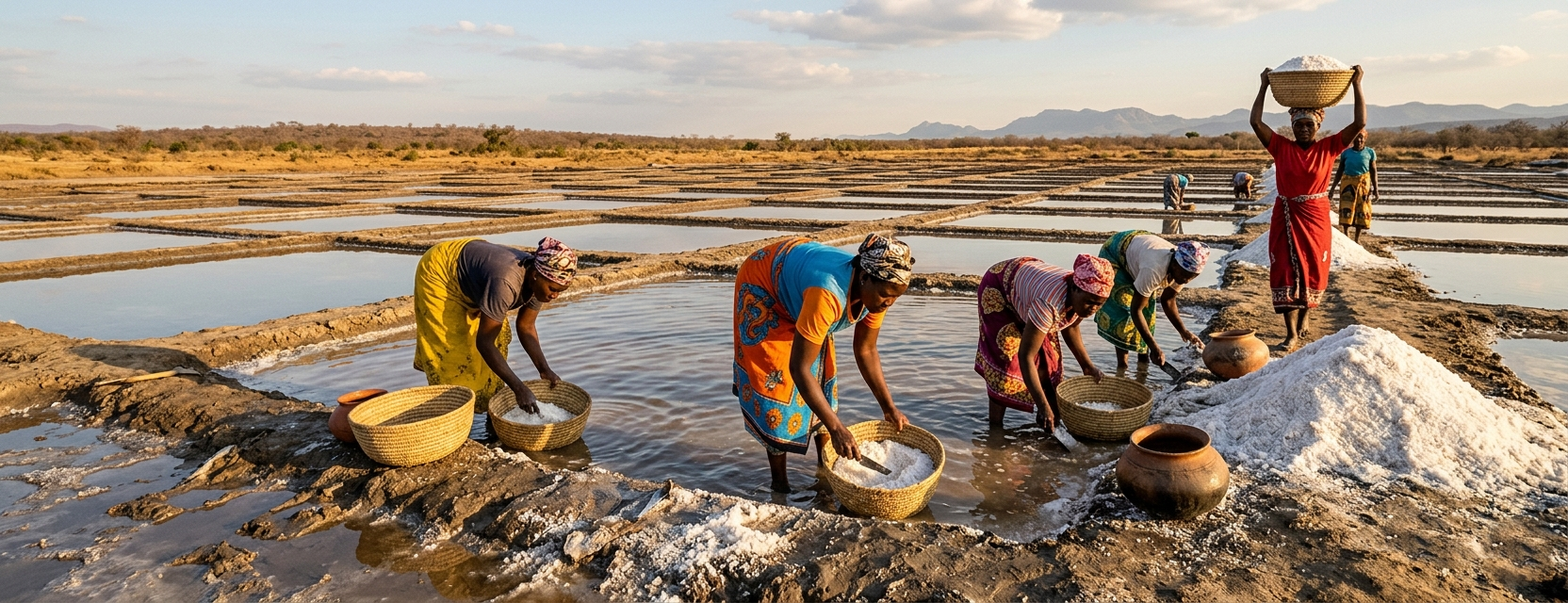
There is no way to scale this production without destroying what makes the salt valuable. Mechanization would alter the mineral profile. Chemical processing would strip away the very elements that distinguish Baleni salt from table salt. The only way to preserve the salt's integrity is to preserve the traditional methods.
Protected Source
Baleni has been declared a Natural Heritage Site, ensuring that the spring itself remains protected from industrial development. Three similar springs in the region were destroyed by development. Baleni remains a living example of what is lost when traditional knowledge and natural resources are sacrificed to progress.
Ethical Sourcing
The Baleni salt we make available is sourced directly from the Tsonga women who harvest it. They are compensated fairly for their labor. Their traditional knowledge is respected. Their methods are documented and preserved.
Appearance and Taste
Baleni salt has a characteristic slightly yellow hue, the natural color of unbleached, unrefined mineral salt. Its crystals are irregular, reflecting the hand-harvested, traditionally processed method of production.
The taste is salt, but with a depth and complexity that commercial salt lacks. Those familiar with natural salts often describe it as "rounder" or "fuller" than the sharp, one-dimensional taste of refined table salt.
Storage
Store in a cool, dry place away from direct sunlight. Because Baleni salt contains no anti-caking agents, it may clump slightly in humid conditions. This does not affect its quality. Simply break apart any clumps before use.
Shelf Life
Properly stored, Baleni salt remains potent indefinitely. As a mineral salt, it does not spoil or degrade. The traditional methods of harvesting and drying have preserved it for millennia; it will preserve for you as well.
Pricing & Availability
The Rotational Mineral Priming Program is the only way to access our rare, traditionally harvested full-spectrum mineral salts. We do not sell them separately. We reserve them for those committed to deep terrain repair and need more than surface-level support. People simply wanting to buy salts will not find what they need here. People ready to restore their terrain have found the right place. Beginners trying basic terrain restoration can start with Rift Valley Alkaline salt easily sourced from local markets and supermarkets across Kenya.
A Complete Mineral Tool for Terrain Restoration
Baleni Spring Salt is not a seasoning. It is not a luxury condiment. It is a therapeutic tool, an essential component of the Terrain Repair Method's second sequence.
After the fast clears the debris, the body must be restored before it can be replenished. That restoration requires minerals, not sodium alone, but the full spectrum of electrolytes and trace elements that human cells require.
Baleni salt provides that full spectrum. Two thousand years of continuous harvest stand behind it. The Tsonga women who produce it carry knowledge that cannot be found in laboratories or textbooks. The geothermal spring that feeds it delivers minerals that no industrial process can replicate.
Table salt cannot do this work. It was never designed to. It flavors food. It prevents iodine deficiency. It does not restore terrain.
Baleni salt does.
After you have fasted, after you have cleared what accumulated, give your body what it actually needs. Give it the complete minerals it has been waiting for. Give it Baleni Spring Salt.
Summary
| Attribute | Detail |
|---|---|
| Origin | Baleni geothermal spring, Limpopo Province, South Africa |
| Harvesting community | Tsonga women, Mahumani Traditional Authority |
| Harvest period | May to September (dry winter months) |
| Method | Hand-collected, traditionally filtered, boiled over open fires |
| Mineral profile | Full spectrum including Mg, K, Ca, Zn, Se, Fe, Mn, Cu, Cr, and trace elements |
| Role in protocol | Sequence Two: Terrain Renovation |
| Use | ¼-½ tsp in 500ml warm water after fasting |
The Terrain Repair Method
Cleanse. Restore. Replenish.
Baleni Spring Salt is a traditional food, not a medicine. It is not intended to diagnose, treat, cure, or prevent any disease. The information provided is for educational purposes based on traditional knowledge and our research. Consult your healthcare provider before beginning any fasting or dietary protocol.