
Lebek Salt
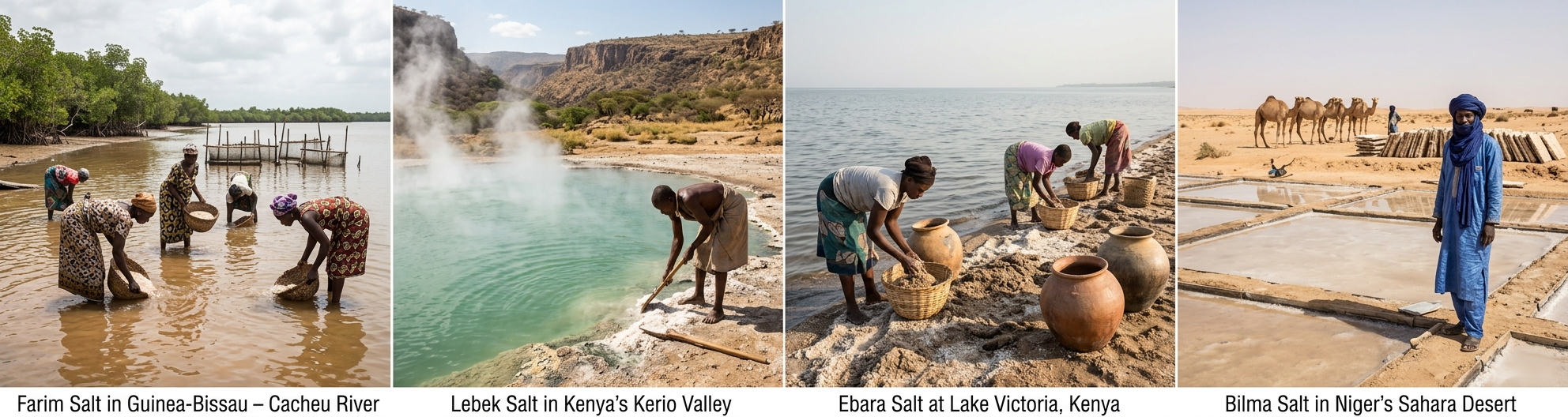
The Calcium-Rich Salt of Kerio Valley
Deep in the Kerio Valley, part of Kenya's Great Rift Valley system, hot springs bubble from the earth, carrying minerals from deep underground. The water emerges warm, saturated with elements dissolved during its journey through ancient geological formations. When the water evaporates, it leaves behind a salt with a remarkable mineral signature: the highest documented calcium concentration of any traditional salt in Kenya.
Lebek salt is not commercially produced. It is not found in supermarkets. It is harvested by local communities from the hot springs of the Kerio Valley, a remote and rugged region known for its dramatic landscapes and geothermal activity. The salt is a traditional food, gathered as it has been for generations, preserved as nature provided.
A Salt Born of Fire and Water
The Kerio Valley is part of the East African Rift System, where the earth's crust is thinning and volcanic activity has shaped the landscape for millions of years. Hot springs are common in such environments. Water percolates deep underground, where it is heated by geothermal energy and dissolves minerals from the surrounding rock. When this mineral-rich water returns to the surface, it carries the signature of the deep earth.
The geology of the Kerio Valley is complex. The region is underlain by volcanic rocks, including basalts and rhyolites, which are rich in calcium, magnesium, and other minerals. As hot water circulates through these formations, it leaches calcium and other elements, concentrating them over time.

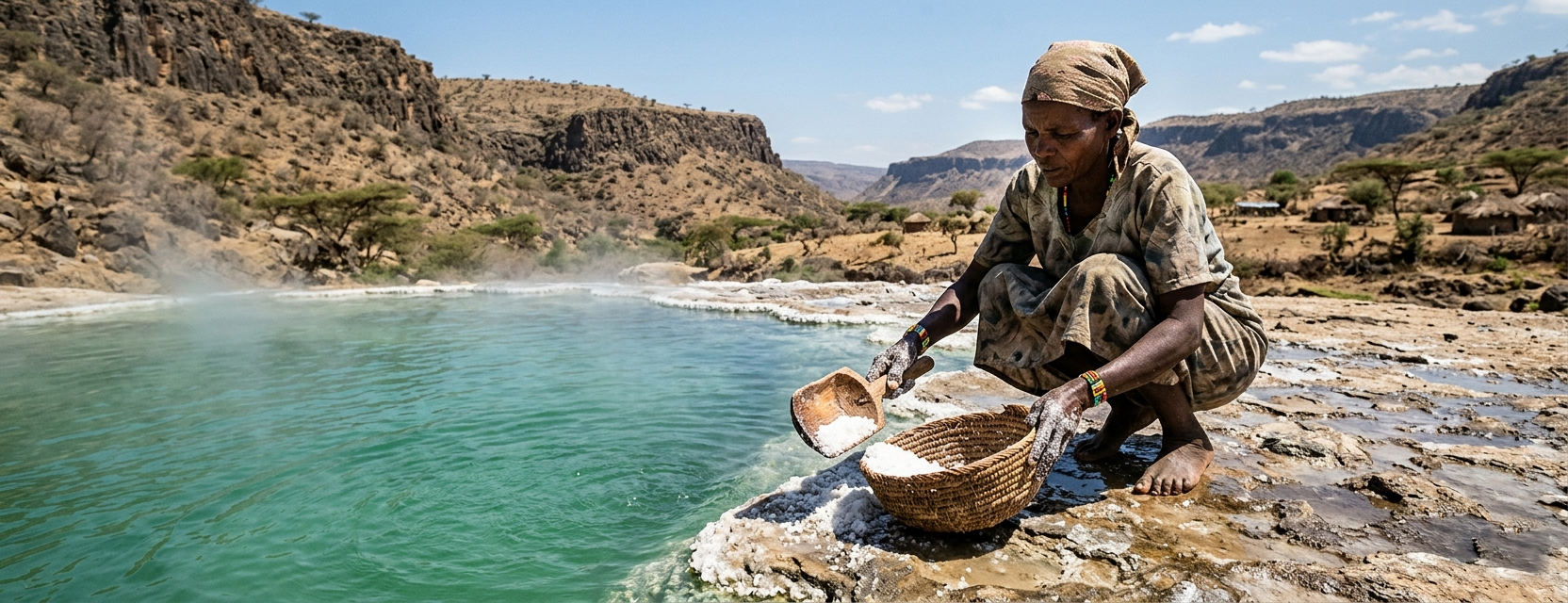
When the spring water evaporates, the dissolved minerals precipitate out, forming salt crusts along the edges of the hot springs. These crusts are collected by hand, traditionally processed, and used as a mineral-rich salt for both human and animal consumption.
Traditional Harvesting
The harvesting of Lebek salt has been practiced by communities in the Kerio Valley for generations. The knowledge of where to find the best springs, when to harvest, and how to process the salt has been passed down through families.
The hot springs are often located in remote areas, accessible only by foot or rough roads. During dry periods, water levels recede, exposing salt crusts along the spring edges. Harvesters collect these crusts by hand, gathering them into woven baskets or containers.
The traditional processing method is simple. The collected salt is dissolved in water to remove sand and debris. The solution is filtered through cloth. It is then boiled in clay pots or metal containers over open fires until the water evaporates, leaving behind purified salt crystals.
No chemicals are added. No industrial processing is applied. The salt is preserved as the spring deposited it.
Mineral Composition
What makes Lebek salt exceptional is its calcium content. Scientific analysis has documented calcium levels of 166.09 mg/g, the highest among the three traditional Kenyan salts studied alongside Ebara and Magadi .
| Mineral | Concentration (mg/g) | Role in the Body |
|---|---|---|
| Calcium | 166.09 | Bone health, cellular signaling, muscle contraction, nerve transmission |
| Iron | Present (comparatively higher than Magadi) | Oxygen transport, energy metabolism |
| Manganese | Present | Bone formation, antioxidant function, nutrient metabolism |
| Zinc | Present | Immune function, tissue repair, enzyme activation |
| Cobalt | Present | Vitamin B12 synthesis, red blood cell formation |
| Copper | Present | Connective tissue formation, neurotransmitter synthesis |
The heavy metal concentration in Lebek follows the order: Fe > Mn > Zn > Co > Cu > Pb > Cd . The presence of cobalt, like Ebara, is notable for its role in vitamin B12 synthesis.
Lebek salt is also highly alkaline, with pH values ranging from approximately 10.09 to 10.85 . This alkalinity is a natural property of the salt, derived from the carbonate and bicarbonate compounds present in the spring water.
The Calcium Advantage
Calcium is the most abundant mineral in the human body. It is essential for bone health, but its roles extend far beyond the skeleton.
| Function | Role of Calcium |
|---|---|
| Bone structure | 99% of body calcium is stored in bones and teeth |
| Cellular signaling | Calcium ions trigger intracellular responses to hormones and neurotransmitters |
| Muscle contraction | Calcium enables the sliding of muscle fibers |
| Nerve transmission | Calcium is required for neurotransmitter release |
| Blood clotting | Calcium is a cofactor in the coagulation cascade |
| Enzyme activation | Many enzymes require calcium as a cofactor |
Calcium deficiency is common, particularly in populations that avoid dairy or have limited access to calcium-rich foods. However, the conventional solution—calcium supplements—has limitations. Isolated calcium supplements can be poorly absorbed and may contribute to vascular calcification when taken without adequate magnesium and vitamin K.
Lebek salt offers calcium in its natural matrix, accompanied by magnesium, manganese, and other trace minerals that facilitate proper utilization. The calcium is not isolated. It is presented as nature intended, in the company of its synergistic partners.
Alkalinity and Carbonate Content
Lebek salt is a basic salt, meaning it is alkaline rather than neutral or acidic. Its alkalinity comes from carbonate (CO₃²⁻) and bicarbonate (HCO₃⁻) compounds. Research has documented Lebek's bicarbonate concentration at approximately 6.2%, lower than Magadi but still significant .
The alkalinity of Lebek salt has practical applications for terrain restoration. When dissolved in warm water and consumed after a fast, it helps buffer the acidity that accumulates during cellular cleanup. The carbonate and bicarbonate compounds neutralize acids, shifting the internal environment back toward balance.
This is not alkalinity through artificial additives or processed alkaline waters. It is alkalinity derived from the natural chemistry of the Kerio Valley's geothermal springs.
Role in the Terra Sequence
In the Terra method, Lebek salt serves a distinct role as a calcium-dominant complement to sodium-dominant and potassium-dominant salts.
| Phase | Application |
|---|---|
| Renovation (Phase Two) | Used as a rotating salt after fasting. Its calcium content supports cellular signaling and muscle function. |
| Rotation (Deepening Phase) | Introduced in month two or three to replenish calcium stores without the mineral competition issues of daily calcium supplements. |
| Maintenance | Used occasionally after the three-month program to maintain bone health and support ongoing cellular function. |
Unlike calcium supplements, which can interfere with magnesium and zinc absorption when taken daily, Lebek salt can be rotated. When used as part of a varied mineral rotation, it provides calcium without the risk of creating imbalances in other minerals.
How to Use Lebek Salt
For Terrain Renovation (After a Fast)
- Prepare 500ml of warm water (not boiling, comfortably warm to drink)
- Add one small pinch of Lebek salt (approximately the size of a small coin)
- Sip slowly over 10 to 15 minutes
- Wait two hours before consuming broth or food
For Daily Electrolyte Support (Non-Fasting Days)
- Add a pinch of Lebek salt to a glass of water
- Drink in the morning or as needed
- Use alongside sodium and potassium salts for balanced mineral intake
In Cooking
- Use as a finishing salt on vegetables, eggs, or meats
- The calcium content can affect the texture of some dishes; best used sparingly in cooking or as a table salt
Comparison: Lebek vs. Other Traditional Kenyan Salts
| Feature | Lebek (Kerio Valley) | Ebara (Lake Victoria) | Magadi (Lake Magadi) |
|---|---|---|---|
| Dominant mineral | Calcium (166.09 mg/g) | Potassium (2.69 mg/g) | Sodium (71.52 mg/g) |
| Secondary minerals | Iron, manganese, zinc | Iron, manganese, cobalt | Iron, cobalt, lead |
| Alkalinity (pH) | 10.09-10.85 | 10.08-10.88 | 9.98-11.26 |
| Carbonate content | Lower (11.8% wt/wt) | Highest (113.9% wt/wt) | Moderate (47.2% wt/wt) |
| Best for | Bone health, cellular signaling, muscle function | Potassium replenishment, pH restoration | Sodium replenishment, alkalinity |
Why Lebek Salt Is Rare
Lebek salt is not commercially produced. It is harvested by small-scale traditional communities in the Kerio Valley, a remote region of Kenya's Rift Valley. The hot springs are often located in areas with limited road access, accessible only to those who know the land.
Production is limited to what can be gathered by hand during dry periods when water levels recede. The salt is used primarily by local communities, with little surplus for trade. The traditional knowledge of where to harvest and how to process the salt is held by a small number of families.
There is no industrial production. No supply chain. No export market. Lebek salt is a local food, known primarily to the communities of the Kerio Valley and those who have sought it out specifically.
Appearance and Taste
Lebek salt has a whitish to light grey appearance, reflecting its natural, unprocessed state. It is not bleached. It is not treated with anti-caking agents. The crystalline structure is irregular, shaped by the traditional evaporation process.
The taste is salt, but with a distinct mineral character shaped by its high calcium content. Some describe it as smoother or less sharp than sodium-dominant salts. The alkalinity gives it a slightly different mouthfeel when dissolved in water.
When dissolved in warm water, it produces an alkaline solution that feels different on the tongue than common salt water.
Storage
Store Lebek salt in a cool, dry place away from direct sunlight. Because it contains no anti-caking agents, it may clump slightly in humid conditions. This does not affect quality. Simply break apart any clumps before use.
Properly stored, Lebek salt remains stable indefinitely. As a mineral salt, it does not spoil or degrade.
A Note on Lead Content
Scientific analysis has documented the presence of lead in Lebek salt, as well as in Ebara and Magadi salts, at levels higher than minimum detection limits . This is not unique to Lebek. Lead is a naturally occurring element found in soils and rocks throughout the Rift Valley region. It is not added. It is not a contaminant from industrial activity.
For context, the lead levels documented in these traditional salts reflect the natural geology of the region. The Rift Valley is volcanically active, and volcanic rocks often contain trace amounts of heavy metals. The same geology that provides beneficial minerals like calcium, magnesium, and iron also provides trace amounts of less desirable elements.
Terra tests all salts for heavy metals. The decision to offer a salt depends on whether the benefits outweigh the risks. For most individuals, the mineral replenishment provided by Lebek salt offers substantial benefits. Individuals with specific concerns about heavy metal exposure should consult their healthcare provider.
Summary
| Attribute | Detail |
|---|---|
| Origin | Kerio Valley hot springs, Kenya (Great Rift Valley) |
| Harvesting community | Local communities in the Kerio Valley region |
| Harvest period | Dry season when water levels recede |
| Method | Hand-collected from hot spring edges, dissolved, filtered, boiled |
| Dominant mineral | Calcium (166.09 mg/g) |
| Key trace minerals | Iron, manganese, zinc, cobalt, copper |
| Alkalinity | pH 10.09-10.85 (alkaline) |
| Carbonate content | 11.8% wt/wt |
| Role in protocol | Phase Two: Terrain Renovation; Rotation deepening phase |
| Best for | Calcium replenishment, bone health, cellular signaling, muscle function |
| Use | 1 pinch in 500ml warm water after fasting; wait two hours before broth |
Terra is an educational framework. It is not a medical treatment, diagnosis, or cure. Consult your healthcare provider before beginning any fasting or dietary protocol. Individual results vary.