
Farim Salt
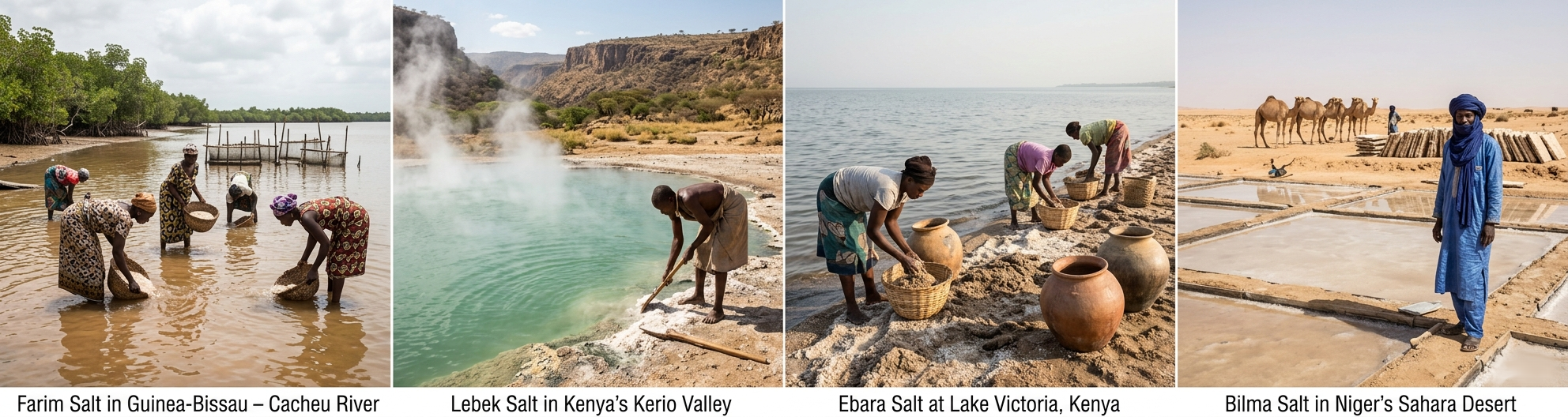
The Women-Harvested Salt of the Cacheu River
In the small village of Farim in northern Guinea-Bissau, more than one hundred kilometers from the Atlantic coast, women have been harvesting salt for generations. The Cacheu River, a marine inlet that reaches deep inland, brings saltwater far from the ocean, creating a basin of brackish water where salt forms naturally during the dry season.
Farim salt is not an industrial product. It is not made in evaporation ponds owned by multinational corporations. It is scraped by hand from riverbeds, filtered through cloth, and boiled over fires fueled by mangrove wood. The salt is produced almost entirely by women, who have turned a devastating environmental change—the salinization of former rice fields—into a source of livelihood and economic independence.
The salt is so distinctive that it has been recognized as a Slow Food Presidium, an international designation that protects traditional foods at risk of extinction. It is highly appreciated in the region, sold at local markets, and sought after by those who understand the value of salt that has not been stripped, bleached, or chemically treated.
A Salt Born of a Sea That Reaches Inland
The Cacheu River is not an ordinary river. It is a sea canal, a marine inlet that pushes far into the interior of Guinea-Bissau. The stretch from Farim to the Atlantic Ocean is saltwater, subject to the ebb and flow of the tides. This geological quirk is what makes Farim salt possible. Despite being located more than one hundred kilometers from the coast, Farim sits on a body of water that is essentially an extension of the sea.

The salt forms on the exposed surface of the riverbed between November and May, the dry season when the tide ebbs and a hot, dry wind blows from the east. As the water retreats, it leaves behind a crust of salt on the riverbed and on the mangroves that line its banks. This salt crust is collected by women who walk to the river, often from villages located several kilometers away.
When Rice Fields Turned to Salt
The story of Farim salt is also a story of resilience. The region was once known for rice cultivation. The bolanhas, or rice fields, were irrigated with fresh water from the river. But over time, less fresh water flowed down from inland. The salty waters from the ocean pressed onward. The rice fields disappeared. The main source of income was lost.
The women of the region, particularly those from the village known as K3 (located three kilometers from Farim, hence the name), turned necessity into opportunity. They discovered that the silt left behind by the retreating waters had a high salt content. They began collecting the silt, carrying it home, filtering it with water from deep wells, and boiling it to produce high-quality salt.
What began as a response to ecological disaster became a thriving tradition. The women organized themselves into associations. The most prominent, Aprosal, was founded in 1994 and now has over 500 members divided into five different production centers. Today, approximately 25 families in the K3 area alone have found a reasonable source of income from salt production. As Djombo Fode Touré, the daughter of the traditional chief, told visiting journalists: "Do not count on others, simply trust your own strength".
The Women Who Make the Salt
Salt harvesting in Farim is almost exclusively women's work. The women walk to the river, sometimes carrying the salty soil for up to five kilometers to their villages. They filter the collected material through pieces of fabric stretched over wooden frames. More rarely, they use pierced clay pots as filters.
The filtered brine is then boiled in large, flat metal pans over fires fueled by mangrove wood. Each boiling session produces approximately six kilograms of high-quality salt. The pans themselves are often made from materials left behind by the Portuguese colonial army, repurposed for traditional salt production.
The work is exhausting. Women haul water for vegetable gardens, sell harvests at markets, cook, and care for children. The salt harvest is an addition to these responsibilities, not a replacement. Yet the women have organized themselves effectively. In Farim, the association Aprosal has a meeting room with a blackboard. It serves as a workspace for organizing activities and as a classroom where women learn the rudiments of writing and calculation.
Traditional Harvesting Process
- Collection. During the dry season, from November to May, women walk to the riverbed where the ebbing tide has left a white crust of salt on the exposed surface. They scrape the salty soil from the riverbed and from around the mangroves, collecting it in containers.
- Transport. The collected material must be transported back to the village. Some women travel up to five kilometers each way, carrying heavy loads.
- Filtration. The salty soil is filtered through fabric stretched over wooden frames. The cloth acts as a sieve, allowing the salt to pass through while trapping sand and larger particles. A less common method uses pierced clay pots as filters.
- Boiling. The filtered brine is poured into large, flat metal pans and boiled over fires fueled by mangrove wood. The boiling process accelerates evaporation. Once the water has evaporated completely, pure dried salt remains on the bottom of the pans.
- Yield. Each boiling session produces approximately six kilograms of salt.
The Slow Food Presidium
Farim salt has been recognized as a Slow Food Presidium, an international designation that protects traditional foods at risk of extinction. Slow Food has three active salt Presidia in Africa: Farim salt in Guinea-Bissau, cane salt from the Nzoia River in Kenya, and Zerradoun salt in Morocco.
The Presidium status provides a specification that describes the traditional process of salt cultivation and certifies the commitment of women to environmental protection. The establishment of the Presidium has also brought international attention. Representatives of the Farim salt producers have attended the Terra Madre event in Turin, Italy, multiple times, sharing their traditional knowledge with a global audience.
Sustainability and Environmental Challenges
The traditional method of boiling brine over mangrove wood fires has had a negative impact on mangrove forests. Mangrove wood is becoming increasingly difficult to find, and its collection is one of the causes of deforestation in the region. Nonprofit organizations and the Slow Food Presidium have been promoting more sustainable methods of salt extraction, using evaporation ponds instead of boiling.
The evaporation pond method uses shallow artificial ponds where brine is left to evaporate naturally under the sun. This eliminates the need for mangrove wood fuel and reduces the environmental impact of salt production. The women are now beginning to adopt this more efficient and profitable method, though the traditional boiling method continues in some areas.
A reforestation effort for mangroves is also underway. The Slow Food Presidium encourages natural evaporation in shallow terracotta basins as a substitute for boiling, addressing both environmental and health concerns associated with smoke from open fires.
Iodization and Health
Iodine deficiency is a serious public health issue in Guinea-Bissau, as it is in much of inland Africa. The women of K3, under the leadership of Djombo Fode Touré, organized themselves into an association that secured funds from a development organization. They used these funds to purchase a machine that adds iodine to the salt.
This is essential. Iodine deficiency causes goiter, developmental delays, and cognitive impairment. By iodizing their salt, the women of Farim have transformed a traditional food into a public health intervention. The association now produces approximately 5,000 kilograms of salt per year, which is very popular in the markets of Bissau.
Mineral Composition
Detailed mineral analysis of Farim salt is not widely available in public sources. However, as a salt produced from marine inlet water, it contains the full spectrum of minerals found in seawater: sodium, chloride, magnesium, potassium, calcium, and trace elements. The salt is described as "high quality" by local producers and is highly appreciated in the region.
The modern iodization process ensures that the salt provides a reliable source of iodine, addressing the deficiency that is common in inland populations.
| Feature | Farim Salt | Commercial Table Salt |
|---|---|---|
| Source | Cacheu River marine inlet | Industrial evaporation ponds or mines |
| Harvesters | Women, traditional associations | Industrial workers |
| Processing | Hand-collected, cloth-filtered, boiled | Mechanized, often chemically treated |
| Iodine | Naturally occurring plus added via iodization machine | Artificially added (in most countries) |
| Additives | None | Anti-caking agents, sometimes sugar |
Cultural Significance
Farim salt is not merely a commodity. It is a source of economic independence for women in a country where political instability has brought the nation close to bankruptcy. The salt associations have enabled women to buy food, clothing for their children, and pay for schooling. As Tambelo, a producer from Ranomay, described in a parallel context, salt production is "a real support for our household."
The work has also fostered a spirit of community. The associations emphasize mutual help and solidarity, recognizing that salt production requires coordinated efforts. As Fatoumata Touré, the president of Aprosal, has demonstrated through her leadership, the women of Farim are not passive recipients of aid. They are entrepreneurs who have built a sustainable industry from the remnants of failed rice cultivation.
Role in the Terra Sequence
In the Terra method, Farim salt serves as a traditional marine salt with the added benefit of iodization.
| Phase | Application |
|---|---|
| Renovation (Phase Two) | Used as a primary or rotating salt after fasting. Provides full-spectrum marine minerals with reliable iodine content. |
| Rotation | Complements volcanic salts (Boke, Lebek) and plant-ash salts (Omo) with a marine mineral profile. |
| Maintenance | Suitable for ongoing daily use as a traditional, unrefined salt. |
Unlike many marine salts, which are industrially produced and stripped of trace elements, Farim salt is harvested using traditional methods that preserve the natural mineral matrix. The added iodization addresses a critical nutritional gap for inland populations.
How to Use Farim Salt
For Terrain Renovation (After a Fast)
- Prepare 500ml of warm water
- Add one small pinch of Farim salt (approximately the size of a small coin)
- Sip slowly over 10 to 15 minutes
- Wait two hours before consuming broth or food
For Daily Use (Non-Fasting Days)
- Use as a table salt or cooking salt
- Because the production process is artisanal, salt crystals may be larger or more irregular than commercial salt; grind if finer texture is desired
In Cooking
- Use as a finishing salt or in cooking
- The marine mineral profile adds depth to soups, stews, and vegetable dishes
Why Farim Salt Is Rare
Farim salt is rare because its production is limited by geography and traditional methods. The salt forms only during the dry season, from November to May. The harvest is dependent on the ebb of the tide and the hot east wind that accelerates evaporation.
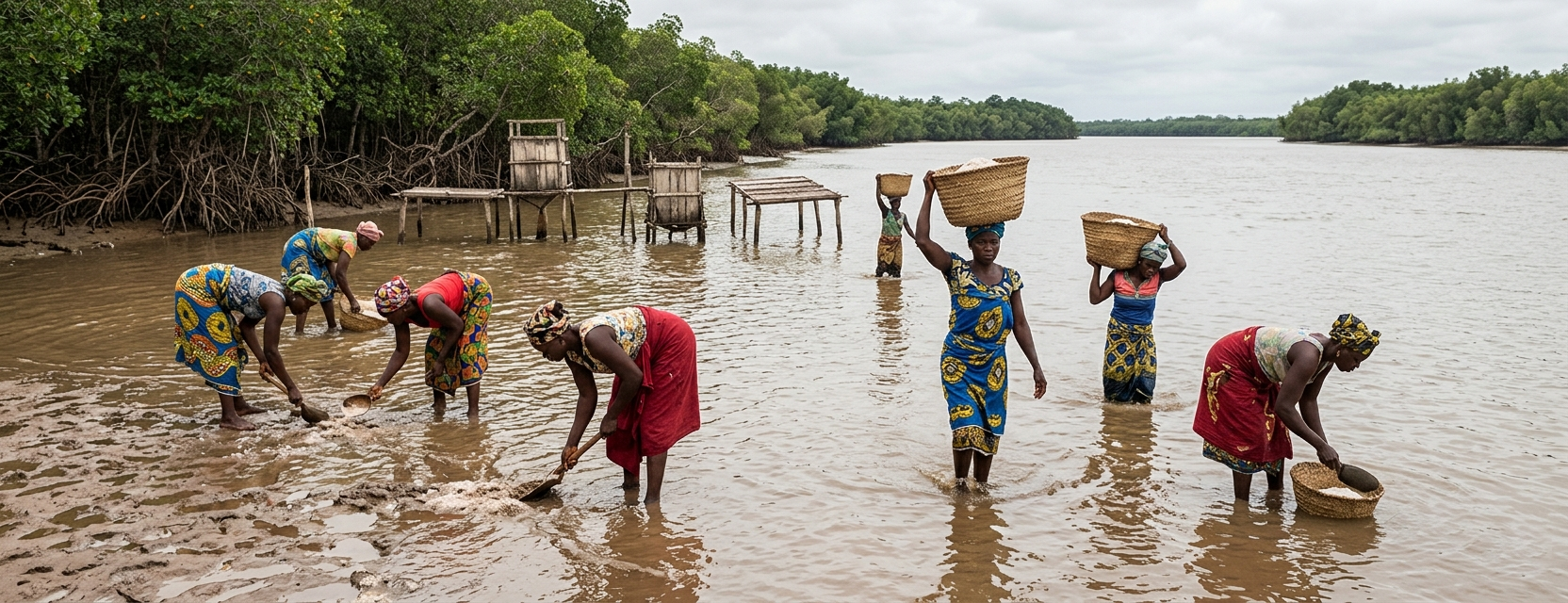
The traditional method is labor-intensive. Women scrape the salt, transport it, filter it, and boil it. Even with the adoption of evaporation ponds, total production remains small. The association produces approximately 5,000 kilograms of salt per year, a tiny fraction of industrial salt output.
The salt is sold primarily at local markets in Guinea-Bissau. It does not have an international distribution network. It is a local product, known to those who live near the Cacheu River and to Slow Food affiliates worldwide.
Appearance and Taste
Farim salt is described as high quality, pure, and crystalline. The crystals are formed through traditional boiling or natural evaporation, giving them an irregular, artisanal appearance. The salt is not bleached. It retains the natural color of unrefined marine salt: white to off-white, with possible variations depending on the specific harvest location.
The taste is salt, but with the complexity characteristic of unrefined marine salts. The presence of trace minerals gives it a rounder, fuller flavor than industrially produced table salt.
Storage
Store Farim salt in a cool, dry place away from direct sunlight. Because it contains no anti-caking agents, it may clump slightly in humid conditions. This does not affect quality. Simply break apart any clumps before use.
Properly stored, Farim salt remains stable indefinitely. As a mineral salt, it does not spoil or degrade.
Summary
| Attribute | Detail |
|---|---|
| Origin | Cacheu River, Farim village, Oio region, Guinea-Bissau |
| Harvesting community | Women's associations (Aprosal, 500+ members across five production centers) |
| Harvest period | November to May (dry season), peak from February to May |
| Method | Hand-scraped from riverbed, cloth-filtered, boiled or evaporated |
| Key feature | Marine salt from inland sea canal; Slow Food Presidium; iodized |
| Best for | Marine mineral profile, iodine supplementation, women-led ethical sourcing |
| Role in protocol | Phase Two: Terrain Renovation; Rotation component |
| Use | 1 pinch in 500ml warm water after fasting; wait two hours before broth |
| Sustainability | Transition from boiling to evaporation ponds; mangrove reforestation underway |
Terra is an educational framework. It is not a medical treatment, diagnosis, or cure. Consult your healthcare provider before beginning any fasting or dietary protocol. Individual results vary.