
Bilma Niger Salt
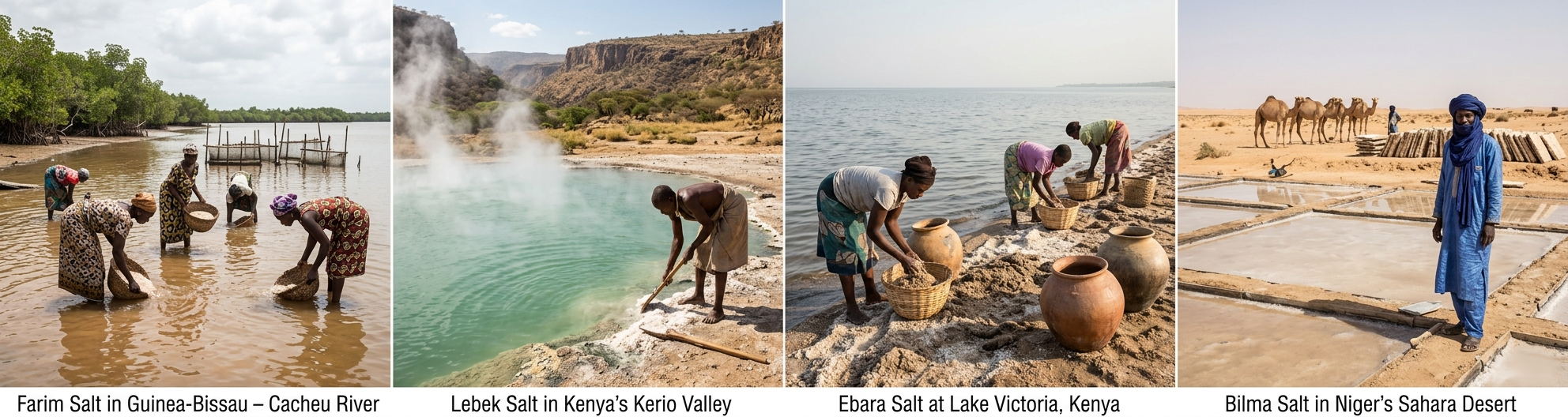
The Naturally Iodized Salt of the Sahara
In the northeastern corner of Niger, deep in the Sahara Desert, there is a salt that has been traded across the continent for centuries. The town of Bilma sits at the heart of a salt-producing region where traditional methods have remained unchanged for generations. Here, in one of the harshest environments on earth, salt is dug by hand from hundreds of pits, formed into slabs, and transported across the desert by camel caravan.
Bilma salt is not ordinary. Local traditional authorities claim it is naturally approximately 90 percent iodized, distinguishing it from most other traditional salts, which require artificial iodization. The salt forms in the Kalala salt pans, a series of shallow basins where water from underground springs evaporates under the Saharan sun, leaving behind mineral-rich deposits.
The salt has been a currency of the Sahara for centuries. Caravans once traveled thousands of miles, carrying Bilma salt south to exchange for gold, slaves, and other goods. Today, the trade continues, though it is threatened by armed gangs, smugglers, and the instability that plagues the region. Bilma salt remains rare, not because it is scarce, but because accessing it is dangerous.
A Salt Born of Extreme Conditions
The Bilma region lies within the Djado Plateau, a vast and desolate expanse of sand, rock, and salt. The climate is hyper-arid. Rainfall is almost nonexistent. Temperatures regularly exceed 45 degrees Celsius (113 degrees Fahrenheit). Water is scarce, but underground springs fed by ancient aquifers rise to the surface, carrying dissolved minerals from deep beneath the desert.
The salt pans of Kalala are the primary source of Bilma salt. These pans are shallow depressions where spring water collects and evaporates. As the water evaporates under the intense desert sun, the dissolved minerals precipitate out, forming salt crusts on the surface.
What makes Bilma salt unusual is its natural iodine content. Most salts contain little to no iodine unless artificially fortified. Bilma salt, according to local traditional authorities, is approximately 90 percent naturally iodized. This claim has not been extensively studied by modern science, but it is consistent with the salt's reputation as a health-promoting resource in a region where iodine deficiency is common.
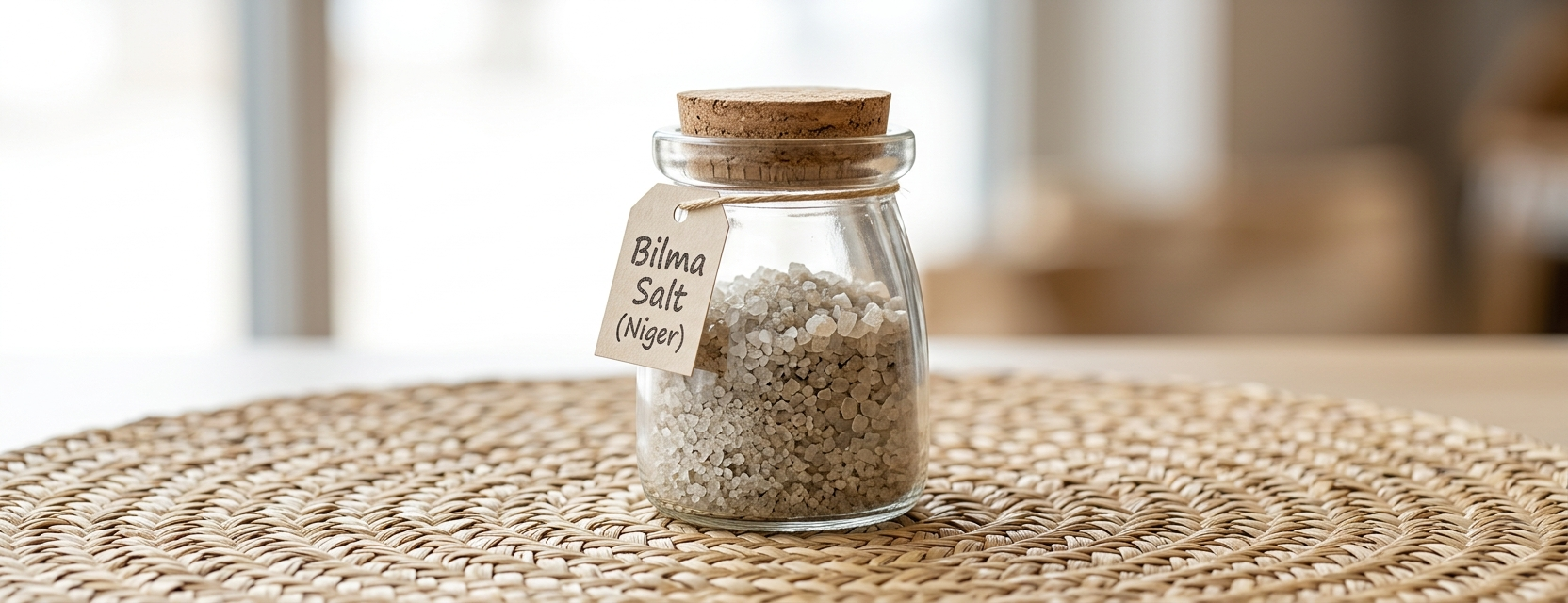
The iodine likely comes from the underground aquifers that feed the springs. These aquifers pass through ancient marine deposits, where iodine accumulates naturally. The water carries this iodine to the surface, where it concentrates in the salt as the water evaporates.
Centuries of Traditional Harvesting
Salt harvesting at Bilma has been practiced for over a thousand years. The methods have changed little. The salt is still dug by hand from pits, still processed using traditional techniques, and still transported by camel.
The salt pits are scattered across the salt pans. They are dug into the ground, reaching down to the water table where brine accumulates. The brine is drawn up and channeled into shallow evaporation basins, where it is left to dry in the sun. As the water evaporates, salt crystals form and are scraped from the surface.
The salt is then formed into slabs using date palm molds. These slabs, known as "Kantauri" or "kel" in the local Tebu language, are rectangular blocks of compressed salt, hardened by the sun. Each slab weighs approximately 1.5 to 2 kilograms.
The slabs are stacked and tied to camels for the long journey across the desert. The traditional salt caravans, known as "Azalai," once numbered thousands of camels. Today, the caravans are smaller, but the method remains the same.
The Azalai: Salt Caravans of the Sahara
The salt trade has been the lifeblood of the Bilma region for centuries. The salt was carried south across the Ténéré Desert, through the Aïr Mountains, and onward to markets in Agadez, Zinder, and beyond. In exchange, the salt caravans brought back grain, cloth, tools, and other goods that the desert could not provide.
The journey is brutal. The Ténéré is one of the most inhospitable deserts on earth. There is no shade. Water is scarce. Temperatures are extreme. Navigation depends on the stars and on the knowledge passed down through generations of caravan guides.
The caravans still run today, though they are smaller and less frequent. The salt is still carried by camels. The journeys still take weeks. The conditions are unchanged. But the region is now plagued by insecurity. Armed gangs, smugglers, and bandits control parts of the route. Travel is dangerous. Some caravans have been robbed. Some drivers have been killed.
This insecurity is why Bilma salt remains rare. Not because the salt is scarce, but because accessing it requires crossing some of the most dangerous terrain on the continent.
Mineral Composition
Scientific analysis of Bilma salt is limited. The region is remote and access is difficult. Most of what is known about the salt comes from traditional knowledge and observational reports rather than systematic laboratory studies.
What is known:
- Naturally iodized. Local traditional authorities claim the salt is approximately 90 percent naturally iodized. If accurate, this makes Bilma salt unique among African traditional salts. Iodine is essential for thyroid function, and iodine deficiency is widespread in inland regions, including much of Africa.
- Sodium chloride dominant. Like most desert salts, Bilma salt is primarily sodium chloride. The iodine content is what distinguishes it from other desert salts.
- Slab form. The salt is compressed into solid slabs. This allows for easy transport and storage. The slabs must be broken or ground before use.
The mineral profile likely includes trace elements from the ancient marine deposits that underlie the Sahara. These may include magnesium, calcium, potassium, and other minerals, though specific concentrations have not been well documented.
The Iodine Advantage
Iodine is an essential nutrient. The thyroid gland uses iodine to produce thyroid hormones, which regulate metabolism, growth, and development. Iodine deficiency is the leading cause of preventable intellectual disability worldwide.
| Consequence of Iodine Deficiency | Population Affected |
|---|---|
| Goiter (enlarged thyroid) | All |
| Hypothyroidism | All |
| Fatigue, weight gain, cold intolerance | All |
| Cognitive impairment | Children |
| Developmental delays | Fetuses and infants |
| Cretinism (severe deficiency) | Fetuses and infants |
Iodine deficiency is common in inland regions, where soils have been depleted of iodine by ancient glaciation and flooding. Kenya, like much of East Africa, is an iodine-deficient region. The Rift Valley, in particular, has low iodine levels in its soils, which is why iodized salt is mandatory in Kenya.
Bilma salt offers a natural source of iodine. Unlike commercially iodized salt, which uses artificially added potassium iodide, Bilma salt contains iodine in its natural form, derived from the ancient marine deposits that underlie the Sahara. The iodine is part of the salt's natural matrix, not a later addition.
This matters because artificially iodized salt has limitations. Iodine can degrade over time, especially when exposed to heat, light, or humidity. Commercially iodized salt loses potency during storage. Naturally iodized salt, with iodine integrated into the crystal structure, may be more stable.
Iodine and Thyroid Function
The thyroid gland is the body's metabolic regulator. Thyroid hormones control the rate at which cells use energy. When iodine is deficient, the thyroid cannot produce enough hormone. The body slows down. Fatigue increases. Weight becomes difficult to manage. Body temperature regulation is impaired. Mental function declines.
For participants in the Terra program, adequate iodine is essential for full metabolic restoration. The three-month protocol includes salts that address magnesium, calcium, potassium, and trace elements. Iodine is often overlooked. Boke salt provides some iodine. Bilma salt would provide substantially more.
For healthy participants seeking deep terrain restoration as a preventative measure, iodine supports:
- Metabolic rate. Adequate iodine allows the thyroid to produce sufficient hormone, supporting healthy energy levels and weight management.
- Cognitive function. Thyroid hormone is essential for brain function. Deficiency is associated with brain fog, memory problems, and slowed thinking.
- Body temperature regulation. Iodine deficiency can cause cold intolerance. Restoring iodine helps normalize temperature regulation.
- Hormonal balance. Thyroid hormone interacts with other hormonal systems. Deficiency can disrupt menstrual cycles, fertility, and adrenal function.
Role in the Terra Sequence
In the Terra method, Bilma salt would serve as a strategic tool for thyroid support and iodine replenishment.
| Phase | Application |
|---|---|
| Renovation (Phase Two) | Used as a rotating salt after fasting. Its iodine content supports thyroid recovery during the three-month program. |
| Rotation (Deepening Phase) | Introduced in month two or three to address iodine deficiency, which is common in inland populations. |
| Thyroid-specific support | For participants with known thyroid conditions or symptoms of hypothyroidism, Bilma salt could be used more frequently. |
Unlike iodized table salt, which is a modern industrial product, Bilma salt is a traditional food. It provides iodine in the context of a complete mineral matrix, not as an isolated additive. The iodine is accompanied by sodium, chloride, and trace elements from the Saharan salt pans.
How to Use Bilma Salt
For Terrain Renovation (After a Fast)
- Prepare 500ml of warm water
- Add a small pinch of ground Bilma salt (approximately the size of a small coin)
- Sip slowly over 10 to 15 minutes
- Wait two hours before consuming broth or food
Note: Bilma salt is usually sold in solid slabs. It must be broken and ground before use. A mortar and pestle or a grinder can be used to reduce the salt to a granular form.
For Daily Thyroid Support (Non-Fasting Days)
- Add a pinch of Bilma salt to food or water
- Use sparingly. A little provides significant iodine.
In Cooking
- Grind the salt before use
- Use as a finishing salt or in cooking
- The iodine content may be reduced by prolonged high heat; best used toward the end of cooking or as a table salt
Why Bilma Salt Is Rare
Bilma salt is rare for reasons that have nothing to do with scarcity. The salt is abundant. The salt pans of Kalala produce salt continuously. The limiting factor is access.
The region is remote. Bilma is located in northeastern Niger, far from any major city. The roads are poor. The desert is vast. The journey from the capital, Niamey, takes weeks.
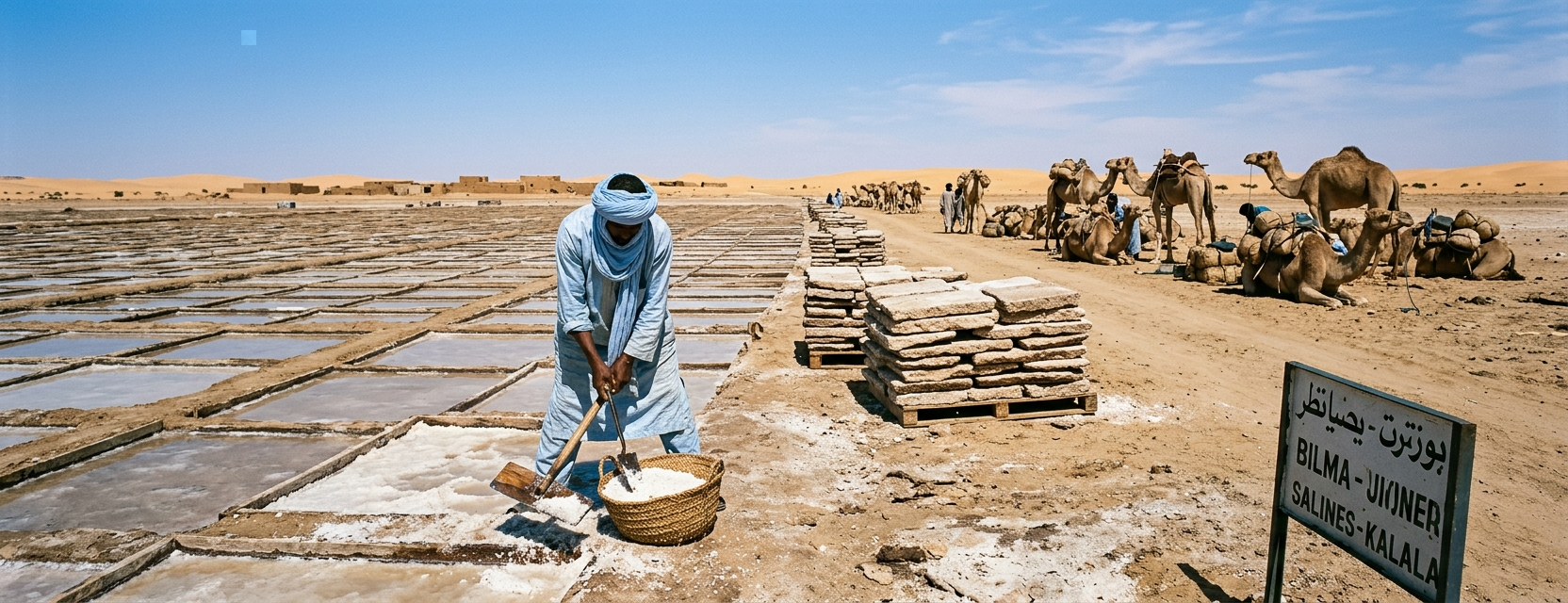
The region is insecure. Armed groups operate in the area. Bandits target caravans and travelers. The salt trade has become dangerous. Some caravans have been robbed. Some drivers have been killed. The insecurity has reduced the flow of salt to a trickle.
The traditional salt caravans are dying. There are no trucks. There are no modern alternatives. The salt is still carried by camels, as it has been for centuries. But fewer young men are willing to risk the journey.
Bilma salt is rare because the people who harvest and transport it are endangered. The salt trade survives, but only barely.
Appearance and Taste
Bilma salt is sold in solid slabs, rectangular blocks shaped by date palm molds. The slabs are greyish-white to light brown, reflecting the natural color of the unrefined salt. The surface is rough, slightly pitted, and may contain small dark specks from the traditional processing method.
The taste is salt, but with a distinct mineral character shaped by the iodine and trace elements of the Saharan salt pans. Some describe it as earthier or more complex than commercial salt. The iodine content gives it a slightly different flavor profile.
When ground, the salt is coarser than table salt, with irregular crystals. It does not flow as freely as commercially processed salt because it contains no anti-caking agents.
Storage
Store Bilma salt in a cool, dry place away from direct sunlight. Whole slabs can be stored for years without degradation. Ground salt should be stored in an airtight container to prevent clumping in humid conditions.
Properly stored, Bilma salt remains stable indefinitely. As a mineral salt, it does not spoil or degrade. The iodine content may slowly degrade over very long periods, but this is not a practical concern for normal use.
The Insecurity Factor
It would be dishonest to present Bilma salt without addressing the reality of its origin. The region is dangerous. Armed groups control parts of the area. Travel is risky. The salt caravans face robbery, violence, and extortion.
Terra does not source Bilma salt directly. We do not have a relationship with harvesters in Niger. We cannot guarantee the safety of those who produce it. We cannot guarantee the purity of salt that comes from a conflict zone.
This article is informational. It documents the existence and properties of Bilma salt for educational purposes. It is not an offer to sell Bilma salt. If Bilma salt becomes available through safe, ethical channels in the future, that may change. At present, it remains a salt of historical interest, a reminder of what is lost when traditional knowledge and ancient trade routes are destroyed by violence.
Summary
| Attribute | Detail |
|---|---|
| Origin | Kalala salt pans, Bilma, Niger (Sahara Desert) |
| Harvesting community | Local Tebu and Tuareg communities |
| Harvest method | Dug from pits, evaporated in sun, formed into slabs |
| Key feature | Naturally iodized (approximately 90% according to local authorities) |
| Form | Solid slabs formed in date palm molds |
| Transport | Camel caravan across the Sahara (Azalai trade route) |
| Role in protocol | Phase Two: Terrain Renovation; Thyroid support |
| Best for | Iodine replenishment, thyroid function, metabolic restoration |
| Availability | Very rare, conflict zone, not commercially sourced by Terra |
| Use | Grind slabs; 1 pinch in 500ml warm water after fasting; wait two hours before broth |
Terra is an educational framework. It is not a medical treatment, diagnosis, or cure. Consult your healthcare provider before beginning any fasting or dietary protocol. Individual results vary. Terra does not currently source Bilma salt due to insecurity in the region. This article is for informational purposes only.