
Rift Valley Alkaline Salt
The Accessible Starting Point for Terrain Restoration
There is a place in Kenya's Great Rift Valley where the earth has been depositing mineral-rich salts for millennia. The lakes here are alkaline, fed by hot springs that rise from deep underground, carrying a unique mineral profile shaped by the volcanic geology of the region.
The Rift Valley is a geological wonder. Stretching from northern Kenya through to Tanzania, it is a place where the earth's crust has thinned, allowing mineral-rich waters to rise from deep underground. The alkaline lakes of this region, including Lake Magadi, Lake Bogoria, and Lake Elementaita, are so saline that they form natural salt crusts along their shores.
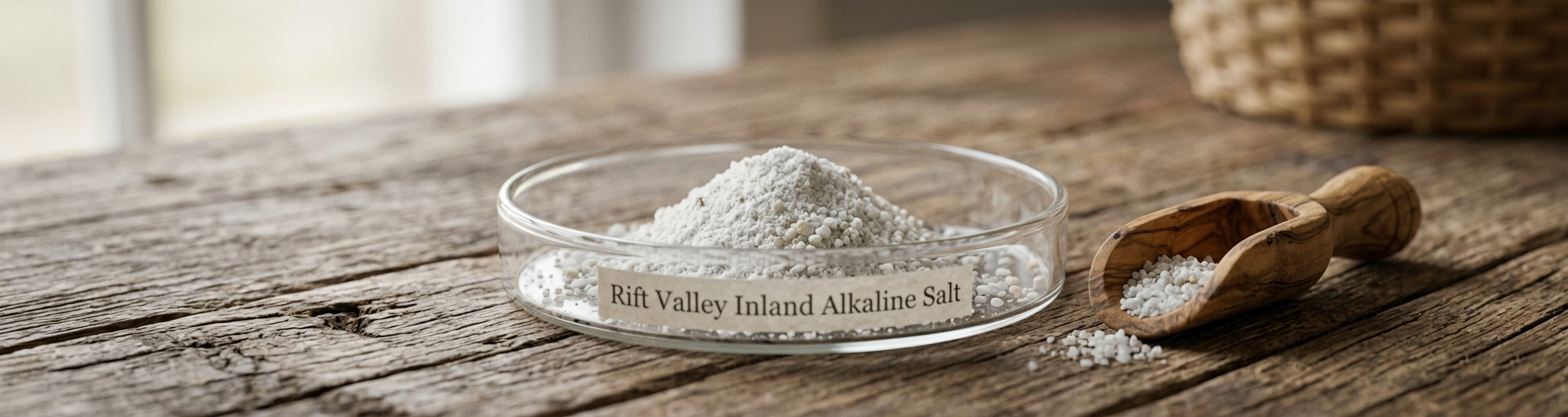
This is where Rift Valley Alkaline Salt comes from. And in the Terrain Fix Method, it serves a specific function: providing an accessible starting point for novices who want to try basic terrain restoration.
A Landscape Shaped by Fire and Time
The Great Rift Valley was formed over millions of years as the earth's crust pulled apart. Volcanic activity accompanied this process, leaving behind a landscape rich in minerals. Hot springs fed by underground geothermal systems brought these minerals to the surface, creating alkaline lakes with unique chemical compositions.
Lake Magadi, one of the most famous alkaline lakes in the Rift Valley, has been a source of salt for generations. The lake is so saturated with minerals that salt crystals form naturally along its edges, particularly during the dry season when water levels recede.
Unlike industrial salt operations that strip minerals away, the alkaline lakes of the Rift Valley produce salt that retains a broad mineral profile, including sodium, potassium, magnesium, calcium, and trace elements unique to the volcanic geology of the region.
Why Alkaline Salt?
The term "alkaline" refers to the pH of the salt and the water from which it comes. Alkaline salts have a higher pH than neutral table salt, meaning they are less acidic. This matters for terrain restoration.
After a period of fasting, the body can become acidic. The release of stored toxins and the breakdown of cellular debris create an acidic internal environment. An alkaline salt helps buffer this acidity, moving the terrain back toward neutral.
Rift Valley Alkaline Salt is naturally alkaline due to the high concentration of minerals like sodium carbonate and bicarbonate present in the lake waters. This alkalinity is not added. It is a natural property of the salt itself.
Mineral Composition
While Rift Valley Alkaline Salt does not contain the full spectrum of trace minerals found in rare salts like Baleni, it offers a solid foundation of major electrolytes essential for basic terrain restoration.
| Mineral | Role in the Body |
|---|---|
| Sodium | Fluid balance, nerve transmission, muscle function |
| Potassium | Cellular communication, blood pressure regulation, heart function |
| Magnesium | Muscle relaxation, nerve function, energy production |
| Calcium | Bone health, cellular signaling, muscle contraction |
| Bicarbonate | pH buffering, alkalizing the internal environment |
| Trace elements | Small amounts of iron, zinc, and other minerals from volcanic geology |
This is not a stripped-down table salt. It is a natural, unrefined salt that retains what the lake deposited. It may not have the full complexity of a geothermal spring salt like Baleni, but it offers more than enough for basic restoration.
Comparison: Rift Valley vs. Baleni
| Feature | Rift Valley Alkaline Salt | Baleni Spring Salt |
|---|---|---|
| Origin | Kenyan Rift Valley alkaline lakes | Baleni geothermal spring, South Africa |
| Mineral spectrum | Broad (major electrolytes + some trace) | Full (major electrolytes + extensive trace minerals) |
| Alkalinity | Naturally alkaline (sodium carbonate/bicarbonate) | Mildly alkaline |
| Accessibility | Easily sourced in Kenya | Rare, only through Foundational Program |
| Best for | Novices, basic terrain restoration | Deep terrain repair, chronic conditions |
| Price | Affordable, widely available | Premium, program-only |
Why We Recommend It for Novices
Not everyone is ready for the full Foundational Program. Some people want to try basic terrain restoration before committing to three months of deep work. Some cannot afford to join our Foundational Program fee, or are not sure the method will work for them.
For these people, we recommend Rift Valley Alkaline Salt.
It is accessible. You can find it in most local markets, supermarkets, and open-air vendors across Kenya. You do not need to join a program. You do not need to wait for shipping. You can start today.
It is affordable. Compared to rare imported salts, Rift Valley salt costs a fraction of the price. This makes it possible for anyone to try the basics of terrain restoration without financial pressure.
It is effective for basic restoration. While it does not have the full mineral complexity of Baleni, it provides the major electrolytes needed to restore balance after a fast. For novices, this is often enough to notice changes in energy, digestion, and mental clarity.
How to Use Rift Valley Alkaline Salt for Basic Terrain Restoration
For novices starting out:
- Fast for 8-12 hours. Start with a shorter fast. Water only. See how your body responds.
- Break the fast with warm water and salt. Prepare 500ml of warm water. Add ¼ teaspoon of Rift Valley Alkaline Salt. Sip slowly over 10-15 minutes.
- Wait before eating. Give the salt time to work. At least 2 hours. The minerals need time to reach your cells.
- Eat a simple, whole-food meal. Vegetables. Broth if you have it. Nothing heavy or processed.
This is basic terrain restoration. It is not the full three-month sequence. It is a starting point. A way to test whether your body responds to this approach before committing to deeper work.
What to Expect
After breaking your fast with Rift Valley Alkaline Salt, many people notice:
- A return of energy within 15-30 minutes
- Reduced hunger compared to breaking fast with food alone
- Mental clarity lifting
- Less digestive distress than eating immediately
These are signs that the minerals are doing their work. The body is being restored before it is asked to digest food.
How to Source Rift Valley Alkaline Salt
Rift Valley Alkaline Salt is widely available across Kenya. You can find it at:
- Local markets. Any open-air market will have vendors selling salt. Ask for "alkaline salt" or salt from Lake Magadi or the Rift Valley region.
- Supermarkets. Major chains like Naivas, Carrefour, Quickmart, and Tuskys stock Rift Valley salt, often in the bulk foods section or alongside specialty salts.
- Open-air vendors. Many vendors at roadside stalls sell salt sourced directly from the Rift Valley lakes.
- Health food stores. Specialty stores may carry higher-quality, less processed versions.
What to look for: Natural, unrefined salt. It should not be bright white. Natural Rift Valley salt often has a slightly grey, pink, or off-white color, indicating that it has not been heavily processed or bleached.
What to avoid: Table salt labeled as "alkaline" but clearly refined. If it is pure white and flows like sand, it has been stripped. Look for salt that retains some character.
Limitations of Rift Valley Salt for Deep Terrain Repair
While Rift Valley Alkaline Salt is excellent for novices and basic restoration, it has limitations.
Limited trace mineral spectrum. The alkaline lakes of the Rift Valley are rich in sodium, potassium, and bicarbonate, but they do not contain the same diversity of trace minerals found in deep geothermal springs like Baleni. For deep terrain repair and chronic conditions, the full spectrum matters.
Variable quality. Because Rift Valley salt is mass-produced for the Kenyan market, quality can vary. Some sources are more refined than others. Some have added anti-caking agents. It takes more effort to find a clean, unrefined source.
Not rotated. The Foundational Program rotates different salts over three months, exposing the body to varied mineral profiles. Rift Valley salt alone cannot provide this diversity.
For novices trying basic restoration, these limitations do not matter. For those with chronic conditions or those ready for deep repair, the Rotational Mineral Priming Program remains the recommended path.
The Bottom Line
Rift Valley Alkaline Salt does not carry the full spectrum of trace minerals that deep geothermal springs provide.
But it does not need to.
For those just starting, or for those who want to test the waters before diving deep, we say: start with Rift Valley Alkaline Salt. It is accessible. It is affordable. It provides the major electrolytes needed to restore balance after a fast. Your local market has it. Your supermarket has it. Start today. See what happens.
Summary: Rift Valley Alkaline Salt
| Attribute | Detail |
|---|---|
| Origin | Kenyan Rift Valley alkaline lakes (Lake Magadi, Lake Bogoria, Lake Elementaita) |
| Formation | Volcanic geology, geothermal springs, alkaline lake evaporation |
| Mineral profile | Major electrolytes: sodium, potassium, magnesium, calcium, bicarbonate; limited trace elements |
| Alkalinity | Naturally alkaline due to sodium carbonate and bicarbonate |
| Role in protocol | Basic terrain restoration for beginners |
| Use | ¼ teaspoon in 500ml warm water after a 16-24 hour fast |
| Availability | Widely available in Kenyan local markets, supermarkets, and open-air vendors |
| Best for | Beginners, testing the method, basic restoration |
The Terrain Fix Method is an educational framework. It teaches a sequence of dietary practices drawn from traditional knowledge. It is not a medical treatment, diagnosis, or cure. Consult your healthcare provider before beginning any fasting or dietary protocol.