
Ebara Salt
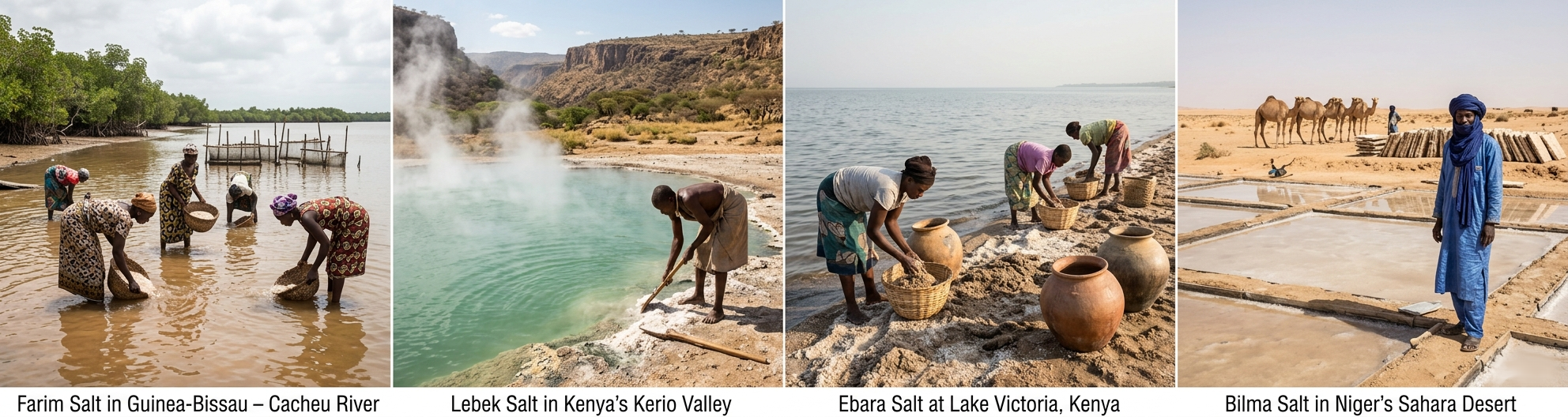
The Potassium-Rich Salt of Lake Victoria
On the shores of Lake Victoria, Africa's largest lake, there is a salt that has been harvested by indigenous communities for generations. Unlike the sodium-dominated salts found in most of the world, Ebara salt carries a distinctive mineral signature: exceptionally high potassium content, a unique alkalinity, and a profile shaped by the largest body of freshwater on the continent.
The name Ebara, also spelled Para, comes from the local communities who have harvested this salt for centuries. It is not a commercial product. It is not industrially processed. It is a traditional food, gathered by hand from the alkaline edges of the lake, preserved as nature provided.
A Salt Shaped by Africa's Largest Lake
Lake Victoria is not a typical source of salt. Most lake salts are sodium chloride dominant, formed through evaporation in arid basins. Lake Victoria, by contrast, is a freshwater lake with alkaline pockets where mineral concentrations rise. The salt that forms along its shores reflects this unique environment.
The lake's geology is ancient. It sits in a shallow depression between the eastern and western branches of the Rift Valley. The surrounding rocks are volcanic in origin, rich in minerals that have leached into the lake over millennia. Ebara salt carries the signature of this geology: high potassium, high alkalinity, and a trace mineral profile distinct from any other salt on the continent.
Unlike coastal salts, which are formed from marine evaporation, Ebara is a basic salt. Its pH ranges from approximately 10 to 11, making it highly alkaline. This alkalinity is not added. It is a natural property of the salt itself.
Generations of Harvesting
The harvesting of Ebara salt has been practiced by communities along the Kenyan shores of Lake Victoria for centuries. The knowledge of where to find the salt, when to harvest, and how to process it has been passed down through generations.

The salt forms naturally along the lake's edges during dry seasons when water levels recede. A whitish crust appears on the exposed mudflats. This crust is collected by hand, gathered into baskets, and carried to nearby villages for processing.
The traditional method is simple. The salt crust is dissolved in water. The solution is filtered through cloth to remove sand and debris. It is then boiled in clay pots or metal containers over open fires until the water evaporates, leaving behind the salt crystals.
No chemicals are added. No industrial processing is applied. The salt is preserved exactly as the lake deposited it.
Mineral Composition
What makes Ebara salt distinct is not its sodium content. It is its potassium.
Research on Ebara salt has documented its unique mineral profile:
| Mineral | Concentration (mg/g) | Role in the Body |
|---|---|---|
| Potassium | 2.69 | Cellular communication, blood pressure regulation, heart function |
| Iron | Present | Oxygen transport, energy metabolism |
| Manganese | Present | Bone formation, antioxidant function, nutrient metabolism |
| Cobalt | Present | Vitamin B12 synthesis, red blood cell formation |
| Zinc | Present | Immune function, tissue repair, enzyme activation |
| Calcium | Present | Bone health, cellular signaling, muscle contraction |
The presence of cobalt is particularly notable. Cobalt is rare in dietary sources. It is essential for the synthesis of vitamin B12, which supports nerve function and red blood cell formation. Cobalt deficiency is uncommon but can contribute to anemia and neurological issues when combined with B12 deficiency.
Ebara salt is also highly alkaline, with pH values ranging from approximately 10 to 11. This alkalinity is rare among traditional salts and has implications for terrain restoration.
The Potassium Advantage
Most traditional salts are sodium dominant. Sodium is essential, but modern diets already contain excessive sodium from processed foods. Potassium, by contrast, is often deficient. The ratio of sodium to potassium in modern diets is heavily skewed toward sodium, contributing to hypertension, fluid retention, and metabolic dysfunction.
Ebara salt offers a different ratio. Its high potassium content makes it an ideal complement to sodium-dominant salts like Baleni or commercial sea salt. When rotated alongside sodium-dominant salts, Ebara helps restore the sodium-potassium balance that has been disrupted by modern diets.
Potassium is required for cellular communication. It regulates the electrical gradient across cell membranes. It supports muscle contraction, nerve transmission, and heart rhythm. Potassium deficiency is associated with fatigue, muscle weakness, high blood pressure, and increased risk of stroke.
For individuals with hypertension or cardiovascular concerns, Ebara salt offers a way to replenish minerals without adding excessive sodium to an already sodium-loaded diet.
Alkalinity and the Internal Environment
The human body maintains a tightly regulated pH balance. The blood remains slightly alkaline, between 7.35 and 7.45. However, the tissues and the cellular environment can become acidic due to diet, stress, and accumulated metabolic waste.
Chronic low-grade acidosis is associated with inflammation, insulin resistance, bone loss, and muscle wasting. Restoring the body's pH balance is a key component of terrain restoration.
Ebara salt's natural alkalinity makes it uniquely suited for this purpose. When dissolved in warm water and consumed after a fast, it helps buffer the acidity that accumulates during the cellular cleanup process. The bicarbonate and carbonate compounds in the salt neutralize acids, shifting the internal environment back toward balance.
This is not alkalinity through artificial additives or processed alkaline waters. It is alkalinity derived from the natural chemistry of Lake Victoria's unique geology.
Role in the Terra Sequence
In the Terra method, Ebara salt can serve as a strategic complement to sodium-dominant salts like Baleni and Omo.
| Phase | Application |
|---|---|
| Renovation (Phase Two) | Used as a primary or rotating salt after fasting. Its potassium content restores electrolyte balance without excessive sodium. Its alkalinity buffers post-fast acidity. |
| Rotation (Deepening Phase) | Introduced in month two or three to shift the sodium-potassium ratio. Particularly valuable for participants with hypertension or cardiovascular concerns. |
| Maintenance | Used occasionally after the three-month program to maintain mineral balance and support long-term health. |
Unlike sodium-dominant salts, Ebara can be used more liberally without concern for sodium overload. A pinch dissolved in warm water provides potassium and trace minerals without contributing to the sodium burden.
How to Use Ebara Salt
For Terrain Renovation (After a Fast)
- Prepare 500ml of warm water (not boiling, comfortably warm to drink)
- Add one small pinch of Ebara salt (approximately the size of a small coin)
- Sip slowly over 10 to 15 minutes
- Wait two hours before consuming broth or food
For Daily Electrolyte Support (Non-Fasting Days)
- Add a pinch of Ebara salt to a glass of water
- Drink in the morning or after exercise
- Use alongside sodium-dominant salts for balanced mineral intake
In Cooking
- Use as a finishing salt on vegetables, eggs, or meats
- The alkalinity can affect the texture of some dishes; best used sparingly in cooking or as a table salt
Comparison: Ebara vs. Other Traditional Salts
| Feature | Ebara (Kenya) | Baleni (South Africa) | Omo (Ethiopia) |
|---|---|---|---|
| Dominant mineral | Potassium | Sodium | Trace elements (vanadium, chromium, selenium) |
| Sodium content | Low | High | Moderate |
| Alkalinity | Very high (pH 10-11) | Moderate | Variable |
| Key trace minerals | Iron, manganese, cobalt | Magnesium, calcium | Vanadium, chromium, selenium |
| Best for | Potassium replenishment, pH restoration, hypertension support | Foundational mineral restoration, broad spectrum | Enzyme activation, trace element therapy |
Why Ebara Salt Is Rare
Ebara salt is not commercially produced. It is harvested by small-scale traditional communities along Lake Victoria, primarily during dry seasons when water levels recede. Production is limited to what can be gathered by hand, processed in small batches, and used locally.

The salt has not been widely studied. The research that exists is limited. Its traditional use is well documented, but its mineral composition has only recently begun to be analyzed.
There is no industrial production. No supply chain. No export market. Ebara salt is a local food, known primarily to the communities along the lake.
For those seeking to incorporate Ebara into the Terra rotation, access is limited. The salt is not available in supermarkets. It is found in local markets near Lake Victoria, sold by traditional harvesters in small quantities.
Appearance and Taste
Ebara salt has a whitish to light grey appearance, reflecting its natural, unprocessed state. It is not bleached. It is not treated with anti-caking agents. It may contain small dark specks from the traditional filtration process, which are mineral residues, not contaminants.
The taste is salt, but with a distinct mineral character. It is less sharp than table salt. Some describe it as smoother or rounder on the palate. The high potassium content gives it a slightly different mouthfeel compared to sodium-dominant salts.
When dissolved in water, it produces a mildly alkaline solution that feels different on the tongue than common salt water.
Storage
Store Ebara salt in a cool, dry place away from direct sunlight. Because it contains no anti-caking agents, it may clump slightly in humid conditions. This does not affect quality. Simply break apart any clumps before use.
Properly stored, Ebara salt remains stable indefinitely. As a mineral salt, it does not spoil or degrade.
Summary
| Attribute | Detail |
|---|---|
| Origin | Lake Victoria, Kenya |
| Harvesting community | Indigenous communities along the Kenyan shores of Lake Victoria |
| Harvest period | Dry season when water levels recede |
| Method | Hand-collected, dissolved, filtered, boiled over open fires |
| Dominant mineral | Potassium (2.69 mg/g) |
| Key trace minerals | Iron, manganese, cobalt, zinc, calcium |
| Alkalinity | pH 10-11 (highly alkaline) |
| Role in protocol | Phase Two: Terrain Renovation; Rotation deepening phase |
| Best for | Potassium replenishment, pH restoration, hypertension support |
| Use | 1 pinch in 500ml warm water after fasting; wait two hours before broth |
Terra is an educational framework. It is not a medical treatment, diagnosis, or cure. Consult your healthcare provider before beginning any fasting or dietary protocol. Individual results vary.