
What a Cow Consumes Determines What Its Bones Carry

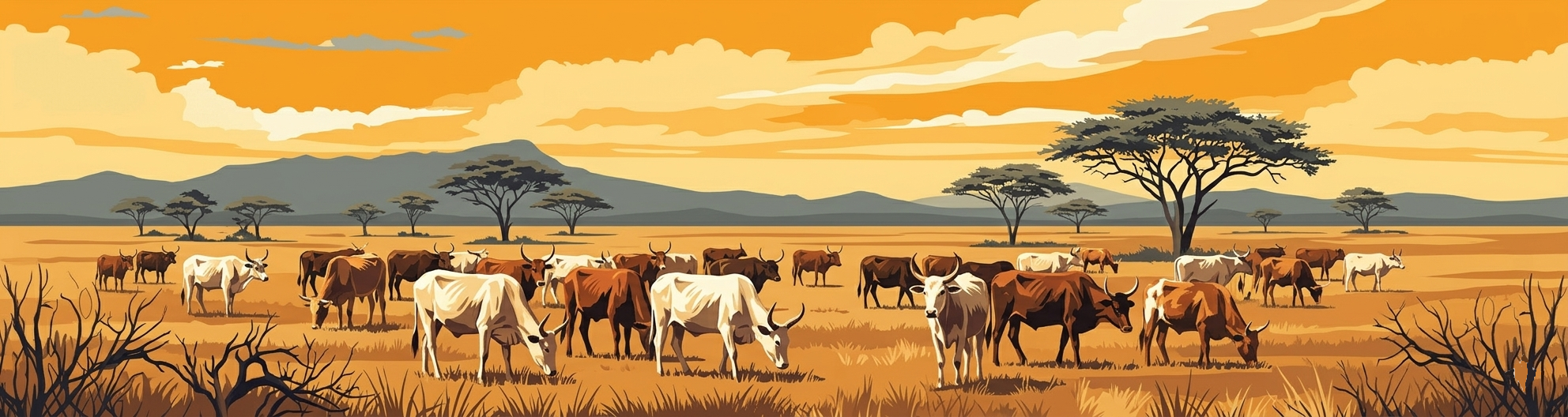
There is a question we hear often from participants in our Mineral Priming Program: is all broth the same? The answer, we have learned over five years of research, is no. The medicine that comes from an animal's bones is a direct reflection of what that animal ate over its lifetime. And what an animal eats depends entirely on where it lived.
A cow that spent its life in the grasslands of Laikipia, browsing on acacia and wild grasses, carries a different medicine than a cow that grazed on the shrublands of Turkana, eating plants built for dry conditions. A goat that climbed the hills of Meru, eating leaves and bark from trees that grow nowhere else, produces broth with a different mineral makeup than a cow that wandered the Rift Valley, drinking from alkaline springs and eating plants that thrive in volcanic soil.
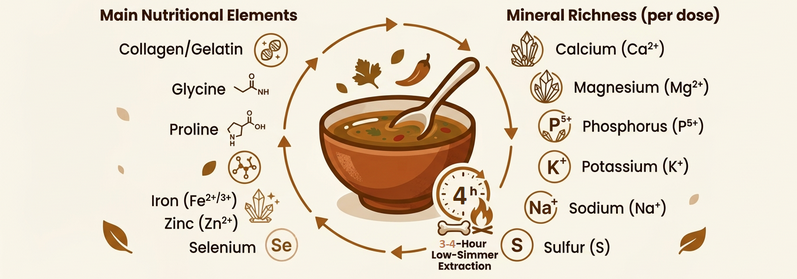
The animal eats plants that humans cannot digest. It processes those plants through its unique digestive system. And it concentrates the bioactive compounds, the flavonoids, alkaloids, glycosides, and terpenoids, into its bones, its connective tissues, its marrow. When we simmer those bones for 3 to 4 hours, we take out what the animal gathered. We drink the medicine of a place.
This article looks at three distinct geographical regions in Kenya, the plants that grow there, the cattle that eat them, and the broths that result. It looks at how these broths work with specific salts, Baleni, Omo River, Rift Valley, and Boke, to target particular health conditions. And it shares the stories of people who discovered that the place an animal lived was as important as the animal itself.
Laikipia: Acacia and Wild Herbs
Laikipia lies in the highlands of central Kenya, a vast plateau that stretches from the foothills of Mount Kenya to the edge of the Rift Valley. It is a landscape of open grasslands, acacia woodlands, and riverine forests. The altitude ranges from 1,500 to 2,000 meters, and the climate is moderate, warm days, cool nights, with seasonal rains that support a wide variety of plants.
This is cattle country. The ranches of Laikipia have been managed for generations, some by Kenyan families, some by pastoral communities who have moved through this landscape for centuries. The cattle here are not locked up. They roam across thousands of acres, browsing on the plants that grow naturally in this area.
The Plants
The cattle of Laikipia eat a remarkable variety of plants:
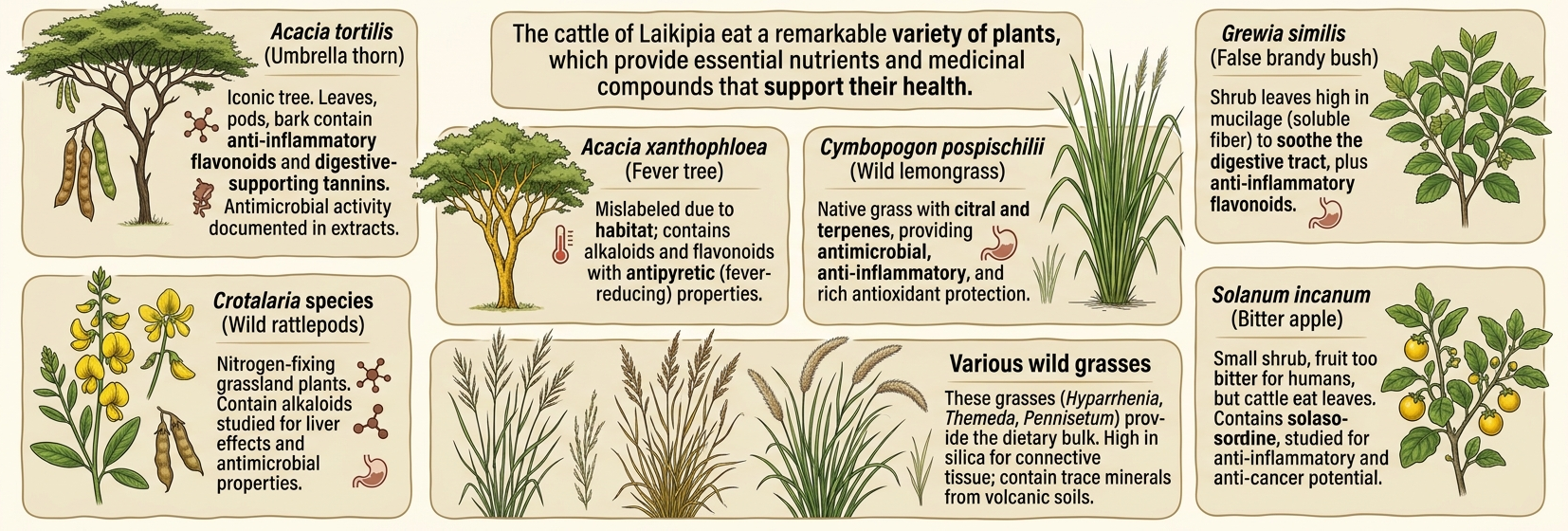
- Acacia tortilis (Umbrella thorn): The most iconic tree of the African savannah. Its leaves, pods, and bark contain flavonoids with anti-inflammatory properties. The tannins in its bark have astringent effects that support digestive health. Research has documented antimicrobial activity in acacia extracts, effective against a range of pathogens.
- Acacia xanthophloea (Fever tree): Named for the mistaken belief that it caused malaria (it grows in swampy areas where malaria was common), this tree contains alkaloids and flavonoids with antipyretic properties, compounds that help reduce fever.
- Cymbopogon pospischilii (Wild lemongrass): A native grass related to cultivated lemongrass. It contains citral and other terpenes with antimicrobial and anti-inflammatory activity. It is also rich in antioxidants that protect cells from damage.
- Grewia similis (False brandy bush): The leaves of this shrub are high in mucilage, soluble fiber that soothes the digestive tract. It also contains flavonoids with anti-inflammatory properties.
- Crotalaria species (Wild rattlepods): These nitrogen-fixing plants grow throughout the grasslands. They contain alkaloids that have been studied for their effects on the liver and their antimicrobial properties.
- Solanum incanum (Bitter apple): A small shrub whose fruit is too bitter for humans, but cattle eat its leaves. It contains solasodine, a compound studied for its anti-inflammatory and potential anti-cancer properties.
- Various wild grasses: Hyparrhenia, Themeda, and Pennisetum species provide the bulk of the diet. These grasses are high in silica, which supports connective tissue, and contain a range of trace minerals drawn from the volcanic soils of the region.
The Broth
Broth from Laikipia cattle is known for:
- High collagen content: The cattle move over long distances, developing strong connective tissue that translates to rich gelatin in the broth.
- Balanced mineral profile: The volcanic soils of the area contribute a full range of trace elements.
- Flavonoid richness: The acacia species are rich in anti-inflammatory compounds.
- Moderate silica: From the native grasses, supporting connective tissue repair.
Target Conditions
Laikipia broth is especially effective for:
- General inflammation: The anti-inflammatory flavonoids from acacia address inflammation throughout the body.
- Digestive issues: The tannins and mucilage soothe the gut lining.
- Connective tissue repair: The silica and collagen support joints, tendons, and ligaments.
- Immune modulation: The mix of plant compounds helps support balanced immune function.
Interaction with Salts
Baleni Spring Salt works exceptionally well with Laikipia broth. The complete mineral profile of Baleni salt provides the magnesium and calcium that work together with the broth's flavonoids and silica. Together, they create a foundation for whole-body restoration.
Turkana: Desert Shrubs
Turkana is the land of extremes. Northwestern Kenya, bordering Lake Turkana, is a vast area of arid plains, volcanic rock, and dry riverbeds. Rainfall is scarce and unpredictable. Temperatures are high. Water is life here, and life has adapted to scarcity.
The cattle of Turkana are not the large, calm breeds of Laikipia. They are the small, hardy Zebu, animals that can go days without water, that can survive on plants that would starve other cattle. They are herded by the Turkana people, pastoralists who move with their animals across this harsh landscape, following the rains and the grazing.
The Plants
The cattle of Turkana eat plants that have adapted to dryness, and that have concentrated their medicinal compounds in the face of environmental stress:
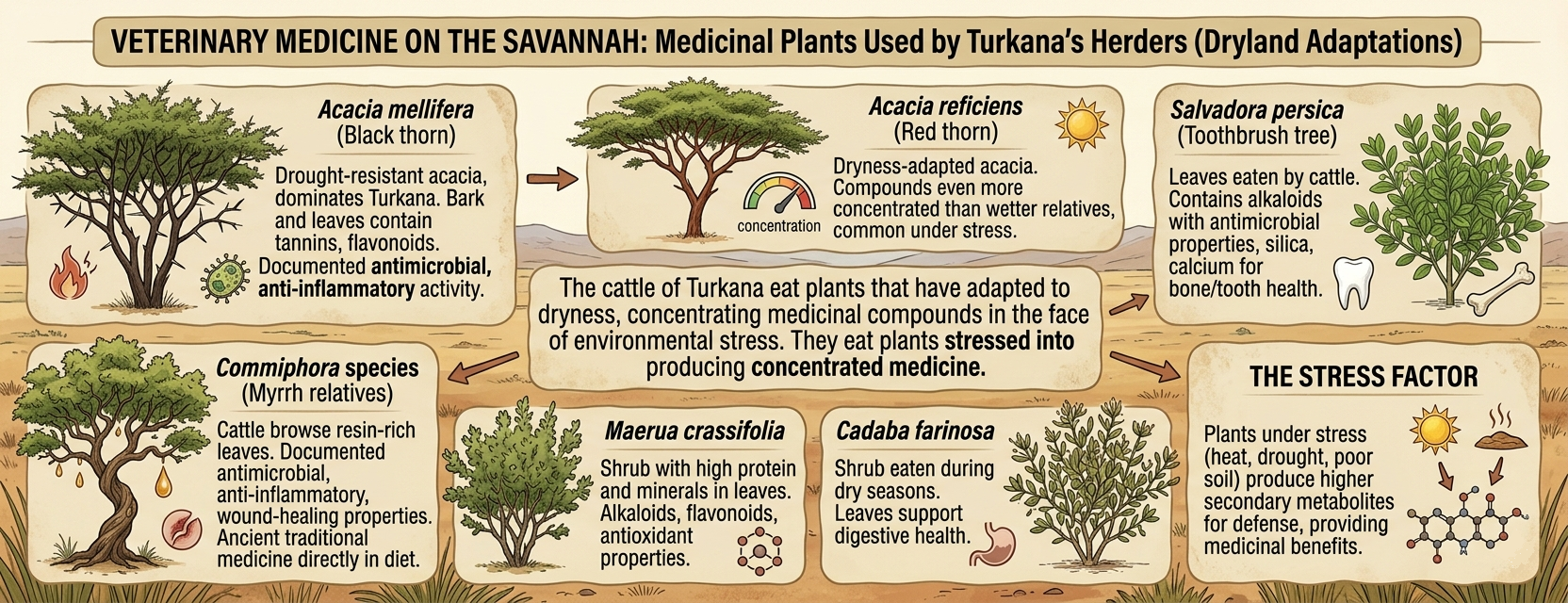
- Acacia mellifera (Black thorn): A drought-resistant acacia that dominates much of the Turkana landscape. Its bark and leaves contain high amounts of tannins and flavonoids, with documented antimicrobial and anti-inflammatory activity.
- Acacia reficiens (Red thorn): Another acacia species adapted to dryness. Its compounds are even more concentrated than those of its relatives that grow in wetter areas, a common thing in plants that grow under stress.
- Salvadora persica (Toothbrush tree): The leaves of this tree are eaten by cattle in Turkana. It contains alkaloids with antimicrobial properties, as well as silica and calcium compounds that support bone and tooth health.
- Commiphora species (Myrrh relatives): Several Commiphora species grow in Turkana, producing resin-rich leaves that cattle browse. These contain compounds with documented antimicrobial, anti-inflammatory, and wound-healing properties. Myrrh has been used in traditional medicine for thousands of years, and here it enters the cattle's diet directly.
- Maerua crassifolia: A drought-tolerant shrub whose leaves are high in protein and minerals. It contains alkaloids and flavonoids with antioxidant properties.
- Cadaba farinosa: A shrub that grows in dry areas, eaten by cattle during dry seasons. Its leaves contain compounds that support digestive health.
The stress factor: Plants growing under stress, heat, drought, poor soil, often produce higher amounts of secondary metabolites, including the compounds that serve as plant defense and that provide medicinal benefits. The cattle of Turkana are not just eating plants. They are eating plants that have been stressed into producing concentrated medicine.
The Broth
Broth from Turkana cattle is known for:
- High antimicrobial activity: The acacia and Commiphora species contribute compounds that support the body's defenses.
- Concentrated flavonoids: Stress-grown plants produce higher amounts of anti-inflammatory compounds.
- Dense mineral content: The cattle browse on plants that draw minerals from volcanic soils.
- Distinctive flavor: The resinous compounds from Commiphora give the broth a slightly bitter, complex taste that experienced broth drinkers recognize as medicine.
Target Conditions
Turkana broth is especially effective for:
- Infections: The antimicrobial compounds support the body's ability to clear pathogens.
- Chronic inflammation: The concentrated flavonoids address deep inflammatory processes.
- Wound healing: The myrrh-related compounds support tissue repair.
- Oxidative stress: The antioxidant compounds protect cells from damage.
Interaction with Salts
Boke Black Salt is the ideal partner for Turkana broth. The volcanic origin of Boke salt, harvested from the depths of the El Sod crater in southern Ethiopia, echoes the volcanic landscape of Turkana. The iron content of Boke salt supports the blood, while the sulfur compounds work together with the myrrh-related compounds in the broth. Together, they create a strong combination for infection and inflammation.
Rift Valley: Alkaline Lakes
The Great Rift Valley is one of the most geologically active regions on earth. Here, tectonic plates are pulling apart, creating a landscape of volcanoes, cliffs, and deep basins. The valley floor is dotted with alkaline lakes, Lake Bogoria, Lake Magadi, Lake Elementaita, whose waters are filled with minerals from deep underground.
The cattle that graze along the Rift Valley have access to plants that grow nowhere else, plants adapted to alkaline soils, plants that draw minerals from volcanic deposits, plants that have evolved in one of the most mineral-rich environments on earth.
The Plants
The Rift Valley's unique geology creates conditions for specialized plant communities:
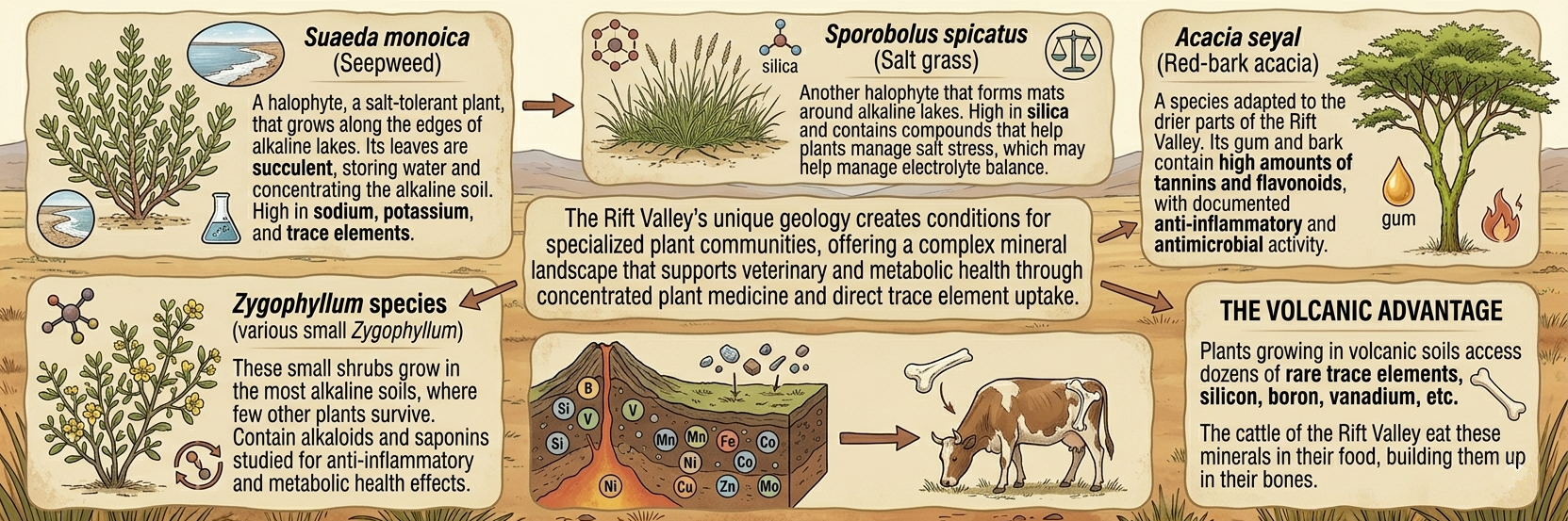
- Suaeda monoica (Seepweed): A halophyte, a salt-tolerant plant, that grows along the edges of alkaline lakes. Its leaves are succulent, storing water and concentrating minerals from the alkaline soil. It is high in sodium, potassium, and trace elements.
- Sporobolus spicatus (Salt grass): Another halophyte that forms mats around alkaline lakes. It is high in silica and contains compounds that help plants manage salt stress, compounds that may help the body manage electrolyte balance.
- Acacia seyal: A species adapted to the drier parts of the Rift Valley. Its gum and bark contain high amounts of tannins and flavonoids, with documented anti-inflammatory and antimicrobial activity.
- Zygophyllum species: These small shrubs grow in the most alkaline soils, where few other plants survive. They contain alkaloids and saponins that have been studied for their effects on inflammation and metabolic health.
The volcanic advantage: Plants growing in volcanic soils have access to a wider range of minerals than plants growing in sedimentary soils. Volcanic rocks contain dozens of trace elements, silicon, boron, vanadium, chromium, manganese, iron, cobalt, nickel, copper, zinc, molybdenum, that are rare in other soils. The cattle of the Rift Valley eat these minerals in their food, and those minerals build up in their bones.
The Broth
Broth from Rift Valley cattle is known for:
- High mineral diversity: The volcanic soils contribute a broad range of trace elements.
- Alkalizing compounds: The halophytes contribute minerals and compounds that support pH balance.
- Silica richness: From the salt grasses, supporting connective tissue.
- Unique flavor: The alkaline environment gives the broth a distinctive quality that many describe as "bright" or "clean."
Target Conditions
Rift Valley broth is especially effective for:
- Acidic terrain: The alkalizing compounds help restore pH balance after years of acid-forming diets.
- Connective tissue issues: The silica supports joints, tendons, and ligaments.
- Mineral depletion: The broad mineral spectrum addresses deficiencies that other foods cannot.
- Electrolyte imbalance: The sodium, potassium, and magnesium from the halophytes support proper cellular function.
Interaction with Salts
Rift Valley Alkaline Salt is the natural partner for Rift Valley broth. Both come from the same geological system. Both carry the mineral signature of the volcanic corridor. Together, they create a combined effect, the salt providing the immediate mineral restoration that prepares the terrain, the broth providing the deeper nourishment that rebuilds it.
Place Matters
Broth and salt from the same geographic region often work together in a supportive way. The Baleni salt from South Africa and the broth from cattle that graze on the same South African landscape would naturally complement each other. The same is true of Rift Valley salt and Rift Valley broth.
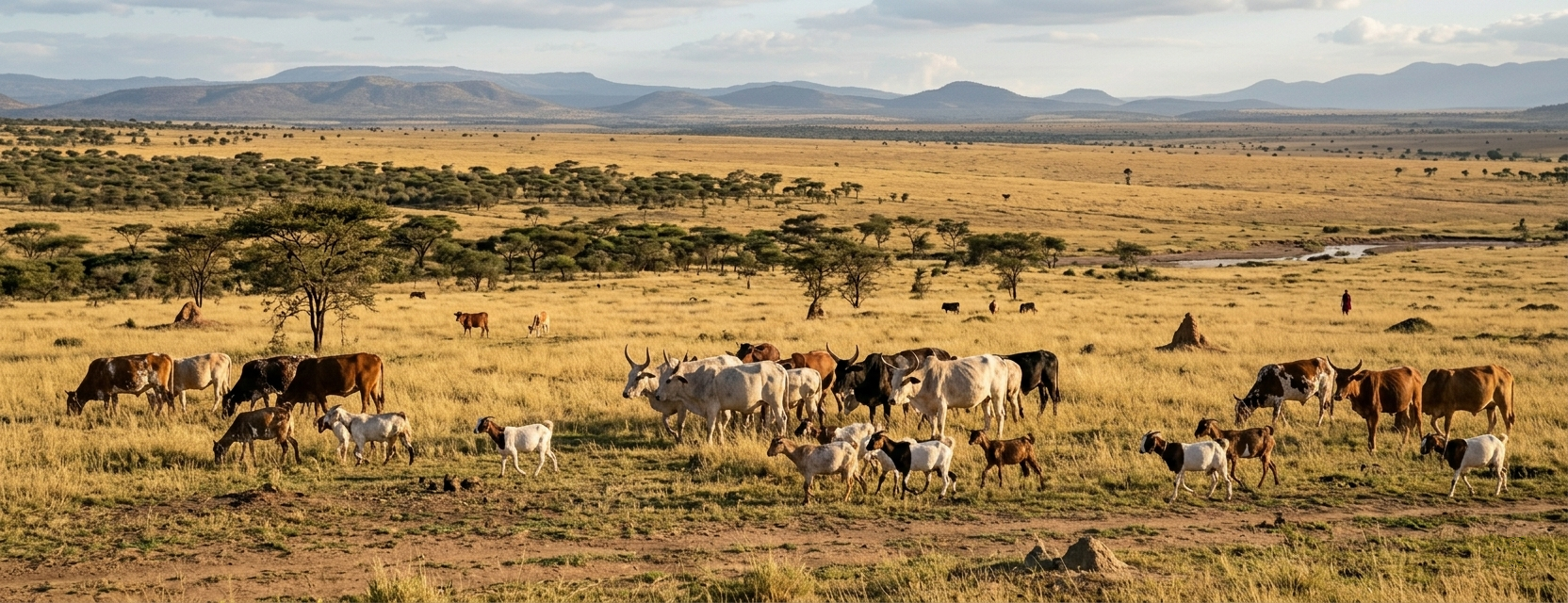
This is ecology. The plants of a region concentrate minerals from the soil. The animals that eat those plants concentrate those minerals in their tissues. The salt from that region carries a similar mineral signature. Together, they provide the body with a complete picture of that place's mineral and plant chemical wealth.
Complementary Profiles
Broth and salt with complementary mineral profiles can work together even when they come from different regions.
Baleni salt, with its balanced magnesium-calcium ratio, complements the anti-inflammatory flavonoids of Laikipia broth. The magnesium supports relaxation while the flavonoids address inflammation.
Omo River salt, with its high potassium content, complements the antimicrobial compounds of Turkana broth. The potassium supports cardiovascular function while the broth's compounds address infection.
Boke black salt, with its iron and sulfur, complements the connective tissue support of Rift Valley broth. The iron supports energy while the silica helps rebuild structure.
Your Body Knows
In the end, the relationship between broth and salt is felt, not just prescribed. Participants in the RMP program learn to pay attention to how their bodies respond.
"I started with Laikipia broth and Baleni salt," a participant said. "My inflammation went down. Then I switched to Turkana broth with Boke salt when I felt an infection coming on. My body fought it off faster than it ever had. Then I used Rift Valley broth with Rift Valley salt when I felt my joints needed support. The rotation made sense to me."
Dr. Sarah Mbugua on Geographic Medicine
"What we are seeing with these geographically distinct broths is something that modern medicine has largely forgotten: the place an animal lived determines the medicine its body carries. The plants of Laikipia produce different compounds than the plants of Turkana. The soils of the Rift Valley provide different minerals than the soils of the highlands. The animal concentrates what the place provides."
She pauses.
"This is not alternative medicine. This is ecology. It is understanding that health is not just about what we eat. It is about where that food came from."
Dr. James O'Sullivan on the UK Perspective
"In the UK, we have lost this connection between food and place. Our meat comes from animals raised on imported grain, in confinement, far from the land. The broth from those animals is the same whether it comes from Scotland or Cornwall. There is no geographic medicine. There is just commodity."
He has been following Terra participants with interest.
"What I see in participants who use these geographically distinct broths in the prescribed sequence is something I cannot explain through conventional nutrition. Their inflammation markers drop. Their energy improves. Their conditions mostly resolve. I do not yet understand why. But I think we are only beginning to understand what is lost when we separate food from place."
The Geography of Broth
The broth from Laikipia carries the medicine of acacia and wild grasses. The broth from Turkana carries the concentrated compounds of desert shrubs grown under stress. The broth from the Rift Valley carries the mineral wealth of volcanic soils and alkaline lakes.
They are not the same. They are not interchangeable. And when combined with the right salts, Baleni with Laikipia, Boke with Turkana, Rift Valley with Rift Valley, they create medicines that address specific conditions with a precision that modern nutrition cannot replicate.
The animal is a bio-accumulator. It eats the plants of a place and concentrates their medicine into its bones. When we simmer those bones for 3 to 4 hours, we drink the medicine of that place. When we combine that broth with salt from a complementary source, we give the body what it has been missing.
Kennedy in our priming program healed his gut with Laikipia broth and Baleni salt. Fatima cleared her infections with Turkana broth and Boke salt. Samuel regenerated his joints with Rift Valley broth and Rift Valley (inland alkaline) salt. They are people who discovered that the place an animal lived was as important as the animal itself.
The body knows where it came from. It knows the land. It knows the plants. It knows the minerals. Give it what it remembers, and it will heal.
The geographic origin of broth matters. The plants an animal ate determine the medicine its bones carry. Combine with the right mineral salts, and the body receives what it has been missing. This combination enables the body to reverse its symptoms with medical precision. Not because the broth and salts are drugs, but because they restore the precise biological conditions the body requires to heal itself.