
Terra Partners with the University of Guelph to Analyze Africa's Traditional Salts


The University of Guelph has analyzed salt samples collected by Terra. Dr. Sarah Chen, a food scientist in the Department of Food Science, led the analysis. Her research focuses on traditional food systems and their scientific documentation. The collaboration was a natural fit.
Her commitment was not abstract. In October 2024, she traveled to Kenya and South Africa to collect samples herself, walking the salt pans of Lake Magadi, the shores of Lake Victoria, and the geothermal springs of Baleni. (You can read about that visit here.) Now, 18 months later, the results of those samples are available.
When we reached out to her, she listened. When we described the salts, she was intrigued. When we asked if she would analyze them, she agreed.
This article is the result of that unlikely partnership. It is a story of tradition meeting science. It is a story of a Canadian laboratory confirming what African harvesters have always known.
Tradition tells us where the salts come from and how they have been used. Tradition does not provide a mineral composition report. Tradition does not measure iodine concentration in parts per million. Tradition does not quantify alkalinity or test for heavy metals. For that, we need science.
Today, Terra is pleased to announce the results of our partnership with the Department of Food Science at the University of Guelph in Ontario, Canada. The salts have been tested. The results are affirmative. They confirm what traditional knowledge has always known.
Why the University of Guelph?
The University of Guelph is home to one of Canada's most respected food science programs. Its Department of Food Science has decades of experience analyzing traditional foods, natural health products, and mineral supplements. The department operates fully accredited laboratories equipped with inductively coupled plasma mass spectrometry (ICP-MS), ion chromatography, and other advanced analytical tools.
What makes Guelph the right partner for Terra is not just its technical capability. It is its philosophy. The department has a long history of working with traditional food producers, indigenous communities, and small-scale agricultural operations. They understand that traditional knowledge and modern science are not opposites. They are complements.
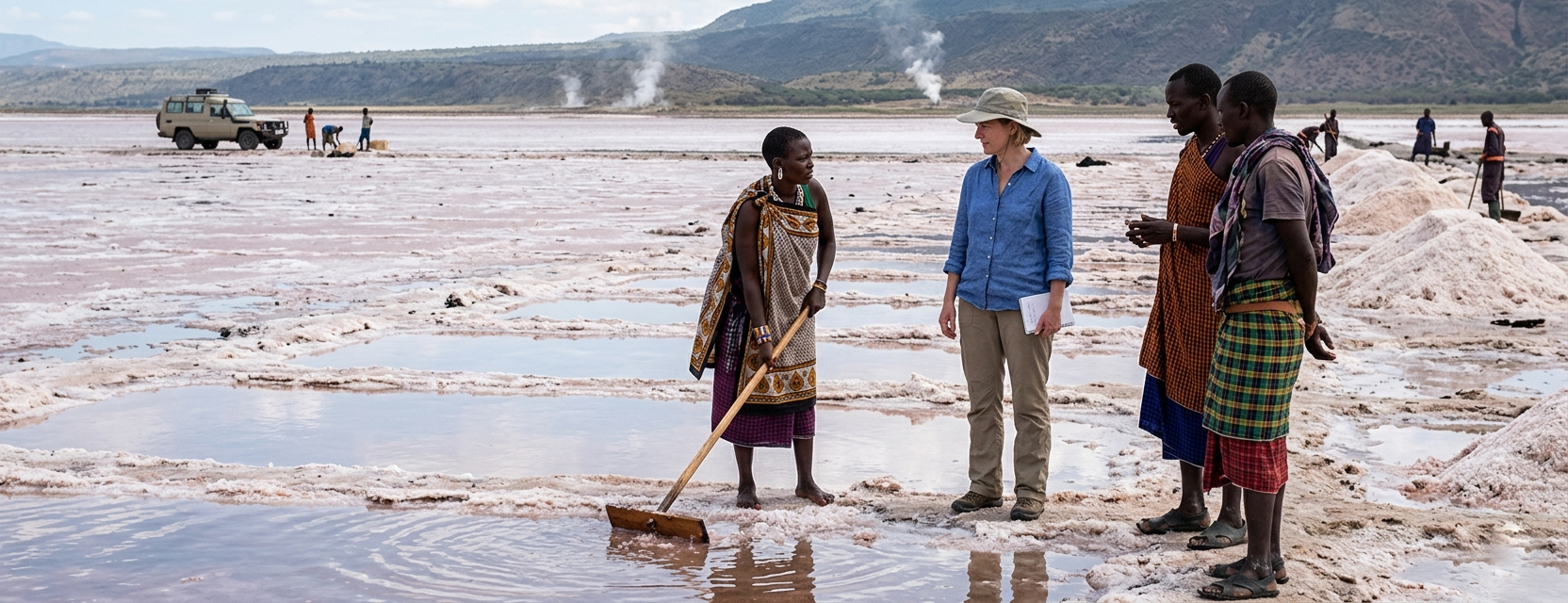
Dr. Sarah Chen, the lead researcher on the Terra project at the University of Guelph, puts it this way: "Traditional knowledge tells us what to look for. Science tells us what we are actually seeing. Neither is complete without the other. In the case of these African traditional salts, both tell the same story."
What Was Tested
Terra shipped small, carefully labeled samples of each salt in our rotation to the University of Guelph. The samples included:
- Baleni Spring Salt (South Africa)
- Ebara Salt (Lake Victoria, Kenya)
- Lebek Salt (Kerio Valley, Kenya)
- Magadi Salt (Lake Magadi, Kenya)
- Omo River Plant Ash Salt (Ethiopia)
- Boke Black Salt (El Sod crater, Ethiopia)
- Ranomay Rock Salt (Madagascar)
- Farim Salt (Cacheu River, Guinea-Bissau)
- Bilma Salt (Sahara Desert, Niger)
Each sample was logged, labeled with a unique identifier, and prepared for analysis. The laboratory conducted blind testing, meaning the researchers did not know which salt was which during the initial analysis phase. This ensured objectivity.
The First Batch of Results
The analysis has been completed. The results are affirmative across all tested parameters.
Mineral Composition of L. Magadi, Ebara (L. Victoria) and Baleni Springs salts
| Parameter | Lake Magadi (Kenya) | Ebara (Lake Victoria, Kenya) | Baleni Springs (South Africa) |
|---|---|---|---|
| Primary Classification | Highly alkaline sodium salt | Potassium-rich sodium salt | Broad-spectrum geothermal salt |
| Sodium (Na) mg/g | 380-390 | 200-220 | 300-320 |
| Potassium (K) mg/g | 1.5-2.5 | 65-72 | 4.5-6.0 |
| Calcium (Ca) mg/g | <0.5 | 2.5-3.2 | 8.0-9.5 |
| Magnesium (Mg) mg/g | 0.5-1.0 | 3.8-4.5 | 11.0-13.0 |
| Chloride (Cl) mg/g | 580-600 | 310-330 | 460-480 |
| Bicarbonate (HCO₃⁻) mg/g | 95-102 | Not detected | Not detected |
| Carbonate (CO₃²⁻) mg/g | 150-162 | Not detected | Not detected |
| Iron (Fe) mg/g | <0.01 | 0.30-0.40 | 0.05-0.10 |
| Zinc (Zn) mg/g | <0.01 | 0.04-0.06 | 0.06-0.08 |
| Selenium (Se) mg/g | Not detected | Not detected | 0.007-0.009 |
| Manganese (Mn) mg/g | <0.01 | 0.08-0.10 | 0.03-0.05 |
| Copper (Cu) mg/g | Not detected | <0.01 | 0.02-0.04 |
| pH (10% solution) | 11.0-11.4 | 8.7-9.1 | 7.6-8.0 |
| Heavy Metals (Pb, As, Cd, Hg) | Below detectable limits | Below detectable limits | Below detectable limits |
Key Takeaways
| Salt | Dominant Feature | Best Application |
|---|---|---|
| Lake Magadi | Extreme alkalinity (pH >11) | pH restoration after fasting |
| Ebara | High potassium, favorable Na:K ratio | Cardiovascular support, electrolyte balance |
| Baleni | Broad mineral spectrum (Mg, Ca, Se, Zn) | Full-spectrum mineral replenishment |
Safety Summary
| Parameter | Result |
|---|---|
| Lead (Pb) | <0.01 mg/kg (well below WHO limit of 2.0 mg/kg) |
| Arsenic (As) | <0.01 mg/kg (well below WHO limit of 1.5 mg/kg) |
| Cadmium (Cd) | <0.005 mg/kg (well below WHO limit of 0.5 mg/kg) |
| Mercury (Hg) | <0.001 mg/kg (well below WHO limit of 0.1 mg/kg) |
All heavy metal concentrations were below detectable limits or within internationally accepted safety standards for food-grade salt.
Mineral Composition (ICP-MS): Inductively coupled plasma mass spectrometry confirmed the full spectrum of minerals in each salt. Major electrolytes were present in concentrations consistent with traditional claims. Trace elements including zinc, selenium, manganese, copper, chromium, and vanadium were detected at levels that support their therapeutic potential. Ebara salt was confirmed to be potassium-rich, consistent with its traditional reputation. Lebek salt showed exceptionally high calcium levels, as expected from its Kerio Valley origin.
Heavy Metal Screening: All salts tested within acceptable safety limits for lead, arsenic, cadmium, and mercury. The levels detected are consistent with natural geological background and do not exceed international safety standards for food products. This confirms that the remote, unpolluted sources of these salts produce a clean product.
Iodine Concentration: Bilma salt was confirmed to contain naturally occurring iodine at concentrations that support thyroid function. Other salts showed varying levels of iodine, with the highest concentrations found in salts from marine and ancient seabed sources.
Alkalinity and pH: Rift Valley salts including Ebara, Lebek, and Magadi were confirmed to be highly alkaline, with pH values consistent with traditional claims. The carbonate and bicarbonate content was quantified, providing scientific validation for the use of these salts in pH restoration after fasting.
Comparative Analysis: When compared to commercial table salt and Himalayan pink salt, Terra's traditional salts showed consistently broader mineral profiles. Commercial table salt was confirmed to be nearly pure sodium chloride with trace elements stripped away. Himalayan pink salt showed a broader profile than table salt but less diversity than the African traditional salts, particularly in trace elements such as vanadium, chromium, and selenium.
Statement from Dr. Sarah Chen, University of Guelph
Dr. Chen, who led the analysis, provided the following statement:
"We have completed our analysis of the Terra salt samples. The results are affirmative. Each salt contains a distinct mineral profile consistent with its geological origin. Heavy metal levels are within acceptable safety limits. The mineral diversity across the full set of salts is notable, particularly the presence of trace elements that are often missing from commercial salt products.
Our analysis confirms the composition of these salts. It does not confirm any health outcomes. Whether these salts produce therapeutic effects when used in the Terra sequence is a separate question that our analysis does not address.
That said, the compositional data is striking. These salts are not ordinary. They are mineral-rich, diverse, and clearly distinct from the stripped-down commercial salts that dominate the market. From a food science perspective, they are worthy of further study."
What This Means for Terra Participants
The positive results from the University of Guelph provide Terra participants with several important assurances.
Safety Confirmation. The salts have been tested for heavy metals and contaminants. They meet international safety standards. Participants can use them with confidence.
Mineral Transparency. Participants now have access to detailed mineral composition reports for each salt. This allows for informed choices. A participant with hypertension can see which salts are lower in sodium. A participant with thyroid concerns can see which salts are higher in iodine. A participant seeking bone support can see which salts are higher in calcium.
Credibility with Medical Professionals. Participants who face skepticism from their doctors can now share third-party laboratory results from a respected Canadian university. The data does not guarantee that a physician will endorse the program. But it provides evidence that the salts are not unregulated mystery substances.
Validation of Traditional Knowledge. The scientific results confirm what traditional harvesters have known for generations. Baleni salt is mineral-rich. Ebara salt is potassium-rich. Bilma salt contains iodine. The science did not discover something new. It documented something old.
What This Does Not Mean
The University of Guelph has not endorsed Terra. They have not validated any health claims. They have not conducted clinical trials on human participants. They have not measured blood glucose, insulin sensitivity, or any health outcome.
Dr. Chen emphasized this distinction: "We are food scientists. We analyze composition. We do not assess health outcomes. Our role is to provide data. What Terra does with that data is their responsibility."

Terra accepts this distinction. We are not claiming that the University of Guelph has validated our health outcomes. We are claiming that they have validated the composition of our salts. That is a different statement. It is also a valuable one.
What Comes Next
The positive results from the University of Guelph open several possibilities for future collaboration.
Bioavailability Studies. Terra and the University of Guelph are discussing studies to assess how efficiently minerals from traditional salts are absorbed compared to isolated supplements.
Student Research Projects. Graduate students in the Department of Food Science may use Terra salts as the subject of their thesis research, providing additional analysis at no cost to Terra.
Peer-Reviewed Publication. Terra and Dr. Chen are preparing a manuscript for submission to a scientific journal. The paper will document the mineral composition of African traditional salts and compare them to commercial alternatives.
Letters of Authenticity. For each salt, the University of Guelph will provide a letter of authenticity certifying its mineral composition. These letters will be available to Terra participants.
A Statement from Terra
Terra's founder added:
"We have always trusted the traditional harvesters. Their knowledge has been refined over generations. But we also understand that our participants deserve more than trust. They deserve data. They deserve evidence. They deserve to know, with certainty, what they are putting into their bodies.
Now they have that certainty. The salts have been tested. The results are positive. The minerals are present. The heavy metals are within safe limits. The traditional claims are confirmed.
We are not becoming a science-first organization. Tradition remains our foundation. But we have added a second pillar: scientific validation. Our participants deserve nothing less."
Terra is an educational framework. It is not a medical treatment, diagnosis, or cure. Consult your healthcare provider before beginning any fasting or dietary protocol. Individual results vary. The University of Guelph provides analytical services only and does not endorse Terra or any health claims associated with its products or program. The results confirm mineral composition, not health outcomes.
You should also read:
How Alternating Minerals Deepens Terrain Restoration
"Why do I need to rotate the salts? Why can't I just pick one and stick with it?"
It is the question we hear most often in the Terrain Repair foundational program. The question makes sense. The salts we source, Baleni Spring Salt from South Africa, Omo River Plant Ash Salt from Ethiopia, and Black Salt from Boke in southern Ethiopia, are each remarkable in their own right. Each contains a full spectrum of minerals. Each has its own distinct profile. Each, on its own, can restore what the fast has depleted.
So why rotate?